Cold War · MAR 1946
Was the Cold War inevitable or the result of choices?
The seminar question: “Was the Cold War inevitable in 1945, or did avoidable choices make it?”
The Soviet Union and the United States defeated Nazi Germany together, then defined security in opposite ways: Moscow sought control of the ground between it and Berlin, Washington a world of open trade and free alignment. Disputes over Poland and Iran in 1945–46 hardened mutual suspicion into a lasting rivalry.
WW2 is free in full, and chapter 1 of every atlas is free. A free account opens 3 more chapters a day. Starter, at $9 a month, opens all 21 with no daily limit — see the plans.
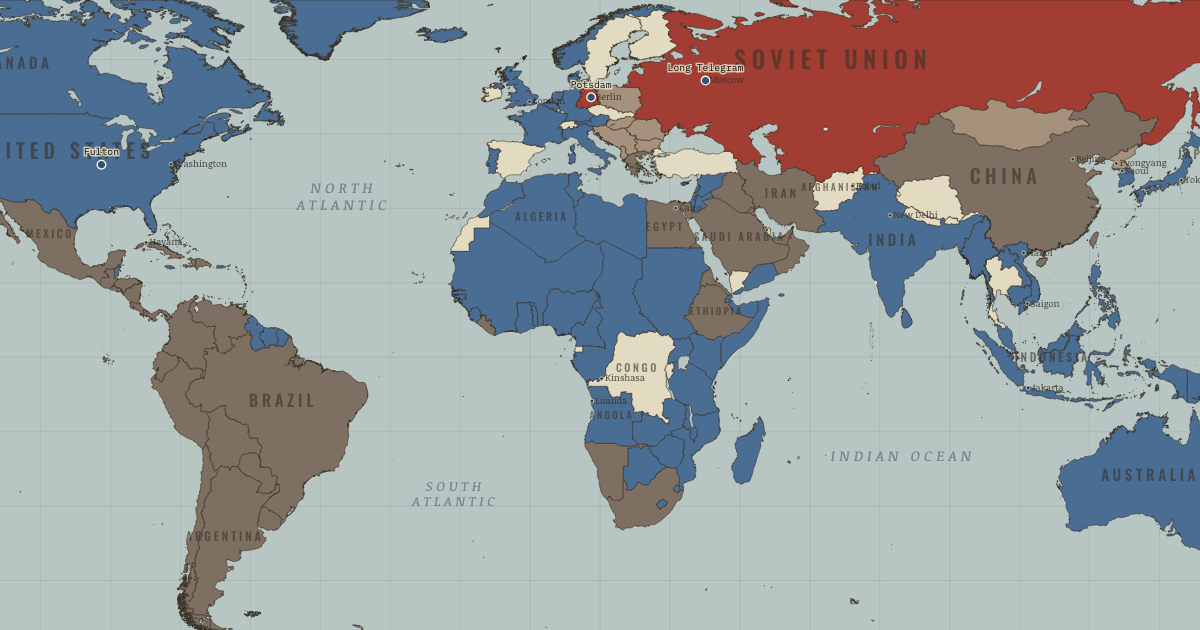
The postwar map began with the places armies had reached. Soviet troops occupied territory in central Europe from the east, while Western forces held ground taken from the opposite direction. Britain, France and other European powers still ruled empires across much of Asia and Africa. In Germany the victors divided both the country and its capital. Berlin lay deep inside the Soviet zone, so the Western powers could supply their sectors only by crossing territory held by the Soviet Union. Access to the city gave Moscow a way to exert pressure without a battle.
The short answer
- The security dilemma — two rational fears. Soviet leaders wanted distance between Moscow and a possible invader. Two invasions through Poland in thirty years, followed by a war that killed some 27 million Soviet people, made that desire urgent. American leaders drew a different lesson from two world wars entered amid European collapse: no single power should dominate Eurasia. A Soviet-controlled buffer appeared to Washington to advance precisely that danger. American efforts to resist it, meanwhile, could appear to Moscow as encirclement. The steps taken for safety could leave both sides feeling less safe.
- Ideology made compromise read as defeat. The rivalry was also a dispute about the nature of political systems. Leninism taught that capitalist encirclement made eventual war likely; American liberal thought drew from the 1930s the lesson that closed societies bred aggression. Both offered explanations meant to apply far beyond one border. A struggle over Polish ministries or Iranian oil could consequently seem to disclose the direction of world politics. If each local dispute carried that significance, giving way in one might look like a defeat for the whole cause.
- Poland: the test case that failed. Britain had entered the war in 1939 over Poland. At Yalta Stalin agreed to “free and unfettered elections”, but Home Army leaders were arrested, the 1946 referendum was rigged, and the 1947 election was falsified. Washington saw the sequence as evidence that Soviet promises could not be trusted. Moscow saw Western protest through its fear of being surrounded again by hostile states. For Poles the immediate consequence was that the promised choice had been denied.
- A power vacuum with two occupants. The defeat of Germany and Japan left the powers that had organized either end of Eurasia in ruins. Britain was financially exhausted and, within three years, would devalue and retreat from commitments in Greece, India and Palestine. France had been humiliated. The United States and the Soviet Union retained resources to shape events on a comparable worldwide scale. Neither had chosen to become one of two such powers, but their decisions would be made in the space their defeated and weakened rivals had left.
THE TURNING POINT
Moscow, 22 February 1946. A routine question about Soviet opposition to the World Bank prompted George Kennan’s roughly 5,000-word cable of 22 February 1946. He argued that hostility served the Soviet regime’s internal needs, so Western friendliness alone could not remove it. His proposed response was patient, firm resistance: Soviet pressure could be contained without war until the system mellowed or broke. The cable circulated widely, including to American embassies, and gave officials a way to interpret subsequent events. Some forty-five years later the Soviet system did break apart.
What it changed
Containment becomes policy. Aid to Greece and Turkey and the Marshall Plan gave containment political and financial force within eighteen months; NATO followed later. Kennan had favored concentrating political and economic resistance at important centers of power. As containment acquired a larger military role, he protested for decades. His diagnosis had given policymakers a starting point, but they chose how far and by what means to apply it.
The wartime alliance is unrecoverable. The Soviet government developed an adversarial account of its own. In 1946 Ambassador Novikov warned that America sought “world domination”, and Stalin told voters that war was inherent in capitalism. Officials could now fit new events into opposing explanations of an enemy’s aims. Under those conditions a concession could look like weakness, making an escape from confrontation harder to recognize.
Europe divides before the world does. Churchill’s iron curtain is shown on the map as a dashed line from the Baltic to the Adriatic. Switch to the EUROPE theater to follow it. This division remained the center of the confrontation for decades, even as Cold War violence took devastating forms in Asia, Africa and Latin America.
The full answer, argued
Orthodox historians have stressed Stalin’s expansionism; revisionists have emphasized American economic ambition. Post-revisionists, including John Lewis Gaddis, ask how the inherited distribution of power and leaders’ decisions worked together. Germany and Japan had been defeated, leaving two exceptionally powerful states with universal ambitions facing each other. Rivalry was likely, but its severity was open to choice. A Poland with limited autonomy like Finland’s or an early agreement to share atomic knowledge suggests a less hostile settlement, although neither outcome was assured. Tensions also appeared in Korea, Germany and Iran where the powers’ interests met. The security dilemma helps explain why similar fears recurred; it does not remove the need to judge what governments chose to do.
An interesting fact
In October 1945, ten weeks after Hiroshima, George Orwell coined “cold war” in Tribune. He imagined nuclear-armed super-states living in “a peace that is no peace”. Bernard Baruch brought the phrase into an official speech in April 1947: “let us not be deceived: we are today in the midst of a cold war”. Walter Lippmann’s book that autumn helped establish it. Churchill’s “iron curtain” had a predecessor too: Goebbels used the phrase in print in February 1945, thirteen months before Fulton.
This is the study layer of Origins of the Cold War, chapter 1 of The Cold War, 1945–1991; the full index of the atlas is here.
Related questions
THE FREE PRINTABLE STUDY GUIDE
Get the printable study guide for The Cold War free. I’ll send you a few short letters, then one when a new atlas opens. That’s all. — Paul
NO TRACKING · YOUR ADDRESS IS USED FOR THE DISPATCH AND NOTHING ELSE · UNSUBSCRIBE ANYTIME