MAPS OF HISTORY · THE QUESTIONS · Could the United States have won in Vietnam —…
The Cold War, 1945–1991 · AUG 1968
Could the United States have won in Vietnam — and what would “winning” have had to mean?
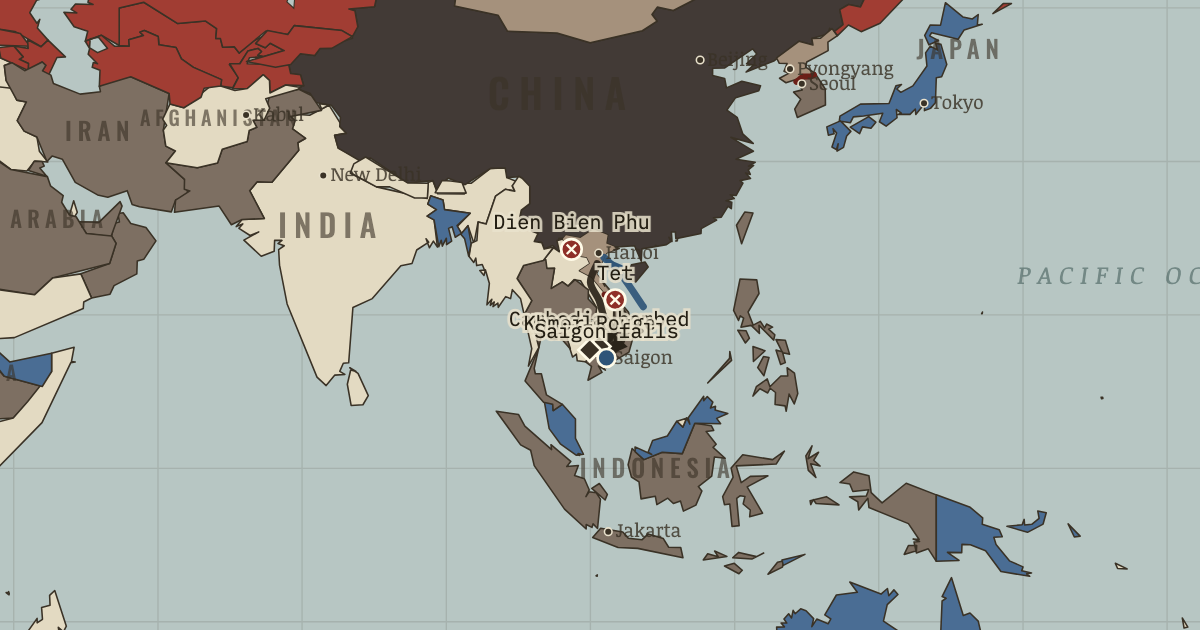
The war grew out of France’s defeat at Dien Bien Phu in 1954, which ended colonial rule but left the promised reunification elections unheld. American leaders came to treat South Vietnam less as a place worth defending for its own sake than as a test of whether US commitments anywhere would be believed. This credibility logic made each new escalation feel necessary, even as South Vietnam’s governments remained unstable, changed hands repeatedly, and never won broad legitimacy among the people they claimed to lead.
THE SHORT ANSWER
- The domino logic and its critics. The theory treated nationalism as a transmission belt for Moscow and Beijing, when in Vietnam communism was the nationalist movement. Ho had led the anti-Japanese, then anti-French resistance for thirty years, and his 1945 declaration of independence quoted Jefferson. Critics from Kennan to de Gaulle (“you will sink step by step into a bottomless quagmire”) argued exactly this at the time. They were overruled by the credibility doctrine NSC-68 had installed: the belief that resolve anywhere guarantees resolve everywhere, so no commitment, however marginal, can be liquidated. Note the inversion: the war was fought less to save Vietnam than to prove America would fight.
- Attrition against patience — why the strongest power lost. US strategy. Search-and-destroy, body counts, graduated bombing. Assumed a pain threshold Hanoi did not have: Le Duan’s regime absorbed casualty ratios of ten to one and losses (ultimately ~1 million fighters) no democracy could contemplate, because for one side this was a limited war and for the other it was the whole of national existence. Meanwhile the South’s governments. Nine changes between 1963 and 1965, land reform stalled, Buddhist crises answered with raids. Never won the legitimacy contest in the villages where the war actually lived. Firepower can win every battle and still lose a war whose object is allegiance. Tet proved both halves of that sentence at once.
- The war the neighbors were drafted into. Laos became the most-bombed country per capita in history as the Trail was pounded. Cambodia’s neutrality died under secret B-52 campaigns (1969–73) and a US-welcomed coup, and the wreckage radicalized the countryside that Pol Pot harvested. The Khmer Rouge’s 1975–79 rule. Cities emptied, roughly 1.7 million dead of execution, starvation and slave labor. Was ended not by the West but by communist Vietnam’s 1979 invasion, which China answered by invading Vietnam. Hold that sequence: it dismantles every simple story about blocs, dominoes and who fights whom.
THE TURN
Tet, 30 January 1968 — the hinge of perception. An offensive that fails on every military metric succeeds at the only level that ends wars fought by consent: it breaks the story the American government had told its public. After Tet, US policy is no longer about winning but about the terms and pace of leaving. Everything from 1969 to 1975 is denouement. The lesson is not “media lost the war”. It is that in open societies, strategy and truth-telling are load-bearing on each other, and a credibility gap, once opened, prices every future claim.
WHAT IT CHANGED
The costs, counted honestly. Vietnamese military and civilian dead: commonly estimated 1.5–3.6 million across both zones, plus hundreds of thousands in Laos and Cambodia before the Khmer Rouge’s toll. 58,220 Americans. Ecological damage (Agent Orange) and unexploded ordnance still killing today. In the US: the draft’s end, the War Powers Act, “Vietnam syndrome” constraining intervention for a generation, and a broken Great Society budget. Communism’s costliest victory and containment’s costliest defeat. On the same battlefield.
The dominoes that didn’t fall. Indochina went red. The rest of Southeast Asia did not. Indonesia had already swung violently the other way in 1965–66 (an army-led massacre of perhaps 500,000 alleged communists, with US lists and approval. A Cold War atrocity too rarely on maps), and ASEAN’s states rode export growth into stability. Defenders of the war argue it bought that decade. Critics answer that nationalism, not American firepower, was always the firewall. The map lets you argue either. That is the assignment.
Détente becomes thinkable. The war wrecked the dollar’s Bretton Woods parity, split the Democratic party, and convinced Nixon and Kissinger that the era of paying any price was over: better to set the two communist giants against each other than to bleed against their clients. The road to Beijing 1972 runs directly out of the Vietnamese jungle.
THE FULL ANSWER, ARGUED
Separate the military from the political question. Militarily, more force earlier (mining Haiphong in 1965, unrestricted bombing) might have raised Hanoi’s costs. But the constraint was never capability, it was that escalation risked Chinese entry (Korea’s lesson, correctly feared: Beijing had 170,000 support troops in the North by 1967) and that no level of bombing manufactures a legitimate government in Saigon. “Winning” would have required what no external power possessed: the ability to make South Vietnam’s state worth dying for to its own citizens. Most historians therefore judge the war unwinnable at acceptable cost as defined. And note that the definition (“an independent non-communist South”) was itself the choice most worth interrogating. When you cannot state a victory condition an adversary can concede, you do not have a strategy. You have a posture.
AN INTERESTING FACT
The era’s closing image is almost always miscaptioned. Hubert van Es’s photograph of 29 April 1975 — the ladder of evacuees climbing to a helicopter on a Saigon rooftop — shows not the US embassy but the Pittman Apartments at 22 Gia Long Street, a residence used by CIA officers, and the Huey perched on the elevator housing belonged to Air America; van Es spent thirty years correcting the caption, largely in vain. The evacuation it belongs to had been triggered in code over the radio: “the temperature in Saigon is 105 degrees and rising,” followed by “White Christmas.”
This is the study layer of Chapter 7 — Vietnam in The Cold War, 1945–1991; the full index of the atlas is here.
SEE IT MOVE ON THE INTERACTIVE MAP →New here? Chapters 1–2 of every atlas are free to sample, and the WW2 atlas is free in full. One membership opens all thirteen — the Cartographer’s Circle.
MORE QUESTIONS FROM THE COLD WAR
THE DISPATCH
One short letter when a new atlas opens — and the printable study guide for The Cold War is yours now, free.
NO TRACKING · YOUR ADDRESS IS USED FOR THE DISPATCH AND NOTHING ELSE · UNSUBSCRIBE ANYTIME