Cold War · AUG 1953
Should UN forces have stopped at the 38th parallel?
The seminar question: “Would stopping at the 38th parallel in October 1950 have been wiser?”
North Korea invaded across the 38th parallel on 25 June 1950. After the Inchon landing reversed the war, UN forces pushed north and China intervened with some 300,000 troops. The front settled near where it began; the armistice of 27 July 1953 was a ceasefire, not a peace. Estimates of the dead range from 2.5 to 4.5 million.
Chapter 4 is included with every paid plan. WW2 is free in full, and chapter 1 of every atlas is free. A free account opens 3 more chapters a day. Starter, at $9 a month, opens all 21 with no daily limit — see the plans.
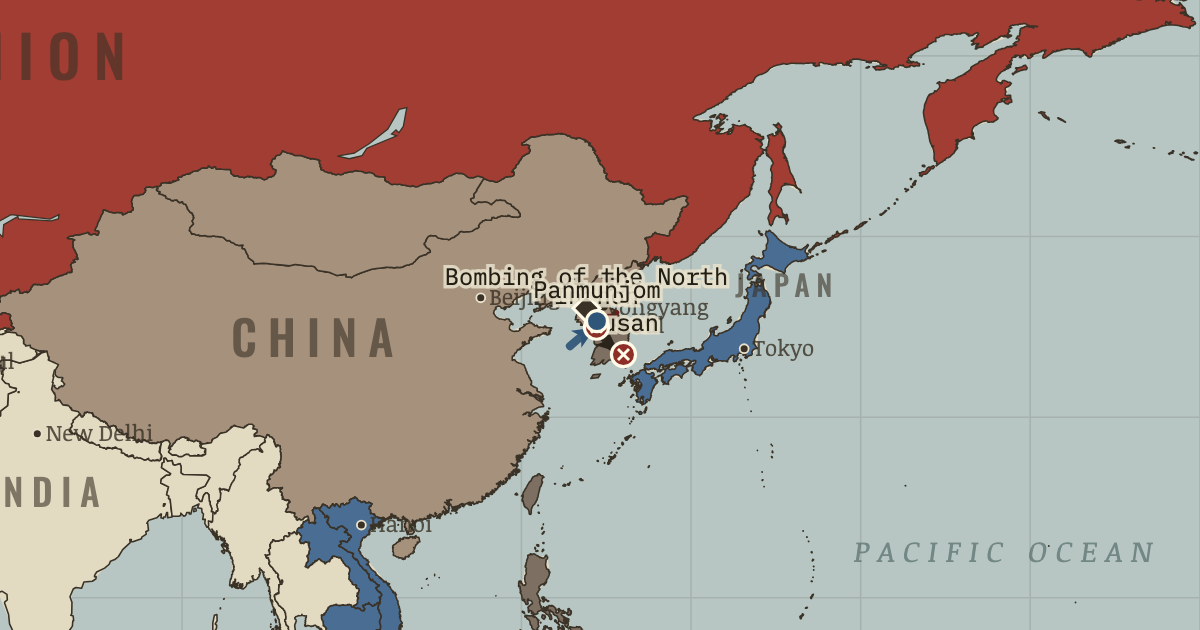
Kim Il-sung expected his invasion of South Korea to be a three-week war of liberation. He believed people in the South would rise to welcome his army. Stalin had previously resisted an attack, but the Soviet bomb and the communist victory in China made the risk look cheaper. Secretary of State Dean Acheson’s January account of the existing American Pacific defense perimeter had left Korea outside its stated line, giving Kim and Stalin reason to think Washington might stand aside. It did not.
The short answer
- Estimates that compounded one another. Kim promised a three-week victory and expected South Koreans to welcome his troops. Stalin, having refused earlier requests, reconsidered after the Soviet bomb and China’s communist victory made the risks appear cheaper. He also sought deniability; Soviet pilots later flew in Chinese markings. Acheson’s January 1950 description of the existing Pacific defense perimeter left Korea outside its stated line. Kim and Stalin could read that as a sign that the United States might stay out. Their expectations met Truman’s decision to intervene.
- China’s decision to intervene. Mao’s Politburo debated for weeks. China was exhausted by war and lacked a modern navy and air force, so intervention carried a heavy cost. Yet an American-led army at the Yalu would stand beside China’s industrial region, and Mao feared Chiang Kai-shek might be restored behind it. He also judged that a revolution unwilling to act abroad could be vulnerable at home. Beijing warned Washington through Indian diplomats, but Washington treated the messages as bluff. Moscow promised air cover and supplied it only partly, adding to resentments that later entered the Sino-Soviet split.
- The absent Soviet veto. The Security Council could authorize force because one of its permanent members was absent. The Soviet delegation was boycotting the Council over China’s seat and therefore cast no veto. UN forces fought under the UN flag against a Soviet-backed government. Moscow returned and did not leave the same opening again; the veto remained a formidable obstacle to collective action in disputes at the center of great-power rivalry.
THE TURNING POINT
Inchon, 15 September 1950. The Inchon landing placed North Korean forces between MacArthur’s troops and defenders breaking out from Pusan. Within two weeks they disintegrated. This remarkable victory made reunification seem possible and gave MacArthur greater prestige as UN forces considered an advance beyond the parallel. China’s warnings remained, however, and the landing could not settle how far the army should go. Within ten weeks of Inchon, Chinese intervention had forced a long retreat.
What it changed
A larger military Cold War. Korea made defense increases associated with NSC-68 politically attainable. Congress supported them, and US defense spending rose from approximately 5 percent to 14 percent of GDP by 1953. NATO acquired an integrated command, American divisions returned to Germany, and West German rearmament became a live proposal. The alliance system strengthened during the war endured for decades.
War orders and Japan’s recovery. The war brought roughly $3 billion in American procurement to Japan, including orders for trucks, textiles and steel. Toyota later credited Korean War orders with helping it survive. The San Francisco peace treaty was signed in 1951 and took effect in 1952, ending the occupation; Japan became a central American ally and supplier in Asia. Korea suffered devastation while the demand generated by the war gave its neighbor’s recovery a substantial stimulus.
The armistice line endures. Find the armistice line on the map. Around it lies a demilitarized zone four kilometers wide, still heavily guarded; North Korea is governed by a hereditary authoritarian state. The 1953 agreement stopped the fighting without establishing a peace treaty. Scrub to 1991 and notice what does not change: the division of Korea survived the Cold War that helped produce it.
The full answer, argued
After Inchon, crossing offered a prospect that stopping could not: unification and the defeat of the government that had invaded the South. Stopping at the old line would leave the division from which the war had begun. Yet China had warned against an advance toward its frontier, which mattered directly to Beijing’s security, and MacArthur’s command discounted contrary intelligence. Chinese intervention brought more than two further years of war. The original account puts the additional deaths at two million, and the eventual line lay near the old division. That result weighs heavily against crossing, though a fair judgment must also consider what leaders knew in October. Who could make the warnings heard before the Yalu? Truman dismissed MacArthur in April 1951, provoking a political storm. The difficulty of hearing unwelcome evidence returns at the Bay of Pigs and in Vietnam.
An interesting fact
On 27 July 1953 Nam Il and William Harrison signed eighteen copies of the armistice in about ten minutes. They left without a word, a handshake or a glance. South Korean president Syngman Rhee refused to sign; about five weeks earlier he had released some 27,000 anti-communist prisoners overnight in an attempt to disrupt the negotiations. The ceasefire agreement carries no South Korean signature.
This is the study layer of Korean War, chapter 4 of The Cold War, 1945–1991; the full index of the atlas is here.
Related questions
THE FREE PRINTABLE STUDY GUIDE
Get the printable study guide for The Cold War free. I’ll send you a few short letters, then one when a new atlas opens. That’s all. — Paul
NO TRACKING · YOUR ADDRESS IS USED FOR THE DISPATCH AND NOTHING ELSE · UNSUBSCRIBE ANYTIME