Cold War · OCT 1949
Was China ever America’s to lose in 1949?
The seminar question: ““Who lost China?” convulsed American politics for a decade. Was it ever America’s to lose?”
On 29 August 1949 the Soviet Union tested an atomic bomb years earlier than most Western estimates, ending the American nuclear monopoly. Five weeks later Mao Zedong proclaimed the People’s Republic of China. Washington answered with the ‘Who lost China?’ debate and NSC-68, which called for roughly tripled defence spending.
Chapter 3 is included with every paid plan. WW2 is free in full, and chapter 1 of every atlas is free. A free account opens 3 more chapters a day. Starter, at $9 a month, opens all 21 with no daily limit — see the plans.
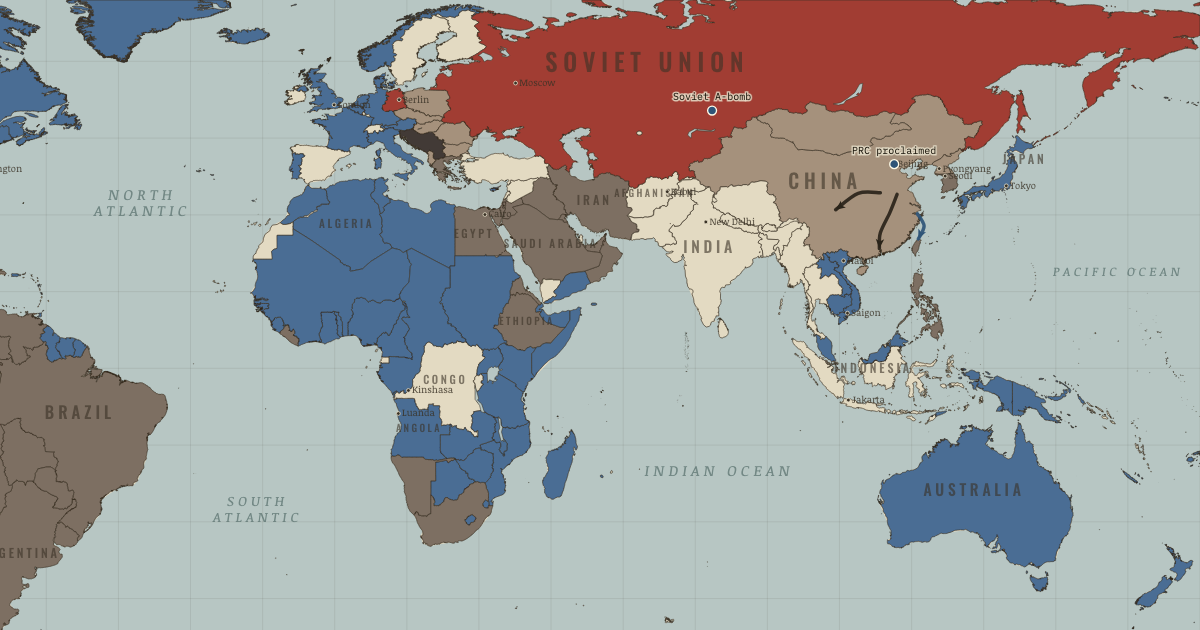
The Soviet explosion at Semipalatinsk ended an advantage the United States had possessed since 1945. Klaus Fuchs had passed genuine Los Alamos designs to Moscow, shortening the route to a plutonium weapon. Yet knowing how to design a bomb was only part of the task. The USSR had to mine uranium, build reactors and create a nuclear industry under enormous strain before it could test one.
The short answer
- Why the Nationalists lost. In 1946 Chiang’s Nationalists appeared to hold the stronger hand: they had the major cities, American equipment and, by one estimate, three times their opponents’ troops. Yet hyperinflation destroyed pay and savings, corruption diverted aid, and armies sent deep into Manchuria were cut off and captured. Communist land reform offered peasants a reason to support Mao in a country about 85 percent rural. Stalin’s advice to Mao to stop at the Yangtze shows how far this outcome was from a plan directed by Moscow.
- A design and an industry. Klaus Fuchs, Theodore Hall and the Rosenberg network provided information that confirmed the plutonium-implosion route and may have saved the Soviet program one or two years. That information could shorten the work, but it could not do the work. Under Beria’s coercive administration, the war-devastated USSR built reactors and other facilities, and gulag labor mined uranium. The American search for spies helped feed McCarthyism. The strategic lesson was broader: a determined industrial state might be delayed in acquiring a bomb, but keeping it from one indefinitely would be difficult.
- NSC-68 and the cost of containment. Paul Nitze’s 1950 review assumed that Moscow intended to dominate Eurasia. If a setback anywhere damaged American credibility everywhere, the United States needed strength across the globe; negotiation could wait until that strength had been rebuilt. George Kennan and Charles Bohlen thought the threat inflated and the price excessive. The proposed response gave containment a military budget: defense spending rose from roughly $13 billion toward $50 billion within two years. The same concern for credibility would shape later choices over Vietnam.
THE TURNING POINT
Semipalatinsk, 29 August 1949. No border moved when the bomb exploded at Semipalatinsk. What changed was the American monopoly. The United States retained a large advantage, but a growing Soviet arsenal would make retaliation an increasingly serious prospect. First-strike calculations, deterrence and eventually mutual assured destruction emerged in the strategic world that followed.
What it changed
The arms race accelerates. Truman ordered work on a hydrogen bomb in January 1950, despite the objections of Oppenheimer’s advisory committee. The United States tested one in 1952 and the Soviet Union in 1953. Over subsequent decades arsenals grew from hundreds toward tens of thousands of warheads. Each side’s estimate of what the other might build helped justify building more.
An alliance with strains of its own. Mao spent two months negotiating in Moscow, often under humiliating conditions, before securing the Sino-Soviet Treaty in February 1950. China gained aid and advisers and later received nuclear assistance. But Stalin’s condescension and unequal terms also left resentment. To Washington the two powers could look like a single bloc; the strains within their alliance would help produce the split that changed the map in the 1960s.
Containment’s Asian frontier. After China’s revolution, American planners gave Asia greater attention and made occupied Japan an anchor of the Pacific alliance. In January 1950 Secretary of State Dean Acheson described a defense perimeter that left Korea ambiguously outside its stated line. Stalin and Kim Il-sung read the speech and could consider what it suggested about an American response. North Korea invaded the South five months later.
The full answer, argued
The question puts the United States in charge of the outcome of a civil war among roughly 500 million people. American aid mattered, but it offered no obvious cure for hyperinflation, land hunger or the loss of the Nationalist government’s legitimacy. George Marshall encountered those limits when he was sent to mediate in 1946. The question nevertheless had a political life of its own: the charge of having ‘lost’ a country made withdrawal dangerous. Kennedy and Johnson later invoked China when considering Vietnam, so a misleading account of one revolution helped narrow choices in another conflict.
An interesting fact
The first American evidence of First Lightning arrived in the atmosphere. On 3 September 1949 a WB-29 in the Air Force’s new long-range detection program flew a routine filter-paper collection run from Japan to Alaska and picked up radioactive debris. Laboratory analysis traced it to a plutonium implosion bomb. Truman announced the discovery on 23 September; TASS replied with a statement about large-scale ‘blasting work.’ The Soviet government left the test unconfirmed at home for years, and its public learned of the bomb from foreign reports.
This is the study layer of Soviet atomic bomb and Mao’s victory, chapter 3 of The Cold War, 1945–1991; the full index of the atlas is here.
Related questions
THE FREE PRINTABLE STUDY GUIDE
Get the printable study guide for The Cold War free. I’ll send you a few short letters, then one when a new atlas opens. That’s all. — Paul
NO TRACKING · YOUR ADDRESS IS USED FOR THE DISPATCH AND NOTHING ELSE · UNSUBSCRIBE ANYTIME