Industrial Revolution · 1910
How far did the Meiji state industrialise Japan?
The seminar question: “How far was Japan’s industrialisation the achievement of the Meiji state?”
After American warships under Commodore Perry forced Japan open in 1853–54, the Meiji government that took power in 1868 set out to make the country rich and strong. The state built railways and model factories such as the Tomioka silk mill (1872), and private firms such as the Osaka Spinning Company (1883) led the next phase.
Chapter 10 is included with every paid plan. WW2 is free in full, and chapter 1 of every atlas is free. A free account opens 3 more chapters a day. Starter, at $9 a month, opens all 21 with no daily limit — see the plans.
Free printable Industrial Revolution study guide, sent by email ↓
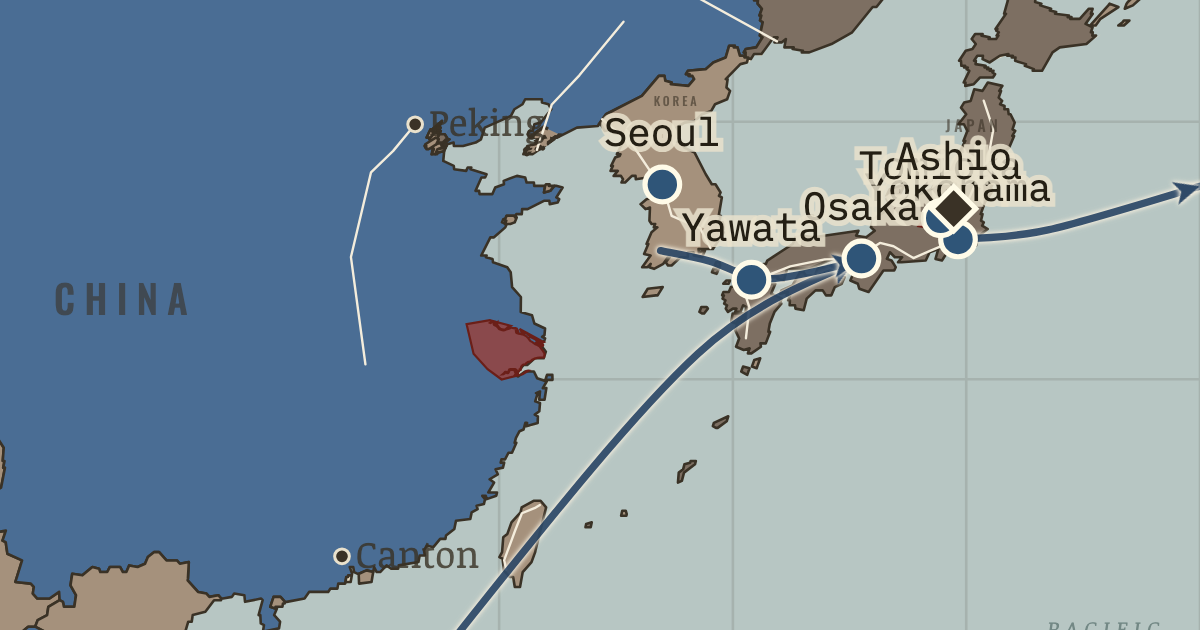
In 1839–42 Britain fought China in the Opium War after China tried to stop British merchants selling Indian opium. Britain's steam-powered navy humbled Asia's greatest empire. Japan's rulers had reason to notice: when Commodore Perry arrived in 1853 with American steam warships, Japan had no effective answer.
The short answer
- The shock of Western power. China tried to stop British opium sales, but Britain's steam-powered navy defeated it in the Opium War of 1839–42. Commodore Perry's American steam warships arrived off Japan in 1853 and showed that Japan, too, could not keep foreigners out. Treaties signed under threat limited its import tariffs and its courts' reach. Many samurai, members of the hereditary warrior class, concluded that Japan needed industry to finance an army and navy capable of avoiding China's fate. Fear of Western power gave modernization urgency.
- A state that chose industry. The Meiji government that took power in 1868 dismantled the domains of the daimyo, the feudal lords who had ruled Japan's regions. It raised a national army by conscription, or compulsory service, and collected a cash land tax. The revenue supported railways, telegraphs, shipyards and model factories that private firms could copy. Officials also looked abroad for knowledge. The Iwakura Mission of 1871–73 sent senior ministers to study the United States and Europe, and the government hired about three thousand foreign experts. Where private capital was missing, the state accepted the early risks, as economic historian Alexander Gerschenkron's theory of late development predicts.
- An educated, commercial society. Modern industry could draw on institutions and skills developed during the preceding 265 years of Tokugawa military rule. Edo, today's Tokyo, and Osaka were large cities; rice, silk and cotton circulated in national markets; merchant houses such as Mitsui dated from the seventeenth century. Perhaps 40 percent of boys had received some schooling. Rural households already spun, wove and reeled silk from cocoons for sale. These activities supplied workers, managers, capital and customers for new enterprises.
- Silk paid for machines. Imported machinery, ships and Indian raw cotton had to be paid for in foreign currency. Japan's great export, raw silk, earned it. Disease devastated European silkworms in the 1860s and helped Japanese trade. Young women in Nagano and Gunma reeled thread from cocoons, and the silk traveled through Yokohama to France and the United States. Their textile labor helped finance further light industry and heavy industries making steel and ships.
THE TURNING POINT
The Osaka Spinning Company, 1883. Government mills had been small and mostly unprofitable. The Osaka Spinning Company demonstrated a different possibility: private investors could earn steady profits from industry on a large scale. In 1883 Shibusawa Eiichi, a former official turned banker, raised money from aristocrats and merchants and imported 10,500 spindles, rods that twist fiber into thread. Steam powered the machines, and two shifts kept them running day and night. From 1886 electric light helped make that possible. Investors copied the profitable mill around Osaka. Within fifteen years Japan had changed from importing cotton yarn to exporting it. Industrialization could now proceed through the pursuit of profit as well as government policy.
What it changed
Japan competes in Asian markets. By the 1900s Japanese cotton yarn and cloth were competing against British and Indian goods in China and Korea. Japanese shipping lines carried Indian cotton to Osaka, and reformers from China to India studied Japan's example. It was the first Asian country to beat the industrial West at its own trade in Asian markets. In a world economy that assigned much of Asia the role of raw-material supplier, Japan alone had escaped that role, showing that the industrial gap could be closed.
Empire becomes part of the economy. The empire supplied Japan on terms set for Japanese benefit. Taiwan provided sugar and rice, Korea rice and land, and the Japanese-run South Manchuria Railway coal and soya beans. Colonial authorities built railways and factories for Japanese purposes and treated resistance harshly. Many Korean farmers lost land through the colonial survey of 1910–18 and later emigrated to Japan and Manchuria as cheap labor. Japan had used industrial strength to escape colonial rule; it then imposed rule on its neighbors to feed that industry.
Regulation arrives a generation late. Industrial growth exposed people with little power to serious costs. Communities protested pollution from the Ashio copper mine, mill girls struck, and the government's 1903 survey documented factory conditions. Japan passed its first Factory Act in 1911, limiting the hours of women and children, though enforcement began only in 1916. As in Britain, regulation followed industrial growth by a generation.
The full answer, argued
The Meiji state made decisive early choices. Within a generation it abolished the domains of the feudal lords, raised taxes for modernization, built railways and telegraphs, founded factories including Tomioka and Yawata, and hired foreign experts. Alexander Gerschenkron's model of late development anticipates this kind of intervention. But government factories were not the whole industrial economy. Many lost money and were sold cheaply to private firms in the 1880s. Cotton spinning and silk reeling, the unwinding of thread from cocoons, earned foreign currency and grew mainly through private investment, from Shibusawa's Osaka Spinning Company to thousands of rural silk workshops. Thomas Smith emphasized state enterprise; Penelope Francks and others have drawn attention to markets, merchants and literacy inherited from the Tokugawa shoguns, military rulers until 1868, and to young women's labor. The state set direction and removed obstacles; private enterprise and women's work did much of the rest. State action can accelerate late industrialization, but it needs a society able to respond.
An interesting fact
In 1872 Tomioka's recruiters faced a rumor that French staff drank young women's blood. They had been seen drinking red wine. To reassure families, the mill's first director, Odaka Atsutada, enrolled his own daughter Yū, then about fourteen, among the first trainees; other officials followed. Japanese carpenters and tilers built the brick mill to a French design. The buildings still stand, and in 2014 UNESCO, the United Nations' cultural agency, listed the mill as a World Heritage Site. A factory needed workers and their families' trust as well as machines.
This is the study layer of Industrialisation of Meiji Japan, chapter 10 of The Industrial Revolution, 1750–1914; the full index of the atlas is here.
Related questions
THE FREE PRINTABLE STUDY GUIDE
Get the printable study guide for The Industrial Revolution free. I’ll send you a few short letters, then one when a new atlas opens. That’s all. — Paul
NO TRACKING · YOUR ADDRESS IS USED FOR THE DISPATCH AND NOTHING ELSE · UNSUBSCRIBE ANYTIME