Russian Revolution · NOV 1905
Why did 1905 fail when 1917 succeeded?
The seminar question: “1905 failed and 1917 succeeded. What was different — the regime, the revolutionaries, or the circumstances?”
Under Nicholas II, Russia industrialised without political reform: an autocracy with no constitution or parliament, crowded factory cities and a land-hungry peasantry. In 1905 defeat by Japan and the shooting of petitioners on Bloody Sunday set off revolution, and the Tsar answered with the October Manifesto.
Chapter 3 is included with every paid plan. WW2 is free in full, and chapter 1 of every atlas is free. A free account opens 3 more chapters a day. Starter, at $9 a month, opens all 21 with no daily limit — see the plans.
Free printable Russian Revolution study guide, sent by email ↓
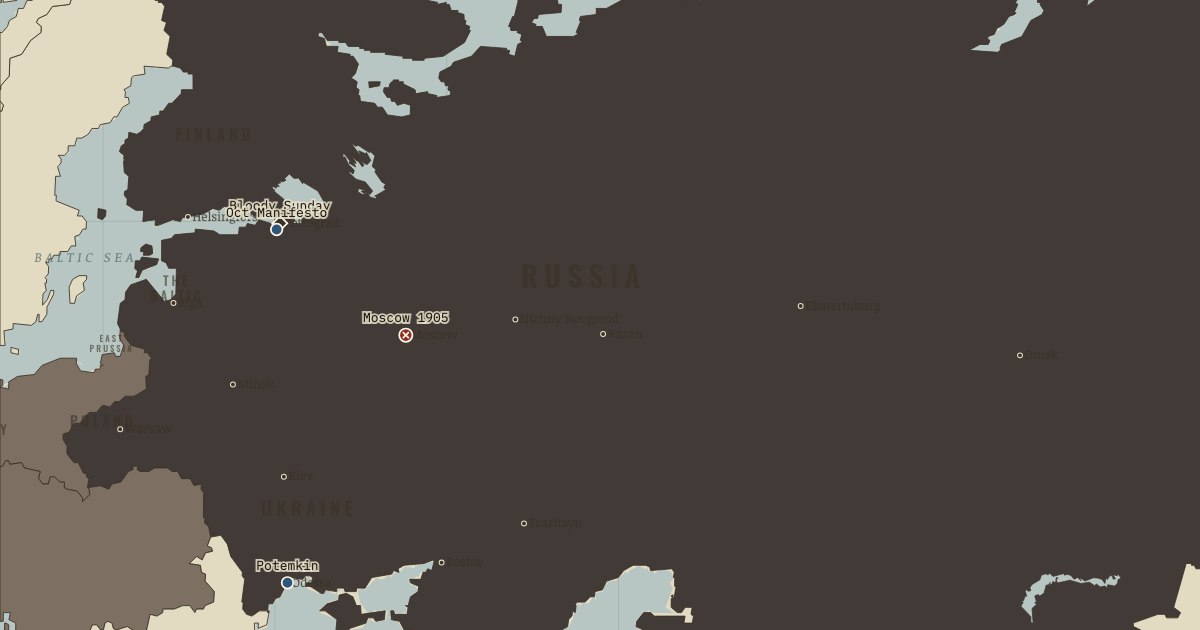
Under Nicholas II, Russia had no constitution, responsible ministry or legal opposition. That mattered when things went wrong. A parliament might have received demands and taken responsibility for decisions, as it did in the European monarchies that survived the century. In Russia complaints about wages, land, censorship and defeat reached a throne that had no such institution between itself and public anger.
The short answer
- Autocracy without a shock-absorber. Nicholas faced demands over wages, land, ethnicity and censorship without a legal opposition or parliament through which they could be addressed. In surviving European monarchies, parliaments shared power and responsibility for hard times. Russia's throne had no comparable intermediary, so complaints about government became complaints directed at the ruler himself.
- Industrialization outran the state. Witte's factories brought hundreds of thousands of workers together in a few cities. Railways then connected those centers, allowing a strike to spread across Russia in days. The police system had been designed for scattered villages; industrialization gave workers new means of collective action without giving them a political institution in which to press their demands.
- The unanswered land question. Four in five Russians were peasants. Freedom from serfdom in 1861 had left many in debt and still wanting the gentry's land. Governments hesitated to give up those estates, but refusing the demand left it alive. It would shape 1917, the civil war and the fortunes of armies that offered land to the villages or threatened it.
- A war lost to Japan. The government undertook the 1904–05 war with Japan partly for prestige: “a short victorious war” might quiet unrest. The result was a lost fleet at Tsushima and a humiliating peace. Defeat by an Asian power the regime had despised exposed its weakness just as the cities erupted.
THE TURNING POINT
The October Manifesto, 17/30 October 1905. On 17/30 October 1905 Nicholas offered a parliament and liberties because a united opposition was pressing him. The October Manifesto gave liberals a reason to accept a settlement, while radicals felt betrayed. Once the regime had survived, it revoked much of what it had conceded. Government leaders saw force and promises on paper work together; the left saw bourgeois allies settle for a Duma when workers wanted more.
What it changed
A pseudo-constitution. The Duma, which first met in 1906, gave Russians an institution in which they could expect representation. But the Tsar could dissolve it, and Stolypin rigged the franchise until it became compliant. Its existence raised hopes that its restricted powers could not satisfy, leaving a generation to see reform within the system as a dead end.
The soviet is invented. In 1905 the Petersburg Soviet of Workers’ Deputies grew from a strike committee into a rival authority. Trotsky gained experience as its chairman. The council supplied a model for later soviets, and twelve years afterward the word would name the revolution itself.
Stolypin’s wager on the peasant. Stolypin wanted members of the peasant commune to become prosperous independent farmers with a stake in order—“a wager on the strong.” He thought the policy needed twenty years of peace; it received nine. An assassin killed him in 1911, and the land question still confronted the government as 1917 approached.
The revolutionaries learn their trade. Lenin, Trotsky, the Mensheviks and the SRs carried lessons from the failed revolution into 1917. They had seen soviets emerge, tested the army's role, confronted the peasant question and learned how far liberal allies could be trusted. Failure gave its survivors experience they could use in another crisis.
The full answer, argued
Circumstances changed most, though revolutionaries had also learned from 1905. Then an army returning from a small colonial war remained loyal and could crush the cities. By 1917, after three years of industrial slaughter, millions of armed peasants in the army was the revolution. Nicholas's regime was no more flexible, arguably less so with Nicholas at the front and Rasputin at court; revolutionaries were better organized and clearer-eyed. The World War had changed the decisive condition: unlike defeat by Japan, it dissolved the state's instrument of force. Anger alone did not determine the outcome; the government's ability to command its soldiers mattered too.
An interesting fact
Father Georgy Gapon led the Bloody Sunday procession through an organization the authorities themselves had blessed. His workers' assembly was part of “police socialism,” an attempt by the Okhrana to sponsor loyal workers' organizations. Instead it brought petitioners to the soldiers' guns. Nicholas was at Tsarskoe Selo, not in the Winter Palace, that day. Gapon escaped abroad and briefly became the most famous man in revolutionary Europe. In 1906 Socialist-Revolutionaries, convinced that he was again informing for the police, hanged him in an empty Finnish dacha.
This is the study layer of Russian Revolution of 1905, chapter 3 of The Russian Revolution, 1855–1924; the full index of the atlas is here.
Related questions
THE FREE PRINTABLE STUDY GUIDE
Get the printable study guide for The Russian Revolution free. I’ll send you a few short letters, then one when a new atlas opens. That’s all. — Paul
NO TRACKING · YOUR ADDRESS IS USED FOR THE DISPATCH AND NOTHING ELSE · UNSUBSCRIBE ANYTIME