Russian Revolution · MAR 1918
Was Brest-Litovsk a betrayal or a realistic necessity?
The seminar question: “Was Brest-Litovsk a betrayal of Russia and the Allies, or the realistic move that saved the revolution?”
With no army left, the Bolsheviks tried Trotsky’s formula of “neither war nor peace” at Brest-Litovsk, and Germany answered with Operation Faustschlag. Lenin forced acceptance of the treaty of 3 March 1918, which gave up Finland, Poland, the Baltic lands, Ukraine and about a third of the empire’s population.
Chapter 7 is included with every paid plan. WW2 is free in full, and chapter 1 of every atlas is free. A free account opens 3 more chapters a day. Starter, at $9 a month, opens all 21 with no daily limit — see the plans.
Free printable Russian Revolution study guide, sent by email ↓
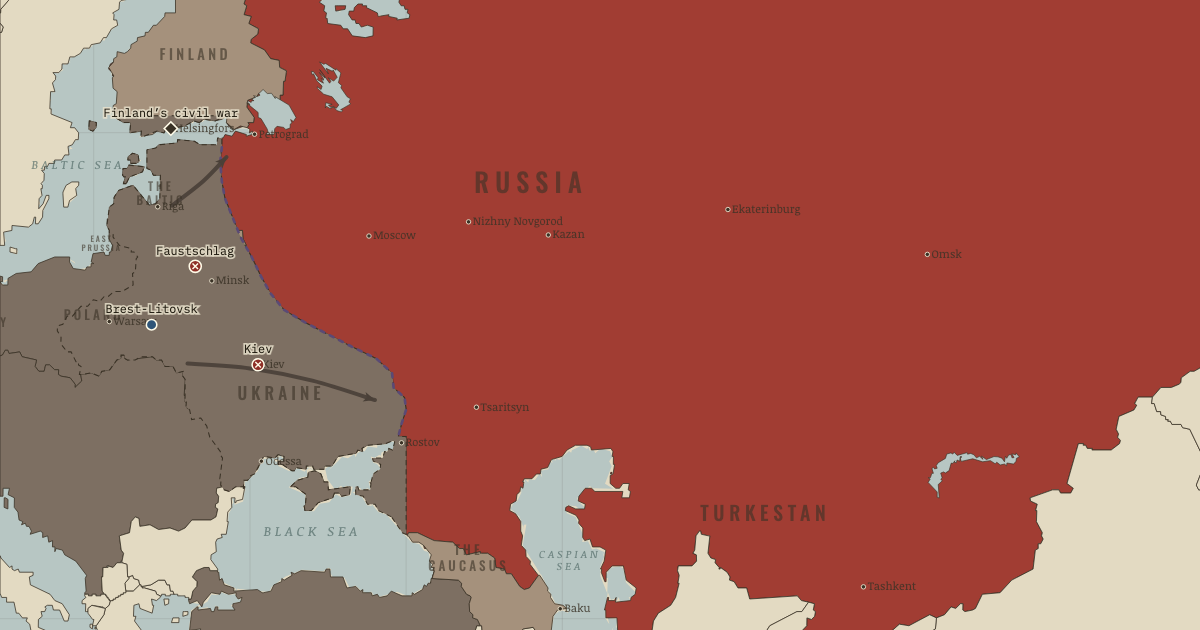
The peace talks at Brest-Litovsk exposed a difficulty the Bolsheviks could not argue away. Soldiers had left the old imperial army in search of peace, and the new Red Army did not yet exist. A government unable to defend its front had little with which to resist German demands. Trotsky tried to escape the choice: Russia would stop fighting but refuse to sign, a position he called “neither war nor peace.” He hoped revolution in Germany would overtake the negotiations.
The short answer
- An army that no longer existed. Lenin’s argument began with what Russia could do. The old army had dispersed, and its replacement had yet to be created. A threat to fight carried little weight in negotiations under those conditions. He wanted “A peace to gain time”: in his judgment, continuing to refuse would end with German troops in Petrograd.
- Trotsky’s gamble on world revolution. “Neither war nor peace” offered a way out only if events elsewhere changed the situation. Trotsky hoped the German proletariat would rise before Germany could enforce a settlement. The expected rising did not arrive; the German army did. The result exposed the cost of relying on revolution abroad to rescue the Russian revolution.
- German war aims in the east. Germany wanted both a breadbasket and a buffer. Detaching Ukraine and the borderlands as dependencies would help supply and secure its position in the east, while peace would release troops for the last great offensive in the west. The settlement reveals ambitions in eastern Europe worth recalling in 1941.
- The regime’s need to survive at any price. Lenin ranked the survival of the Bolshevik state above the preservation of the empire. If holding the territory meant losing the government, he preferred to surrender it. That priority also connects Brest with the Constituent Assembly and the Terror.
THE TURNING POINT
The signing at Brest-Litovsk, 3 March 1918. The signature on 3 March secured the government time at the expense of territory. Ukraine’s lost grain contributed to requisitioning at home; the “obscene peace” supplied the Left SRs with a cause for revolt and the Allies with a pretext for intervention. Hostile or occupied states now surrounded the remaining territory. Lenin called the settlement a breathing space, and Germany’s collapse annulled it eight months later. Yet the conditions of that respite helped produce three years of war.
What it changed
A third of the country goes foreign. The western band of the map changes to the grey of German occupation: the Baltics, Belorussia and Ukraine. Finland, the Baltics and Poland begin separate national lives. Germany’s collapse in November will not simply restore the old empire; for the next three years this band becomes a contested borderland.
The one-party state hardens. By leaving over Brest, the Left SRs ended the only coalition the Bolsheviks had formed. Their revolt in July 1918 gave the Bolsheviks a pretext to suppress them for good. By mid-1918 Russia was in fact a single-party dictatorship; the treaty had helped break the coalition that preceded it.
Grain by force — the road to War Communism. With the Ukrainian breadbasket lost and cities facing famine, the government turned to armed requisition of peasants’ grain. This became central to “War Communism.” The seizures also left a grievance that would help fuel peasant risings in 1920–21.
The intervention gets its excuse. Russia’s departure from the war left Allied munitions stored there potentially available to Germany. Britain, France, America and Japan had grounds to land troops, nominally to protect supplies and reopen an eastern front. The intervention soon also supported the Whites.
The full answer, argued
The charge of betrayal deserves an answer. Russia left its allies in wartime, surrendered millions to occupation and handed Germany a breadbasket that prolonged fighting in the west. Yet a refusal to sign would not have restored the army. The government faced a worse dictated peace or German occupation of the heartland. Lenin surrendered land he could not then hold and kept the Soviet state; within months Germany’s defeat brought the treaty down. On those alternatives, the realist case is stronger. It also reveals the Bolsheviks’ priorities: the revolution was distinct from Russia, and its survival justified territorial and moral costs. Party over nation, and ends over means, remained consequential for good and for horror.
An interesting fact
The first Soviet delegation to Brest-Litovsk was meant to show that diplomacy belonged to the people. It had a worker, a soldier and a sailor, but no peasant. On the way to the station someone noticed the omission, and Roman Stashkov was recruited off the street. At dinner among German and Austrian aristocrats he was asked whether he preferred red or white wine. According to the diplomats’ memoirs, he answered, “whichever is stronger.” The encounter placed a revolution improvising a state opposite generals who could not decide whether to laugh.
This is the study layer of Treaty of Brest-Litovsk, chapter 7 of The Russian Revolution, 1855–1924; the full index of the atlas is here.
Related questions
THE FREE PRINTABLE STUDY GUIDE
Get the printable study guide for The Russian Revolution free. I’ll send you a few short letters, then one when a new atlas opens. That’s all. — Paul
NO TRACKING · YOUR ADDRESS IS USED FOR THE DISPATCH AND NOTHING ELSE · UNSUBSCRIBE ANYTIME