Refugee crises · 1990
How did refugee responses in Europe and Indochina differ?
The seminar question: “Compare and contrast the responses of states and international organisations to displacement in Europe between 1945 and 1960 and in Indochina between 1975 and 1990.”
After 1945 the victors moved borders and peoples in Europe, uprooting 12 to 14 million Germans and millions of Poles, Ukrainians, Finns and Italians. After 1975 Indochina’s new communist regimes targeted old enemies, social classes and the Hoa, and over three million fled. In both, the end of a war began the displacement.
Chapter 12 is included with every paid plan. WW2 is free in full, and chapter 1 of every atlas is free. A free account opens 3 more chapters a day. Starter, at $9 a month, opens all 21 with no daily limit — see the plans.
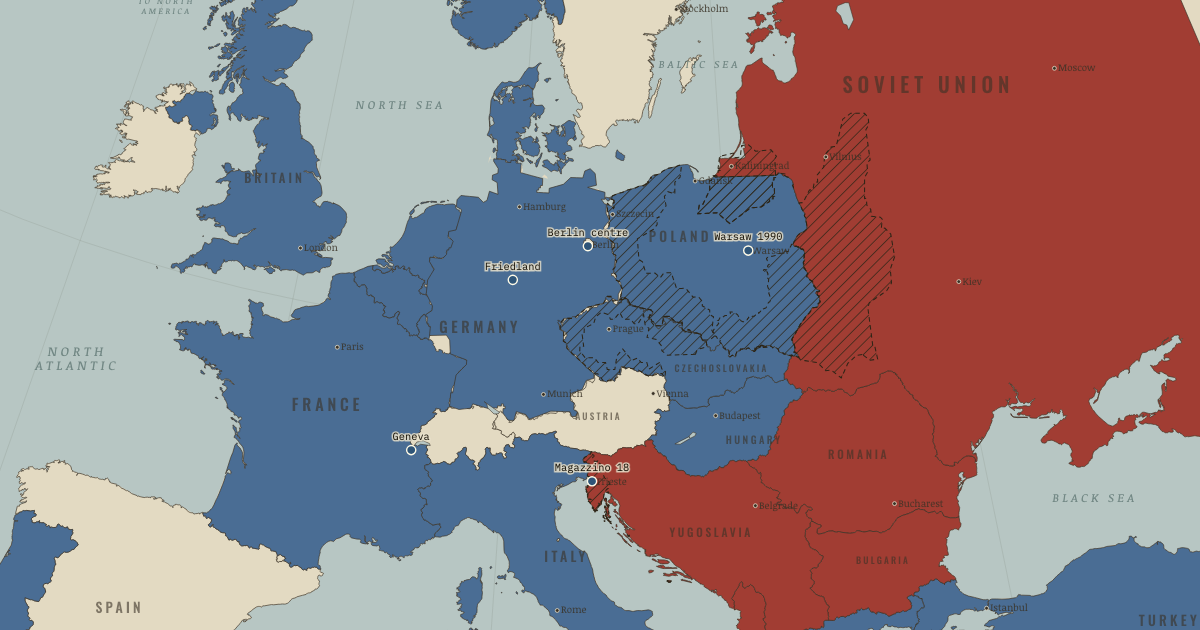
A comparison begins with what the victors wanted to build. In Europe, Poland moved west and Germany lost territory. Removing minorities was meant to bring borders and national populations into closer alignment. Nazi Germany had already expelled populations; at Potsdam in 1945 the Allies endorsed transfers of Germans. In Indochina, the new rulers sought a social revolution. Re-education camps, collectivized trade and the emptying of cities targeted political enemies and classes, while Vietnam’s break with China made the Hoa a suspect minority.
The short answer
- Victors with plans. The end of war gave the victors power to pursue political programs: the Allies redrew central Europe in 1945, and communist parties undertook revolution in Indochina in 1975. These aims shaped who left and when, alongside destruction and flight already under way. For Paper 1, the victors’ plans provide a useful starting point for explaining postwar displacement.
- Ethnicity as a target. A label could expose an entire population to pressure. Germans in Poland and Czechoslovakia were expelled as Germans regardless of individual conduct. After Vietnam’s break with Beijing, Hoa faced suspicion as Chinese as well as economic disruption. The policies differed, but both affected people with no personal connection to the war or the old regime.
- The Cold War frame. Western governments often treated those fleeing communism as evidence against their rivals, from 1947 in Europe and throughout the Indochinese crisis. Alongside humanitarian and other concerns, this helps explain support for the Convention’s persecution-based definition and resettlement in 1956 and 1979. It also helps explain declining generosity in the late 1980s, as the refugees’ political value fell.
- Who signed the rules. European states helped write and joined the 1951 Convention; most Southeast Asian first-asylum states joined neither it nor the Protocol, although the Philippines joined in 1981. A legal commitment gave refugees grounds to argue for protection. Elsewhere, resettlement places and money helped secure first asylum. This difference and local politics matter when comparing Austria in 1956 with Malaysia in 1979.
THE TURNING POINT
Warsaw, 14 November 1990. On 14 November 1990, united Germany and Poland signed the treaty confirming the Oder–Neisse boundary. The border was formally settled 45 years after the expulsions, though memories and property claims remained contested. Meanwhile the CPA was screening Vietnamese boat arrivals in Hong Kong and Malaysia and arranging either resettlement or return. Governments were settling two different questions of belonging long after people had moved: the location of a border and eligibility for refugee protection.
What it changed
A global refugee regime. Europe’s postwar crisis produced UNHCR and the 1951 Convention, later extended by the 1967 Protocol into a worldwide framework. Indochina tested and developed tools including large-scale resettlement, orderly departure and individual screening. Later operations, from the Balkans in the 1990s to Syria and Ukraine in the 2010s and 2020s, drew on institutions shaped by both histories.
Resettlement and return as competing solutions. European policy after 1947 rejected forced return and relied on integration and resettlement. The CPA after 1989 combined resettlement for recognized refugees with monitored return for others. Experiences like these helped shape UNHCR’s three “durable solutions”: voluntary return, local integration and resettlement in a third country. The choice depends on circumstances and on the wishes and rights of those affected.
Memory and reconciliation. The expulsions still influence German relations with Poland and the Czech Republic, just as memories of the boat exodus shape Vietnamese communities abroad and their relations with Hanoi. Reconciliation asks people to acknowledge their own losses alongside wrongs committed by their own side. Both histories show how difficult that balance can be.
Echoes at sea. In May 2015 thousands of Rohingya and Bangladeshi migrants were stranded on boats in the Andaman Sea while Thailand, Malaysia and Indonesia turned arrivals away. Malaysia and Indonesia eventually agreed to temporary shelter. The episode recalled June 1979: first asylum posed an immediate question, but the countries offering it also needed agreement over what would follow.
The full answer, argued
Both responses combined shelter in a neighboring or occupying state with resettlement farther away. UNHCR coordinated burden-sharing, and Cold War politics affected whom Western states welcomed. Yet citizenship changed the scale of the international task. Germany absorbed its own expellees, Europe’s largest displaced group, and Finland and other states integrated citizens too. Many Indochinese refugees depended on foreign hosts and resettlement countries. Europe built the legal refugee regime and recognized Hungarians as a group in 1956. Most Southeast Asian first-asylum states remained outside the Convention; the 1989 CPA instead screened individual claims and provided for resettlement or return. Forced return, abandoned in Europe after 1947, reappeared in Hong Kong in 1989. The system had become more legal in form, while states used the refugee definition to limit eligibility. Rules mattered, but protection also depended on receiving states’ willingness and capacity to act.
An interesting fact
UNHCR’s two Nobel Peace Prizes span both crises in this atlas. The agency was honored in 1954 chiefly for work with Europe’s postwar refugees, and again in 1981, when the Indochinese exodus dominated its work. Only the International Committee of the Red Cross has received the prize more often, three times. Fridtjof Nansen, the League of Nations’ first High Commissioner for Refugees, won it in 1922, tracing recognition of refugee protection from the aftermath of the First World War to the end of the Cold War.
This is the study layer of Europe and Indochina refugee crises, chapter 12 of Uprooted: Refugees in Europe 1945–1960 and Indochina 1975–1990; the full index of the atlas is here.
Related questions
THE FREE PRINTABLE STUDY GUIDE
Get the printable study guide for Uprooted free. I’ll send you a few short letters, then one when a new atlas opens. That’s all. — Paul
NO TRACKING · YOUR ADDRESS IS USED FOR THE DISPATCH AND NOTHING ELSE · UNSUBSCRIBE ANYTIME