Road to WW2 · 1941
Was Pearl Harbor really a surprise attack?
The seminar question: ““A date which will live in infamy” — was Pearl Harbor a surprise attack, or a foreseen war at a surprising place?”
On 7 December 1941 Japanese carrier aircraft struck Pearl Harbor, killing 2,403 Americans and sinking or damaging eight battleships, but they missed the carriers, fuel stores and repair yards. Japan hit Malaya and the Philippines simultaneously. Four days after the US declared war on Japan, Hitler declared war on the US.
Chapter 12 is included with every paid plan. WW2 is free in full, and chapter 1 of every atlas is free. A free account opens 3 more chapters a day. Starter, at $9 a month, opens all 21 with no daily limit — see the plans.
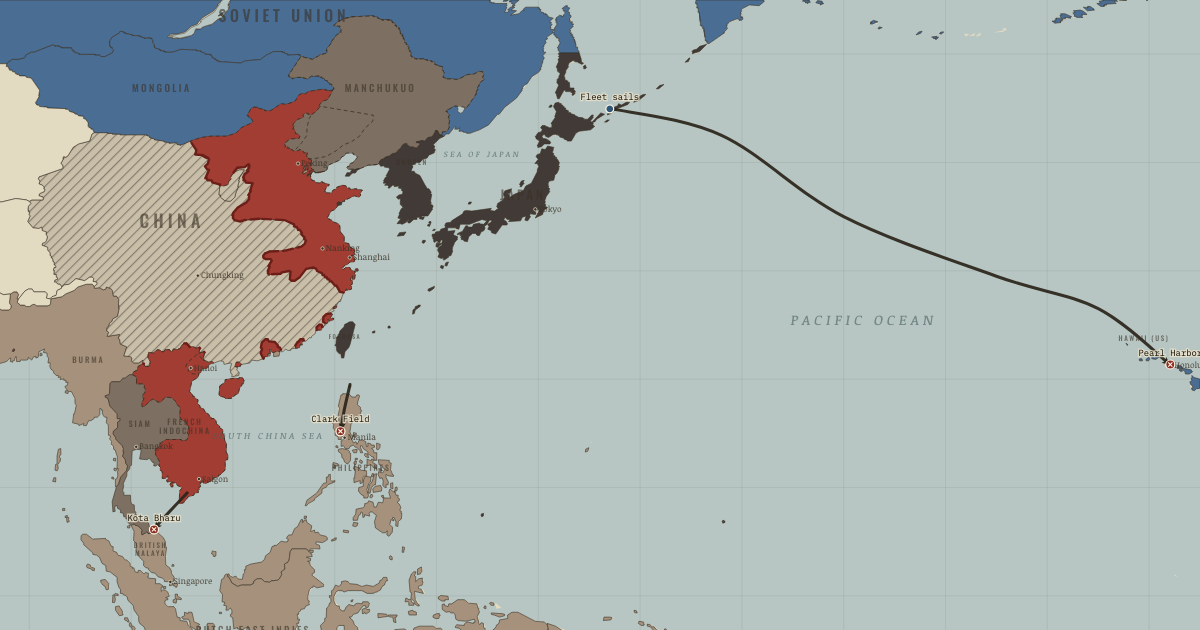
On 26 November 1941, six Japanese carriers departed Hitokappu Bay while negotiations continued in Washington. Eleven days later, on 7 December, their aircraft reached Pearl Harbor. The two waves, comprising 353 aircraft, killed 2,403 Americans and sank or damaged eight battleships. The attackers had crossed the Pacific undetected and achieved devastating surprise.
The short answer
- The oil clock ran out. The August freeze described in Chapter 10 made oil stocks a measure of time as well as supply. Japanese planners expected their capacity for war to decline as those stocks fell. On 6 September the Imperial Conference set a sequence: negotiate until October, then decide on war. Konoe sought a summit, but Washington wanted prior concessions on China. His government fell, and Tōjō inherited the timetable. Hull’s note on 26 November marked a decisive diplomatic breakdown, yet the fleet had sailed that morning. The calculation about fuel had already put the operation in motion.
- Yamamoto’s wager against his own judgment. Yamamoto knew the United States from Harvard and service as naval attaché in Washington. He opposed war with it, telling Konoe that he could “run wild for six months or a year,” but had no confidence thereafter. His Pearl Harbor plan began with a conditional judgment: if Japan went to war, the American battle fleet must be prevented from disrupting the southern offensive. A spectacular blow might also discourage a long American struggle. The first aim gave the attack an immediate military purpose; the second required a political response that Yamamoto himself had reason to doubt. His warning left the problem of what Japan could accomplish after the first months.
- Washington expected war — somewhere else. On 27 November American warnings went to Pacific commands. Officials had read Japanese diplomatic communications through MAGIC and expected war, with the Philippines or Malaya considered likely targets. Hawaii seemed distant, its water too shallow for torpedoes, and such an attack too audacious. Tokyo had studied Taranto (Ch. 11) more carefully. Oahu’s radar detected the incoming formation 132 miles away. The duty officer believed it was a flight of B-17s expected from California. The instrument supplied a contact; the explanation given to it prevented that contact from becoming an effective warning.
- Hitler chose the world war. The Tripartite Pact required assistance to Japan if it were attacked. Japan had attacked the United States, so Germany had no treaty obligation to declare war. Hitler chose to do so on 11 December. His Reichstag speech and table talk suggest his reasoning: U-boats were already fighting American convoy escorts in an undeclared naval war, and Japan might occupy the United States in the Pacific for years. His racial contempt for a “mongrel” nation also led him to underestimate American capacity. His decision joined the wars represented on the atlas’s separate maps.
THE TURNING POINT
Pearl Harbor, 7:48 a.m., 7 December 1941. The ships at Pearl Harbor tell only part of the result: most damaged battleships eventually returned to service. The change in American opinion was faster. On 6 December the America First Committee claimed 800,000 members, and the draft extension had passed the House by one vote. After the attack, opposition to entering the war lost its political force. Japan had hoped a wounded America might negotiate. Instead the attack gave the United States a mandate to fight and mobilize an economy that built more aircraft in 1944 alone than Japan produced during the entire war. Since Mukden, aggressors had repeatedly gambled that their opponents would accept expansion rather than bear the cost of resistance. At Pearl Harbor that expectation failed decisively.
What it changed
The perimeter, then the tide. Japan’s advance continued for roughly the six months Yamamoto had described. Malaya, Singapore in February 1942, the Indies and the Philippines fell; Singapore was a particularly severe imperial capitulation. Then the Battle of the Coral Sea checked an advance in May. At Midway in June, American carriers absent from Pearl Harbor helped sink four of the six Japanese carriers that had attacked it. The WW2 atlas takes up the war that this atlas ends by beginning.
The arsenal opens both doors. Roosevelt could pursue “Europe first” more easily with public support after Germany’s declaration. Lend-Lease was already supplying Britain and the USSR, and became a means of sustaining the global coalition. By war’s end the program had provided about $50 billion in matériel, including Studebaker trucks used by the Soviet Union and food shipped to Britain.
Asia’s empires never come back. The tan across the southern half of the map represents empires whose authority Japan’s victories shook. An Asian power had defeated European colonial forces in weeks. After 1945 European governments attempted to restore their rule, but India became independent in 1947 and Indonesia in 1949; Indochina followed after wars covered in the Cold War atlas. Japan’s conquest was defeated, yet the imperial world it attacked did not survive unchanged.
The full answer, argued
War with Japan was expected in Washington. For two decades American planners had studied it under War Plan Orange; officials read Japanese diplomatic traffic and sent explicit warnings ten days before the attack. But expecting war did not tell commanders where the blow would fall. The intercepts did not name Hawaii, and the decrypt record has not supported claims that Roosevelt knew Pearl Harbor would be attacked. Officials looked chiefly toward Southeast Asia. In Hawaii, concern about sabotage shaped dispositions, and the radar contact was explained as friendly aircraft. The congressional inquiry filled 39 volumes; its evidence points to failures in a system rather than a hidden hand. The distinction matters: a warning that war is likely must be interpreted as an expectation about a particular threat, and people must then act on it. Neither step happens automatically.
An interesting fact
At 6:37 a.m., before the aircraft arrived, USS Ward attacked and sank a Japanese midget submarine near the harbor entrance. Its report was still passing up the chain of command when the first wave arrived. Reservists from St. Paul, Minnesota, served in the gun crew; their No. 3 gun now stands on the Minnesota capitol grounds. Exactly three years later, on 7 December 1944, Ward, then a fast transport, was hit by a kamikaze off Leyte and had to be scuttled. USS O’Brien fired the shots. Its commander that day had commanded Ward at Pearl Harbor.
This is the study layer of Pearl Harbor and US entry into WW2, chapter 12 of The Road to War, 1931–1941; the full index of the atlas is here.
Related questions
THE FREE PRINTABLE STUDY GUIDE
Get the printable study guide for The Road to War free. I’ll send you a few short letters, then one when a new atlas opens. That’s all. — Paul
NO TRACKING · YOUR ADDRESS IS USED FOR THE DISPATCH AND NOTHING ELSE · UNSUBSCRIBE ANYTIME