10 ATLASES
History of Vietnam in maps
Vietnam as it appears in 10 interactive history atlases, from 1840 to 2000: Vietnam, French Indochina. Each era below lists who ruled the land and when control changed, linked to the dated map that shows it.
WW2 is free — every chapter. No sign-up.
What was Vietnam before it was Vietnam? The sections below follow this land through every era covered by the Maps of History atlases: who ruled it, what it was called, and when control changed. Each line links to the dated map. Modern borders serve as an approximation, as each atlas says on the map itself.
Đại Việt & Champa (mod. Vietnam) · Mongol Empire
Đại Việt faced three invasions, in 1258, 1285 and 1287–88, without offering the decisive battle its enemies sought. Its capitals were burned before the invaders arrived, and heat and dysentery wore down their forces. At Bạch Đằng the Yuan fleet met stakes set in the river at ebb tide. Đại Việt accepted nominal tribute but kept its own laws and remained unconquered. The struggle became a founding epic of Vietnamese resistance.
| Beyond the conquests — the opening position |
MONGOL EMPIRE: EVERY CHAPTER AND MAP →
Vietnam (French Indochina from 1887) · Industrial Revolution
| Colony or dependency — the opening position | |
| Colony or dependency |
INDUSTRIAL REVOLUTION: EVERY CHAPTER AND MAP →
Vietnam (Đại Nam; French Indochina from the 1880s) · Meiji Japan and post-Soviet Russia
| Independent neighbours — the opening position | |
| Western powers and allies |
MEIJI JAPAN AND POST-SOVIET RUSSIA: EVERY CHAPTER AND MAP →
French Indochina · WWI
| Entente-aligned & imperial territories — the opening position |
French Indochina (mod. Vietnam) · Chinese Revolution
Vietnam lay at the heart of French Indochina and became the first place to which the Chinese revolution was exported. During the 1920s Ho Chi Minh worked in Canton as a Comintern agent alongside Borodin and founded the Vietnamese revolutionary youth league in the shadow of Whampoa. Chinese Nationalist armies occupied the north in 1945–46 to receive the Japanese surrender. By the last frame of the atlas, the Viet Minh were fighting France with Mao’s doctrine and would soon receive supplies across Mao’s border. China’s new revolution first acted abroad by sponsoring Vietnam’s, with consequences lasting three decades.
| Foreign empires — British, French, Russian, American — the opening position | |
| The Empire of Japan & its puppets | |
| Foreign empires — British, French, Russian, American |
CHINESE REVOLUTION: EVERY CHAPTER AND MAP →
French Indochina (mod. Vietnam) · Road to WW2
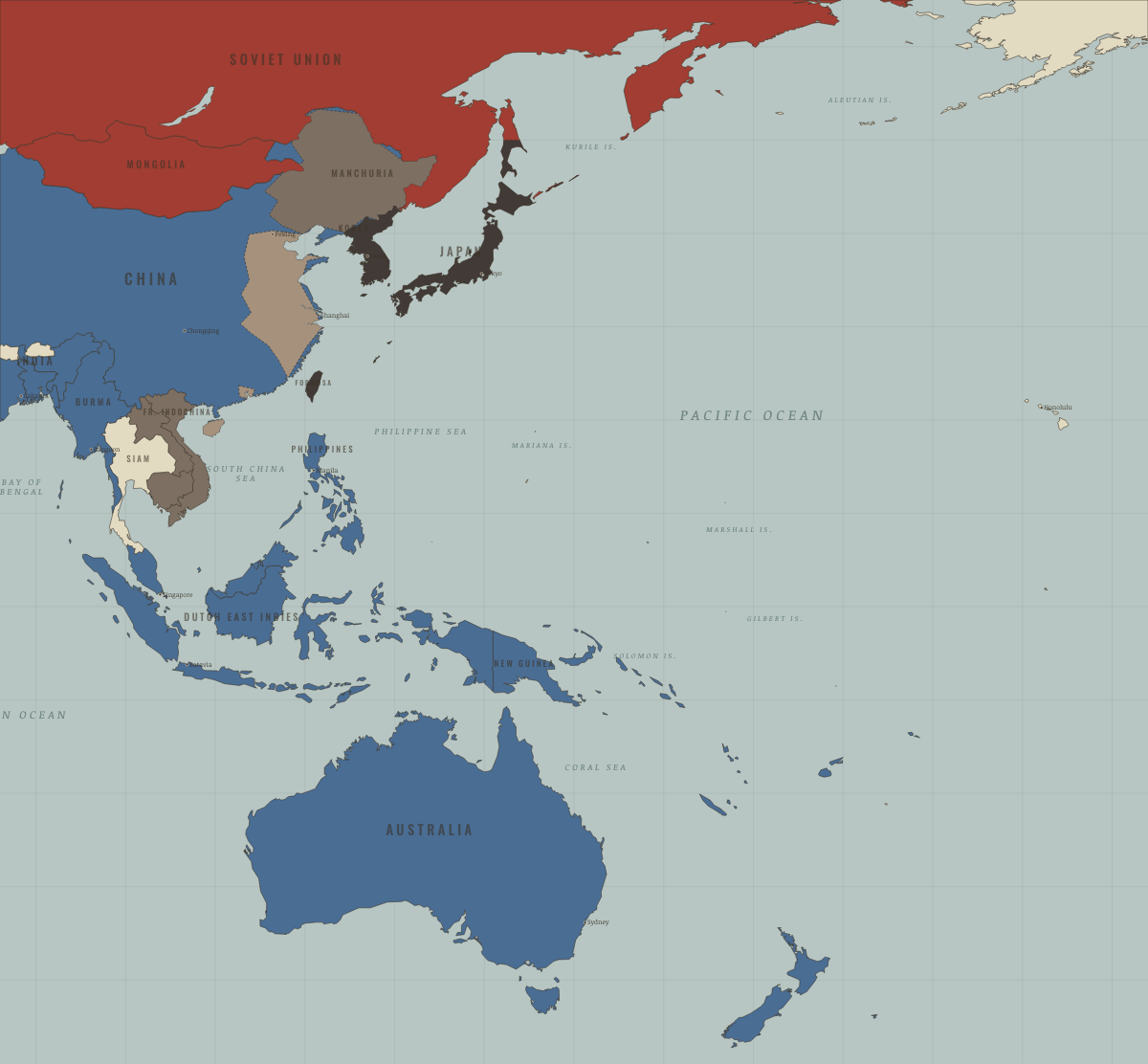
French Indochina became a tripwire for the Pacific war. Vichy's helpless “consent” admitted Japan to Tonkin in 1940, cutting Chungking's supply road. In July 1941 Japan entered the south, gaining bases aimed at Malaya; this second move triggered the oil freeze and set the war's clock running. Indochinese nationalists, among them Ho Chi Minh, who returned in 1941, watched two empires demonstrate that neither was invincible.
| Colonial empires & possessions — the opening position |
ROAD TO WW2: EVERY CHAPTER AND MAP →
Vietnam · WW2
French Indochina was administered by Vichy and occupied by Japan. Famine struck in 1944–45, killing perhaps a million people. Ho Chi Minh’s Viet Minh, armed partly by US officers against Japan, declared independence in September 1945, quoting Jefferson. Three decades of war followed.
| Western Allies — the opening position | |
| Axis allies & puppets | |
| Axis-occupied | |
| Western Allies |
Vietnam · Cold War
Under one leadership, Vietnam fought Japan, France, and America over thirty years and won, at a cost of perhaps three million dead (Ch. 7). Unification in 1975 did not end its wars: it soon fought communist Cambodia and communist China. These conflicts showed how nationalism could wear ideology like a uniform. Postwar poverty and the market turn of 1986 trace China’s arc in miniature.
| NATO & core Western allies — the opening position | |
| US-aligned states | |
| Soviet-aligned states | |
| Communist, outside Moscow’s bloc |
COLD WAR: EVERY CHAPTER AND MAP →
Vietnam · Refugee crises
Vietnam’s division in 1954 prompted about a million northerners to move south; the North’s victory reunited the country in 1975. The new state sent hundreds of thousands to re-education camps, moved city dwellers to New Economic Zones and abolished private trade in 1978. Some officials organized paid departures for ethnic Chinese, or Hoa. From 1975 to 1995 about 800,000 boat people reached first-asylum shores, while more than 600,000 others left legally under the Orderly Departure Program.
| Western bloc or democracy — the opening position | |
| Soviet-occupied or communist |
REFUGEE CRISES: EVERY CHAPTER AND MAP →
Vietnam (French Indochina to 1954, then divided) · Mao’s China
At the Geneva conference China helped urge the division of Vietnam at the 17th parallel in 1954. Beijing armed the North against the French and then the Americans, and sent some 320,000 troops in support roles between 1965 and 1973. After the United States withdrew, Hanoi moved closer to Moscow. In 1979 China and Vietnam went to war.
| Neutral, non-aligned or colonial — the opening position | |
| Beijing’s allies and friends |
MAO’S CHINA: EVERY CHAPTER AND MAP →
Related
THE FREE PRINTABLE STUDY GUIDE
Get a printable atlas study guide of your choice free. I’ll send you a few short letters, then one when a new atlas opens. That’s all. — Paul
NO TRACKING · YOUR ADDRESS IS USED FOR THE DISPATCH AND NOTHING ELSE · UNSUBSCRIBE ANYTIME