15 ATLASES
History of Russia in maps
Russia as it appears in 15 interactive history atlases, from 1206 to 2015: the Rus principalities, the Russian Empire, Russian Empire, Russia, Russia, then the Soviet Union, the Russian SFSR, the Soviet Union, Soviet Union. Each era below lists who ruled the land and when control changed, linked to the dated map that shows it.
WW2 is free in full, and chapter 1 of every atlas is free. A free account opens 3 more chapters a day. Starter, at $9 a month, opens all 21 with no daily limit — see the plans.
What was Russia before it was Russia? The sections below follow this land through every era covered by the Maps of History atlases: who ruled it, what it was called, and when control changed. Each line links to the dated map. Modern borders serve as an approximation, as each atlas says on the map itself.
The lands of the Rus · Norse and Aztecs
| Other peoples and states — the opening position |
NORSE AND AZTECS: EVERY CHAPTER AND MAP →
The Rus principalities (mod. Russia) · Mongol Empire
Ryazan, Vladimir and Suzdal were among the northeastern Rus principalities conquered in the winter of 1237–38, when war was thought impossible. Their princes and faith survived, but for 240 years they paid tribute to the Horde, a relationship known as the “Tatar yoke.” Moscow, a minor town in 1237, rose through collecting the khan’s taxes; eventually it outgrew and outlasted its masters. How much Muscovite autocracy inherited from the Horde remains a question for historians.
| Other settled powers (Jin China, Christendom, Delhi) — the opening position | |
| Tributaries & vassals |
MONGOL EMPIRE: EVERY CHAPTER AND MAP →
The Russian Empire · Industrial Revolution
After freeing its serfs in 1861, the Russian Empire industrialized rapidly, with the state taking the lead. Under Sergei Witte in the 1890s, it built the Trans-Siberian Railway, attracted French loans and grew its industry about eight per cent a year. Coal from the Donbas, oil from Baku and textile mills in Moscow and Łódź helped make Russia a major industrial producer by 1913. Most Russians, nevertheless, remained peasants.
| Industrialising — the opening position | |
| Industrialising | |
| Industrialising |
INDUSTRIAL REVOLUTION: EVERY CHAPTER AND MAP →
Russian Empire · Age of Revolutions
Russia partitioned Poland, absorbed and destroyed the Grande Armée in 1812, and marched to Paris as an arbiter of Europe. Officers returning home brought comparisons with them; the Decembrists were hanged for them in 1825. Under Nicholas I, Russia became the Concert’s gendarme, crushing Poland in 1831 and Hungary in 1849. Serfdom lay beneath these events and would wait until 1861.
| The conservative monarchies — the opening position |
AGE OF REVOLUTIONS: EVERY CHAPTER AND MAP →
Russia (the Russian Empire; the RSFSR; the Russian Federation) · Meiji Japan and post-Soviet Russia
Russia appears on both maps, in two different roles. On the first it is the empire advancing toward Japan: down the Amur in 1858, to Vladivostok in 1860 and into Manchuria and Port Arthur by 1898, before defeat by Japan in 1905. On the Eurasia map Russia is the core of the Soviet Union and, from December 1991, the Russian Federation. Its price reforms, privatization, wars and recovery under Putin make up the atlas’s second case study.
| Western powers and allies — the opening position |
MEIJI JAPAN AND POST-SOVIET RUSSIA: EVERY CHAPTER AND MAP →
Russia · Russian Revolution
In 1905 Russia formed the core of the largest empire on earth. By 1924 it was the largest republic of the USSR. Between those dates it lost a Tsar and a Provisional Government, a third of its territory at Brest-Litovsk, and millions of people to war, terror and famine. The one-party state that emerged would rule for seventy years. Follow chapters 1–14: every color on this map is measured against Russia’s red.
| The Tsarist empire — the opening position | |
| Provisional Government, then the Whites | |
| Soviet power |
RUSSIAN REVOLUTION: EVERY CHAPTER AND MAP →
Russian Empire · WWI
Some 15 million men were mobilized by the Russian Empire, more than by any other belligerent, yet they were armed, fed and led worst. Russia saved France in both 1914 and 1916 and bore the Central Powers’ main weight for three years. Then came two revolutions in 1917 (Ch. 10), separate peace at Brest-Litovsk (Ch. 11), and a civil war deadlier than its world war. The red on this map announces the century to come.
| The Entente & Allies — the opening position | |
| The Entente & Allies | |
| Russia in revolution | |
| Russia in revolution |
Russia, then the Soviet Union · Chinese Revolution
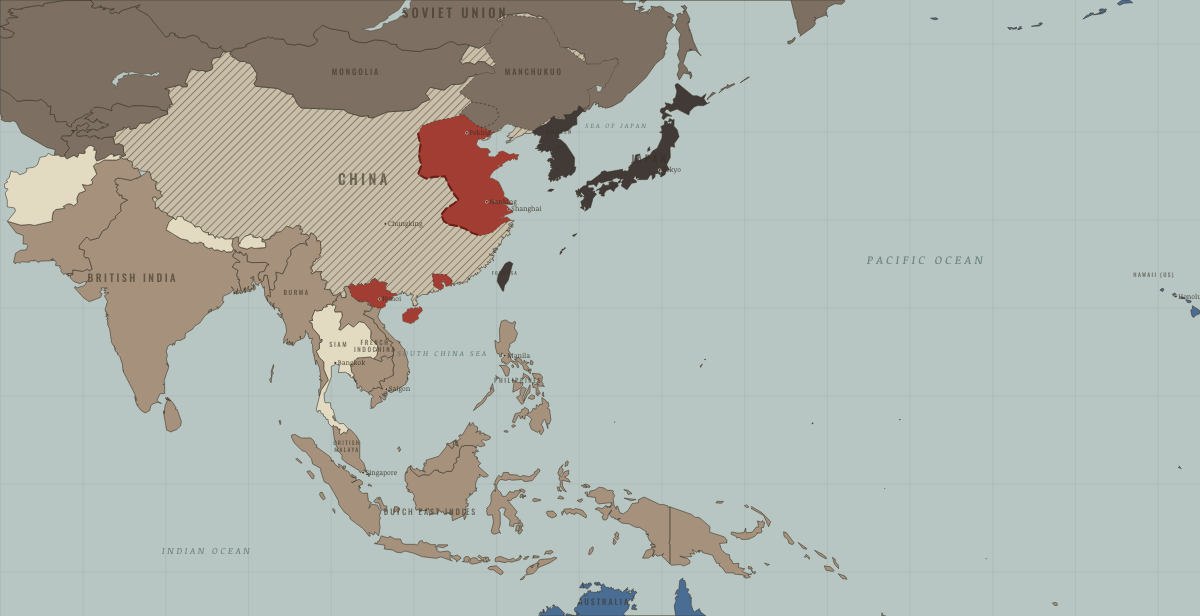
Tsarist Russia held the northern arc in 1911. In 1919 the Soviets loudly renounced the old privileges, but they went on to rebuild influence by practical means. Borodin and the Whampoa package helped build the KMT as much as the CCP, while Stalin’s orders nearly destroyed the CCP in 1927. Soviet interests also kept Xinjiang and Mongolia in their orbit. August Storm in 1945 created the decisive arena of the civil war, even as Moscow signed treaties with the government its arsenals were quietly undermining. In 1949 Stalin advised Mao to stop at the Yangtze; Mao crossed it. That difference lay behind the alliance they signed in 1950.
| Foreign empires — British, French, Russian, American — the opening position |
CHINESE REVOLUTION: EVERY CHAPTER AND MAP →
The Russian SFSR · Stalin’s Soviet Union
The Russian republic stretched from Leningrad to the Pacific and contained most of the Union’s land, people and industry. Moscow governed this core directly; it had no communist party of its own until 1990. Collectivisation reached its villages, camps spread across its northern and Siberian regions, and cities in the Urals became the arsenal of the war. From the late 1930s Russian language and history enjoyed a privileged place, as the “first among equals” of Soviet peoples.
| The Soviet Union — the opening position |
STALIN’S SOVIET UNION: EVERY CHAPTER AND MAP →
The Soviet Union · Road to WW2
The Soviet Union appears on both maps, and its changes of position present the atlas's hardest color problem. Neutral and outside the conflict until 1939, it then appears grey-tan as a partner of the aggressors for twenty-two months. Eastern Poland, the Baltics, Finland, Bessarabia and Katyń belong to that period. On the morning of 22 June 1941 it became the blue power whose depth broke the greatest gamble of all. Stalin trusted one man in Europe; that man invaded him.
| Neutral & unaligned — the opening position | |
| Aggressor clients & partners | |
| Democracies & powers fighting them | |
| Aggressor clients & partners | |
| Democracies & powers fighting them |
ROAD TO WW2: EVERY CHAPTER AND MAP →
Russia · WW2
The Soviet Union was Hitler’s partner from 1939 to 1941; it then became his adversary. It endured the largest invasion in history, lost 27 million people and destroyed roughly 80% of the German army. At the war’s end the USSR was a superpower ruling half of Europe. The war remains a founding myth in Russia today.
| Soviet Union — the opening position |
Russia (RSFSR) · Cold War
Russia lay at the core of the Soviet Union. The Soviet state broke Hitler, took Eastern Europe as a security deposit, and matched America bomb for bomb, although its economy was only a fraction of its rival’s. The effort helped spend it to death. Follow Russia through every chapter; it is the red thread. At Belovezha in 1991, it signed itself out of empire and inherited the USSR’s seat, arsenal, and grievances.
| USSR & Warsaw Pact — the opening position | |
| Non-aligned & neutral | |
| Non-aligned & neutral |
COLD WAR: EVERY CHAPTER AND MAP →
Soviet Union (Russia) · Feminism and the Tunisian Revolution
| Right won in law — the opening position | |
| No reform yet / outside this story | |
| Right won in law |
FEMINISM AND THE TUNISIAN REVOLUTION: EVERY CHAPTER AND MAP →
The Soviet Union (Russia) · Refugee crises
By 1946 the Soviet Union had recovered about 5.35 million citizens from across Europe, some forcibly under the Yalta accords. Returnees faced screening for disloyalty in filtration camps. The USSR also annexed northern East Prussia as the Kaliningrad region, expelled the remaining Germans and brought in Soviet settlers. It refused to join the International Refugee Organization (IRO), calling DPs who would not return traitors.
| Soviet-occupied or communist — the opening position |
REFUGEE CRISES: EVERY CHAPTER AND MAP →
The Soviet Union · Mao’s China
China’s teacher and ally in the 1950s, the Soviet Union supplied loans, factories and about 10,000 experts. Disputes over ideology, nuclear weapons and leadership of the Communist world broke the alliance, and Moscow recalled its experts in 1960. By 1969 the two states were fighting on the Ussuri and the Xinjiang border. Soviet officials asked how Washington would react to a strike on China’s nuclear sites.
| Beijing’s allies and friends — the opening position | |
| Beijing’s adversaries |
MAO’S CHINA: EVERY CHAPTER AND MAP →
Related
THE FREE PRINTABLE STUDY GUIDE
Get a printable atlas study guide of your choice free. I’ll send you a few short letters, then one when a new atlas opens. That’s all. — Paul
NO TRACKING · YOUR ADDRESS IS USED FOR THE DISPATCH AND NOTHING ELSE · UNSUBSCRIBE ANYTIME