13 ATLASES
History of the Netherlands in maps
The Netherlands as it appears in 13 interactive history atlases, from 264 BC to 2015: Batavia, the Low Countries, Netherlands. Each era below lists who ruled the land and when control changed, linked to the dated map that shows it.
WW2 is free — every chapter. No sign-up.
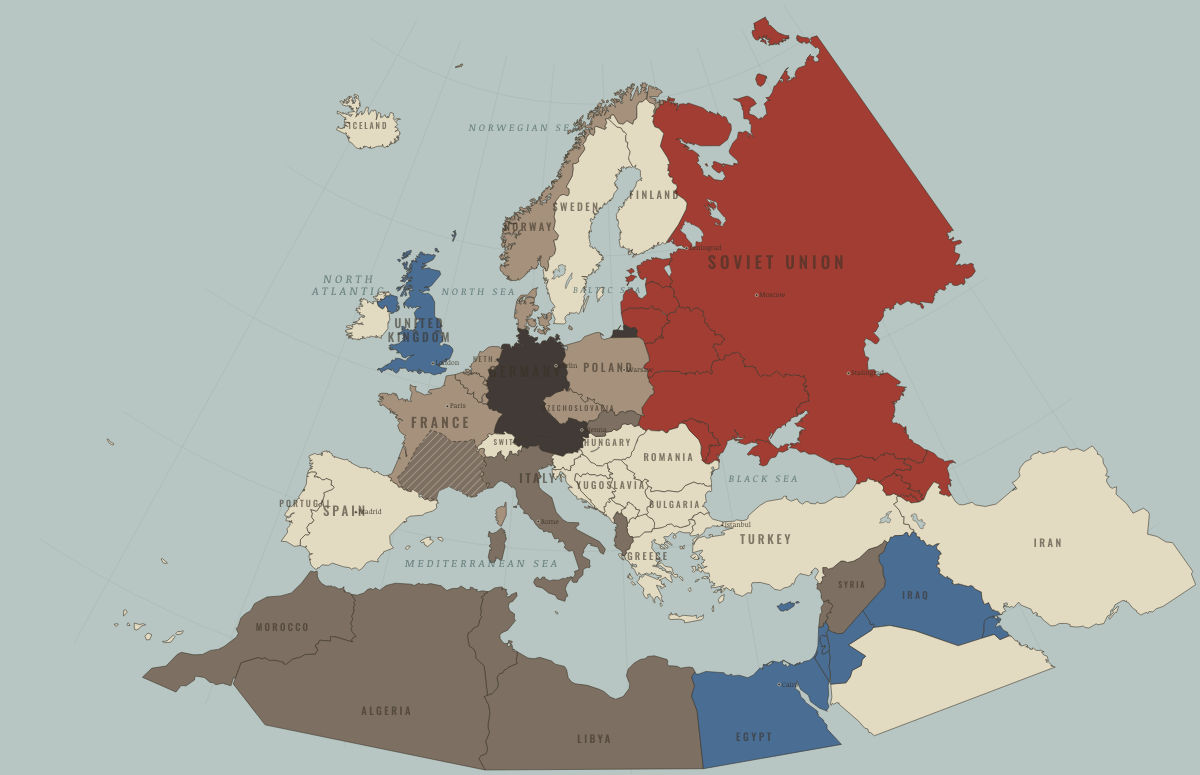
What was the Netherlands before it was Netherlands? The sections below follow this land through every era covered by the Maps of History atlases: who ruled it, what it was called, and when control changed. Each line links to the dated map. Modern borders serve as an approximation, as each atlas says on the map itself.
Batavia (mod. Netherlands) · Ancient Rome
| 264 BC | Tribal peoples & confederations — the opening position |
| 50 BC | Roman clients & allies |
| Roman territory | |
| Tribal peoples & confederations | |
| Former Roman lands (lost) |
ANCIENT ROME: EVERY CHAPTER AND MAP →
Netherlands · Norse and Aztecs
| Other peoples and states — the opening position |
NORSE AND AZTECS: EVERY CHAPTER AND MAP →
The Low Countries (mod. Netherlands) · Crusades
| Latin Christendom — the opening position |
CRUSADES: EVERY CHAPTER AND MAP →
Netherlands · Industrial Revolution
The Dutch Republic had wealth and commerce long before it industrialized. In the eighteenth century its wages were as high as England’s, and it led Europe in shipping and finance. But without cheap coal, it had little reason to mechanize. Growth in industry came after the 1860s, alongside railways, the port of Rotterdam serving the Ruhr, and profits from the Cultivation System, which forced Javanese peasants to grow export crops for the Dutch state.
| Industrialising — the opening position | |
| Industrialising | |
| Industrialising |
INDUSTRIAL REVOLUTION: EVERY CHAPTER AND MAP →
Netherlands · Age of Revolutions
The Dutch Republic was an old, rich and oligarchic state when its Patriot revolt was crushed by Prussia in 1787. France brought about the Batavian Republic in 1795. At Vienna the Netherlands became a kingdom and received Belgium, which left in 1830. The Dutch retained their colonial empire throughout, and it funded their return to great-trading-power status in miniature.
| Neutral / uncommitted — the opening position | |
| Napoleonic client & satellite states | |
| The conservative monarchies |
AGE OF REVOLUTIONS: EVERY CHAPTER AND MAP →
Netherlands · Meiji Japan and post-Soviet Russia
| Western powers and allies — the opening position |
MEIJI JAPAN AND POST-SOVIET RUSSIA: EVERY CHAPTER AND MAP →
Netherlands · WWI
Netherlands · Stalin’s Soviet Union
| Nazi Germany & its allies — the opening position | |
| Nazi Germany & its allies | |
| Other states | |
| Rivals & the Western bloc |
STALIN’S SOVIET UNION: EVERY CHAPTER AND MAP →
Netherlands · Road to WW2
| Neutral & unaligned — the opening position | |
| Occupied — held by force |
ROAD TO WW2: EVERY CHAPTER AND MAP →
Netherlands · WW2
| Axis-occupied — the opening position | |
| Axis-occupied | |
| Western Allies |
Netherlands · Cold War
| NATO & core Western allies — the opening position |
COLD WAR: EVERY CHAPTER AND MAP →
Netherlands · Feminism and the Tunisian Revolution
| Right won in law — the opening position | |
| No reform yet / outside this story | |
| Partial or unequal; treaty signed only; transition |
FEMINISM AND THE TUNISIAN REVOLUTION: EVERY CHAPTER AND MAP →
Netherlands · Refugee crises
| Western bloc or democracy — the opening position |
REFUGEE CRISES: EVERY CHAPTER AND MAP →
Related
THE FREE PRINTABLE STUDY GUIDE
Get a printable atlas study guide of your choice free. I’ll send you a few short letters, then one when a new atlas opens. That’s all. — Paul
NO TRACKING · YOUR ADDRESS IS USED FOR THE DISPATCH AND NOTHING ELSE · UNSUBSCRIBE ANYTIME