13 ATLASES
History of Italy in maps
Italy as it appears in 13 interactive history atlases, from 264 BC to 2015: Italia, Italy — Rome & the maritime republics, the Italian states, Italian states, Italy. Each era below lists who ruled the land and when control changed, linked to the dated map that shows it.
WW2 is free — every chapter. No sign-up.
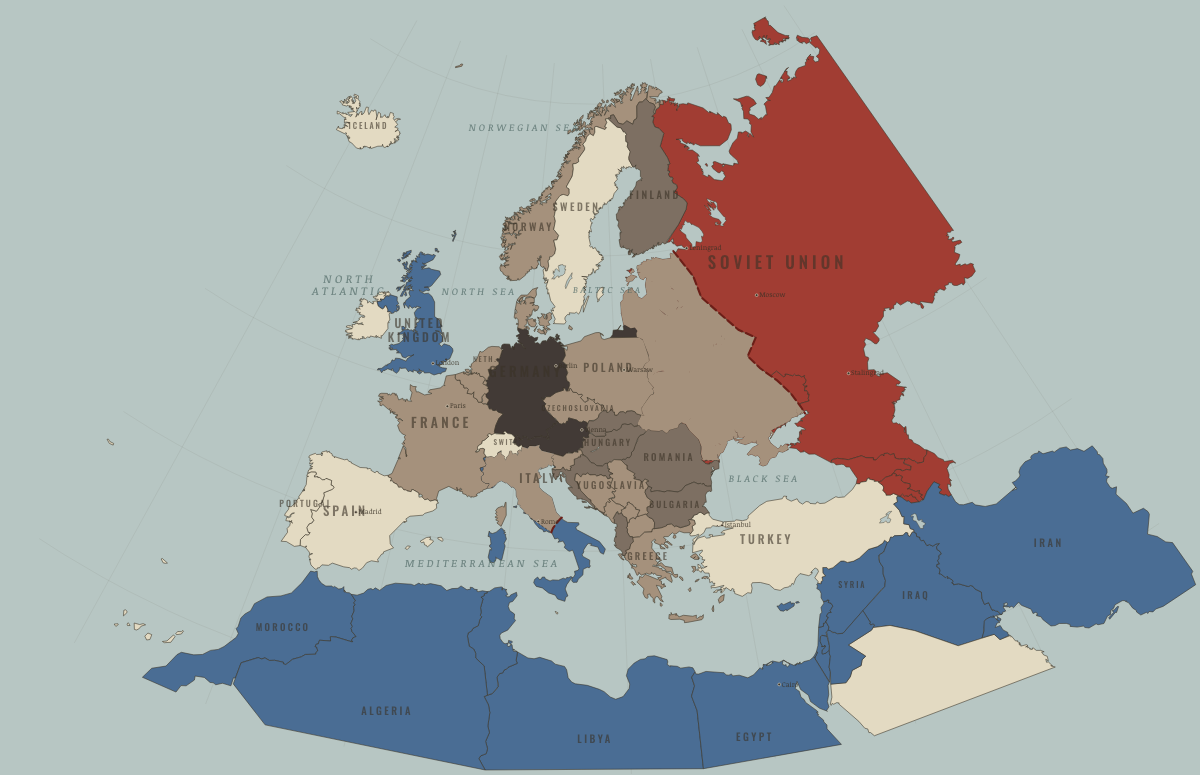
What was Italy before it was Italy? The sections below follow this land through every era covered by the Maps of History atlases: who ruled it, what it was called, and when control changed. Each line links to the dated map. Modern borders serve as an approximation, as each atlas says on the map itself.
Italia (mod. Italy) · Ancient Rome
By 264 BC Rome commanded Italy through the socii system: defeated neighbors supplied soldiers as allies. From Italy, the census, consuls and legions sustained centuries of expansion. At the empire’s height Italy enjoyed tax exemption and demilitarization; later it became a battleground for federate armies. After 476 an Ostrogothic kingdom ruled there, while the Senate continued to meet.
| 264 BC | Roman territory — the opening position |
| Former Roman lands (lost) |
ANCIENT ROME: EVERY CHAPTER AND MAP →
Italy · Norse and Aztecs
| Other peoples and states — the opening position |
NORSE AND AZTECS: EVERY CHAPTER AND MAP →
Italy — Rome & the maritime republics · Crusades
Italy shaped the crusades in two ways. The reforming papacy in Rome launched, financed and steered the venture, directing it against heretics and its own enemies as readily as against Islam. At sea, the republics of Genoa, Pisa and Venice carried armies to Outremer and made its settlements possible, while taking a share of every conquered port. Venice went further: it bent the Fourth Crusade toward the sack of Constantinople and the creation of a commercial empire.
| Latin Christendom — the opening position |
CRUSADES: EVERY CHAPTER AND MAP →
The Italian states (Italy from 1861) · Industrial Revolution
Italy united in 1861 and industrialized late, with growth concentrated in the northwest. Around Turin, Milan and Genoa, textile, steel, engineering and motor industries used hydroelectric power in a country with little coal. The south remained poor and agrarian. Millions of Italians emigrated, many of them from the south, chiefly to the Americas.
| Industrialising — the opening position | |
| Industrialising | |
| Industrialising |
INDUSTRIAL REVOLUTION: EVERY CHAPTER AND MAP →
Italian states (mod. Italy) · Age of Revolutions
Napoleon established sister republics in Italy and then satellite kingdoms. They gave Italians their first common laws and “Italy” as a political project. Vienna divided the peninsula again, leaving Austria in control of the north, but the Carbonari and Mazzini kept the project alive underground. Milan, Venice and Rome rose as republics in 1848. All fell, while Piedmont kept its constitution and the next move.
| The conservative monarchies — the opening position | |
| Napoleonic client & satellite states | |
| Restored monarchies (after 1815) |
AGE OF REVOLUTIONS: EVERY CHAPTER AND MAP →
Italy · Meiji Japan and post-Soviet Russia
| Western powers and allies — the opening position |
MEIJI JAPAN AND POST-SOVIET RUSSIA: EVERY CHAPTER AND MAP →
Italy · WWI
The secret Treaty of London gave Italy a better offer from the Entente than it had in the Triple Alliance (Ch. 6). Italy changed sides and paid on the Isonzo, with eleven offensives, about 650,000 dead and the collapse at Caporetto (Ch. 10), before recovery and victory at Vittorio Veneto. At Paris it received less than promised. “Mutilated victory” became the myth on which Mussolini marched in 1922.
| Germany and its allies — the Central Powers — the opening position | |
| Germany and its allies — the Central Powers | |
| Neutral or unaligned | |
| The Entente & Allies | |
| The Entente & Allies |
Italy · Stalin’s Soviet Union
| Nazi Germany & its allies — the opening position | |
| Nazi Germany & its allies | |
| Other states | |
| Rivals & the Western bloc |
STALIN’S SOVIET UNION: EVERY CHAPTER AND MAP →
Italy · Road to WW2
Italy belonged to the Stresa Front in April 1935. By October it was an invader under sanctions, and the system that had hoped to keep Italy within it faced a different problem. The conquest of Abyssinia cost Italy the democracies' friendship and gave Hitler his best ally. Spain, Albania and the “parallel war” of 1940 followed, with ambitions growing as execution fell short. Within months of entering the world war, Mussolini needed German rescue in Greece and Africa.
| The aggressors (Japan, Germany, Italy) — the opening position |
ROAD TO WW2: EVERY CHAPTER AND MAP →
Italy · WW2
Fascist Italy entered the war in pursuit of prestige, but met defeat (Ch. 5). Its switch of sides in 1943 left a German-occupied north and an Allied south, with a partisan civil war between them. Partisans executed Mussolini in April 1945.
| Axis allies & puppets — the opening position | |
| Western Allies |
Italy · Cold War
| NATO & core Western allies — the opening position |
COLD WAR: EVERY CHAPTER AND MAP →
Italy · Feminism and the Tunisian Revolution
Women’s groups practiced civil disobedience for years before Italy legalized abortion in 1978; a referendum confirmed the law in 1981. On the Tunisian map, Italy is the destination of the harga. In three months in early 2011, about 20,000 Tunisians crossed by boat to Lampedusa, an island belonging to Sicily.
| Right won in law — the opening position | |
| No reform yet / outside this story | |
| Right won in law |
FEMINISM AND THE TUNISIAN REVOLUTION: EVERY CHAPTER AND MAP →
Italy · Refugee crises
After Italy lost its eastern lands in 1947, Istrian, Fiuman and Dalmatian exiles came to the country. Many lived in camps for years before finding homes elsewhere in Italy or emigrating. Jewish DPs also passed through Italy on their way to Palestine, and clandestine ships sailed from its ports. Under a 2004 law, Italy has marked 10 February as a Day of Remembrance for the exodus since 2005.
| Western bloc or democracy — the opening position |
REFUGEE CRISES: EVERY CHAPTER AND MAP →
Related
THE FREE PRINTABLE STUDY GUIDE
Get a printable atlas study guide of your choice free. I’ll send you a few short letters, then one when a new atlas opens. That’s all. — Paul
NO TRACKING · YOUR ADDRESS IS USED FOR THE DISPATCH AND NOTHING ELSE · UNSUBSCRIBE ANYTIME