14 ATLASES
History of Austria in maps
Austria as it appears in 14 interactive history atlases, from 264 BC to 2015: Noricum, the Eastern March, Duchy of Austria, Austria, Austria-Hungary. Each era below lists who ruled the land and when control changed, linked to the dated map that shows it.
WW2 is free — every chapter. No sign-up.
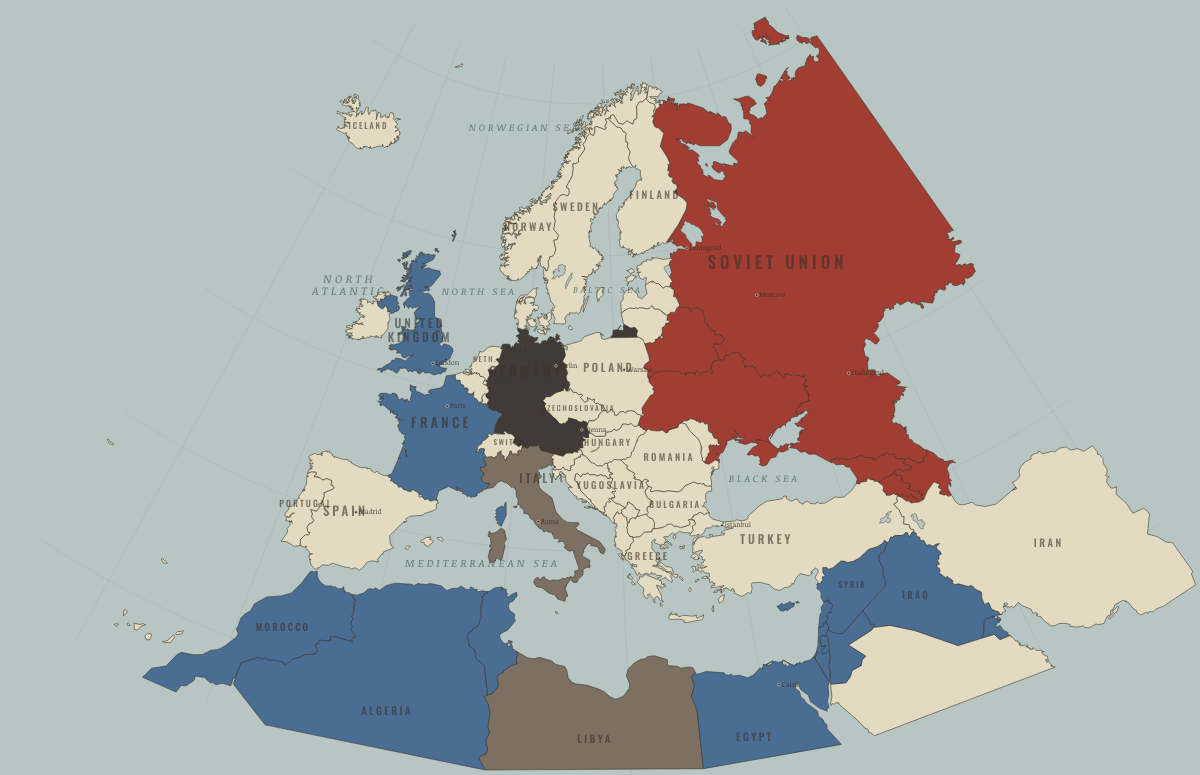
What was Austria before it was Austria? The sections below follow this land through every era covered by the Maps of History atlases: who ruled it, what it was called, and when control changed. Each line links to the dated map. Modern borders serve as an approximation, as each atlas says on the map itself.
Noricum (mod. Austria) · Ancient Rome
| 264 BC | Tribal peoples & confederations — the opening position |
| Roman territory | |
| Former Roman lands (lost) |
ANCIENT ROME: EVERY CHAPTER AND MAP →
Austria · Norse and Aztecs
| Other peoples and states — the opening position |
NORSE AND AZTECS: EVERY CHAPTER AND MAP →
The Eastern March (mod. Austria) · Crusades
| Latin Christendom — the opening position |
CRUSADES: EVERY CHAPTER AND MAP →
Duchy of Austria · Mongol Empire
| Other settled powers (Jin China, Christendom, Delhi) — the opening position |
MONGOL EMPIRE: EVERY CHAPTER AND MAP →
Austria (Habsburg Empire) · Industrial Revolution
Industry grew unevenly across the Habsburg Empire. Vienna, Lower Austria and the Styrian ironworks expanded, and the Alpine railways over the Semmering and the Brenner were engineering marvels. Bohemia was the empire’s real workshop, while the empire as a whole remained largely agrarian. Bairoch estimated its industrial output per head in 1913 at less than a third of Britain’s.
| Industrialising — the opening position | |
| Industrialising | |
| Industrialising |
INDUSTRIAL REVOLUTION: EVERY CHAPTER AND MAP →
Austria (Habsburg monarchy) · Age of Revolutions
The Habsburg monarchy was beaten by Napoleon four times and married him an archduchess. It then hosted the Congress that rebuilt Europe around its security. For 33 years Metternich directed the continent’s counter-revolution from Vienna. In 1848 the monarchy nearly died as Vienna, Milan, Prague and Budapest rose. Its army and its skill at playing nation against nation saved it, at the cost of learning nothing.
| The conservative monarchies — the opening position |
AGE OF REVOLUTIONS: EVERY CHAPTER AND MAP →
Austria · Meiji Japan and post-Soviet Russia
| Non-aligned or stateless — the opening position |
MEIJI JAPAN AND POST-SOVIET RUSSIA: EVERY CHAPTER AND MAP →
Austria-Hungary · WWI
Austria-Hungary appears on this map through modern states it contained: Austria, Hungary, Czechia, Slovakia, Slovenia, Croatia and Bosnia. Its eleven nationalities shared two parliaments and one aging emperor. It began the war to stop South Slav nationalism, only to be destroyed by every nationalism at once. After 1916 it fought as Germany’s ward (Ch. 7). In October–November 1918 the empire dissolved in weeks as each nation declared itself out; rump Austria, forbidden to join Germany, was left with a capital without a country.
| Germany and its allies — the Central Powers — the opening position | |
| Germany and its allies — the Central Powers | |
| Empires in collapse (1918–22) | |
| Neutral or unaligned | |
| Empires in collapse (1918–22) |
Austria · Stalin’s Soviet Union
| Nazi Germany & its allies — the opening position | |
| Nazi Germany & its allies | |
| Other states |
STALIN’S SOVIET UNION: EVERY CHAPTER AND MAP →
Austria · Road to WW2
Two treaties forbade union between Austria and Germany. Mussolini's divisions guarded Austria in 1934; in 1938 he sold it, and it became the first country to vanish without a shot. Crowds cheered the Anschluss. Within days, Jews were made to scrub Vienna's pavements. The change drawn on the map was also a catastrophe in the street.
| Neutral & unaligned — the opening position | |
| The aggressors (Japan, Germany, Italy) |
ROAD TO WW2: EVERY CHAPTER AND MAP →
Austria · WW2
Austria’s annexation in 1938 (Ch. 1) brought jubilant crowds and terror to others. The question of Austria as “first victim” or “willing participant” remains contested. A plebiscite that nobody could safely refuse returned 99% for annexation; some 1.2 million Austrians served in German uniform, and Austrians were over-represented in the SS and the camp system. Meanwhile, Vienna’s 180,000 Jews were driven into exile or murdered. The Allies’ Moscow Declaration of 1943 called Austria “the first victim”, a diplomatic formula postwar Austria adopted; a fuller reckoning waited until the 1980s. Austria was restored in 1945 and became permanently neutral in 1955.
| Axis powers — the opening position | |
| Axis powers | |
| Defeated Axis (occupied) | |
| Western Allies |
Austria · Cold War
| NATO & core Western allies — the opening position | |
| Non-aligned & neutral | |
| Non-aligned & neutral |
COLD WAR: EVERY CHAPTER AND MAP →
Austria · Feminism and the Tunisian Revolution
| Right won in law — the opening position | |
| No reform yet / outside this story | |
| Right won in law |
FEMINISM AND THE TUNISIAN REVOLUTION: EVERY CHAPTER AND MAP →
Austria · Refugee crises
Austria was treated as Hitler’s first victim, but four powers occupied it until the 1955 State Treaty restored its independence and made it neutral. After the war it hosted DP camps and hundreds of thousands of ethnic German refugees. In 1956 it became the first-asylum country for about 180,000 Hungarians. The reception camp at Traiskirchen opened that November and remains a major center for asylum seekers.
| Germany and Austria occupied — the opening position | |
| First asylum open | |
| Neutral or between the blocs |
REFUGEE CRISES: EVERY CHAPTER AND MAP →
Related
THE FREE PRINTABLE STUDY GUIDE
Get a printable atlas study guide of your choice free. I’ll send you a few short letters, then one when a new atlas opens. That’s all. — Paul
NO TRACKING · YOUR ADDRESS IS USED FOR THE DISPATCH AND NOTHING ELSE · UNSUBSCRIBE ANYTIME