Meiji Japan and post-Soviet Russia · 1889
Did the Meiji constitution advance or prevent democracy?
The seminar question: “Was the Meiji constitution a step towards democracy or a device to prevent it?”
Between 1877 and 1894 Japan’s leaders built a modern state in sequence, economy and army first and a constitution after. The Iwakura Mission studied the West, state factories such as the Tomioka silk mill were sold to the zaibatsu, and the constitution was promulgated on 11 February 1889.
Chapter 5 is included with every paid plan. WW2 is free in full, and chapter 1 of every atlas is free. A free account opens 3 more chapters a day. Starter, at $9 a month, opens all 21 with no daily limit — see the plans.
Free printable Meiji Japan and post-Soviet Russia study guide, sent by email ↓
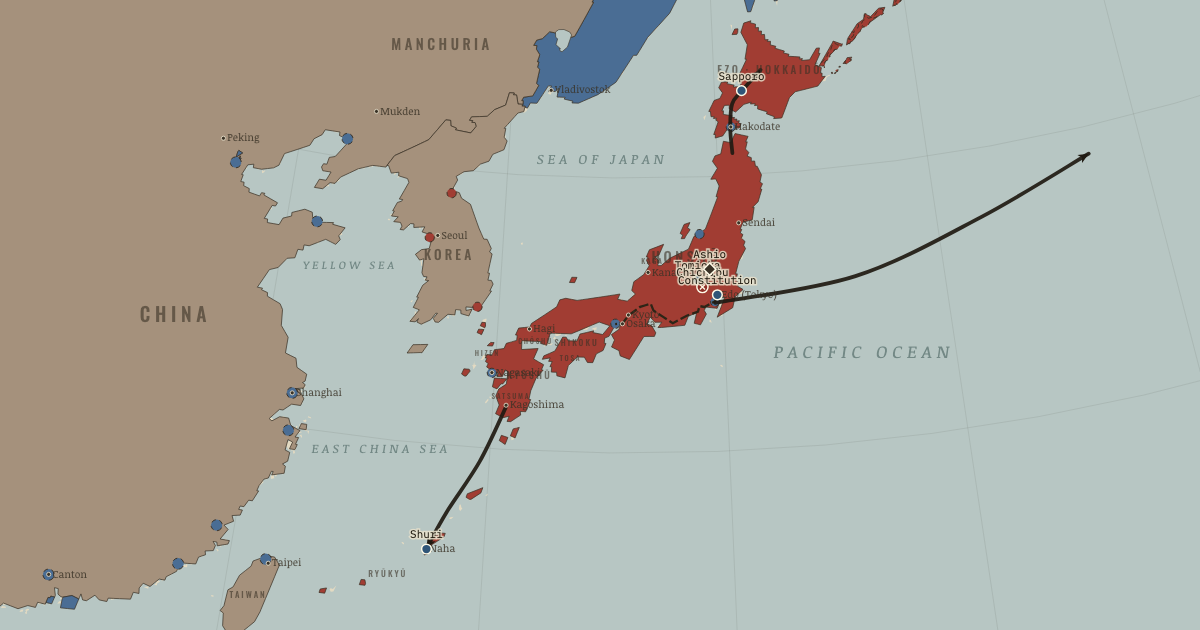
In 1871 Japan sent about half its government’s leaders abroad on the Iwakura Mission. Ōkubo Toshimichi, Kido Takayoshi and the young Itō Hirobumi hoped, among other things, to revise the unequal treaties. They returned in 1873 without that agreement. Factories, schools and laws appeared to them essential if Japan was to claim equality with the powers they had visited. The government hired foreign experts and sent students overseas, taking different institutions as models: the navy from Britain, the army from France and later Germany, and schools from American and French practice.
The short answer
- The Iwakura Mission taught that strength must come first. The 1871 mission sought to begin revising the unequal treaties, but Western powers politely judged Japan’s laws and institutions unacceptable. Visits to Manchester’s factories, American railways and Bismarck’s Germany gave its members a picture of the strength they thought equality required. They returned convinced that economy and army must come first, and that belief shaped the order of reform.
- Inflation forced financial discipline. To pay for the Satsuma Rebellion, the government had printed paper money. By 1880 prices were rising rapidly and confidence in the currency was failing. Finance minister Matsukata Masayoshi responded from 1881 with higher taxes, lower spending, a central bank and convertible notes. The yen and budget stabilized, but lower prices made farm debts harder to bear and pushed farmers into tenancy. Chichibu’s silk farmers rose in 1884.
- A popular movement demanded a voice. Former samurai, rich farmers and urban journalists gave the Freedom and People’s Rights movement an organization after 1874. Meetings and dozens of privately drafted constitutions made its demand concrete; by 1880 petitions for an assembly reached Tokyo from every region. The movement could not take power, but the leaders could no longer ignore the demand for a constitution. They chose to write one themselves before their critics could do so.
- Treaty revision required a legal order the West would accept. Extraterritoriality placed foreigners beyond Japan’s ordinary courts. Western governments would not surrender it until those courts and Japan’s legal codes met their standards. The constitution, cabinet, criminal code and civil code thus served a diplomatic purpose as well as a domestic one: they supplied evidence for Japan’s claim to equality.
THE TURNING POINT
The constitution, 11 February 1889. The constitution promulgated on 11 February 1889 set Japan’s political rules until 1947. It made Japan the first Asian state with a lasting written constitution and elected parliament, helping persuade Britain to give up extraterritoriality in 1894. Its distribution of authority also left consequential ambiguities: the emperor was sovereign without governing, ministers answered to him alone, and the armed forces answered to no civilian. At the ceremony in the new palace, Western dress displayed the modern state its leaders wanted the world to see, while they kept control of its institutions.
What it changed
Treaty revision became possible. Britain agreed in a July 1894 treaty to end extraterritoriality from 1899; other powers followed. Japan’s constitution, cabinet and legal codes supplied the institutional evidence Western governments had demanded. Full tariff control came in 1911, completing the escape from the unequal treaties that began with Perry’s ships.
Parties won a foothold in the state. The first Diet met in 1890, and its elected lower house used budget disputes to press the cabinet. The oligarchs needed party cooperation to govern. The franchise widened in 1900 and 1919, before all adult men gained the vote in 1925. What began as a restricted parliament gave the party governments of the 1920s a foothold.
A state ideology entered every classroom. On national holidays schools read the 1890 Rescript on Education aloud, and pupils bowed before the emperor’s portrait. The demands of this loyalty could be exacting: in 1891 the Christian teacher Uchimura Kanzō was forced from his post after hesitating to bow deeply enough before the Rescript. A literate conscript nation learned loyalty to the emperor in school; that ideology would be mobilized in later wars.
The full answer, argued
The constitution’s designers wanted to contain participation. No assembly approved the document granted from above; the emperor was sovereign, ministers answered to him, and only about 1% of the population could vote. The supreme-command clause later helped the army escape civilian control in the 1930s. But the elected Diet could refuse new budgets. Its politicians acquired leverage, and within a decade the oligarchs had to bargain with parties. The electorate grew until all men could vote in 1925. As historians such as Carol Gluck show, the document supported an ideology of obedience alongside lively public politics. A channel intended to limit participation also gave later generations a way to demand more.
An interesting fact
Tsuda Umeko was only six when she joined the Iwakura Mission, its youngest member and one of five girls sent to the United States for education at government expense. Her father, Tsuda Sen, a former shogunate interpreter turned agricultural reformer, volunteered her. She lived with an American family in Washington and returned in 1882 barely able to speak Japanese. She later studied biology at Bryn Mawr College and in 1900 founded a women’s school that became Tsuda University. In 2024 her portrait appeared on Japan’s new 5,000-yen banknote.
This is the study layer of Meiji Constitution and modernisation, chapter 5 of Remaking the State: Meiji Japan 1600–1912 and Post-Soviet Russia 1964–2000; the full index of the atlas is here.
Related questions
THE FREE PRINTABLE STUDY GUIDE
Get the printable study guide for Remaking the State free. I’ll send you a few short letters, then one when a new atlas opens. That’s all. — Paul
NO TRACKING · YOUR ADDRESS IS USED FOR THE DISPATCH AND NOTHING ELSE · UNSUBSCRIBE ANYTIME