Russian Revolution · EPILOGUE ·
Legacy of the Russian Revolution
Chapter 14 of The Russian Revolution, 1855–1924: “What Had Been Made”
On 30 December 1922 Russia, Ukraine, Belorussia and Transcaucasia formed the USSR, a federation in national form run by one Communist Party, and Lenin died at Gorki in January 1924. The civil war had forged a centralised one-party state with a political police, which also expanded literacy and changed women’s legal position.
Chapter 14 is included with every paid plan. WW2 is free in full, and chapter 1 of every atlas is free. A free account opens 3 more chapters a day. Starter, at $9 a month, opens all 21 with no daily limit — see the plans.
Free printable Russian Revolution study guide, sent by email ↓
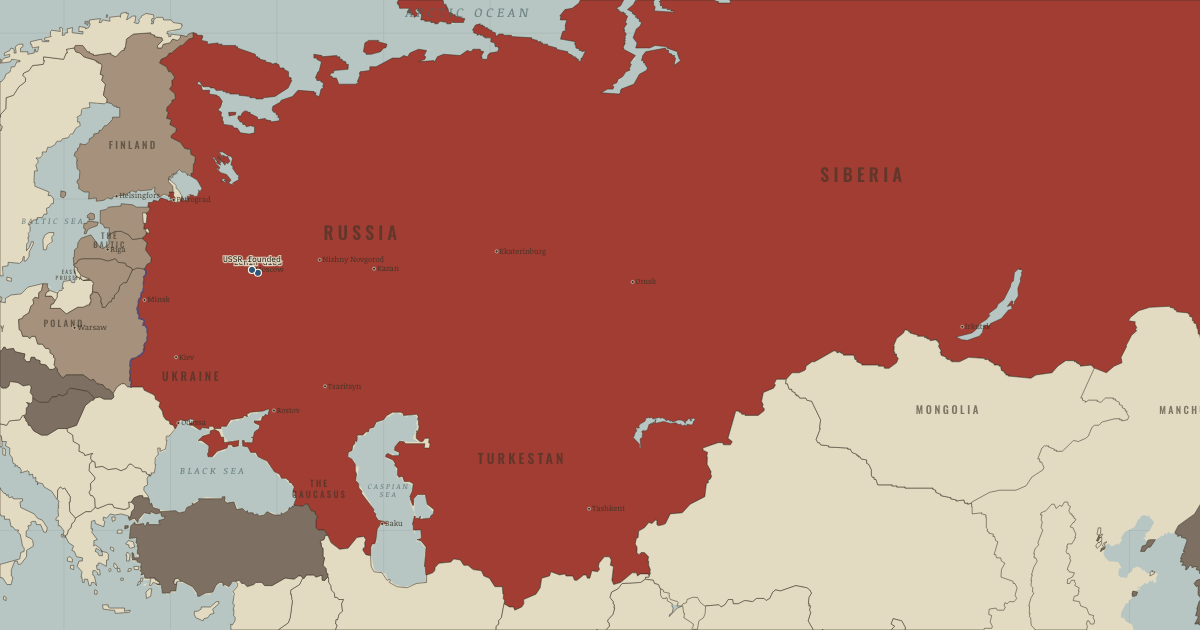
The map above is the world of The Soviet Union, January 1924 — Lenin dies.
Every state on the map that year: The world in 1920 · Europe in 1920.
Part of IB History: The Russian Revolution →
SHORT EXPLANATION
The last foreign troops left Vladivostok in October 1922. By then Red power had returned nearly to the old imperial frontiers. On 30 December Russia, Ukraine, Belorussia and Transcaucasia joined in the Union of Soviet Socialist Republics. Its republics gave the state a national federal form, while a single Communist Party held power across them. The party that had promised peace, land and bread had presided over civil war, requisition and famine; it had won, and would rule for seven decades.
War had helped make the government that emerged: a centralized, militarized one-party dictatorship, closed to dissent and protected by a political police that had made terror an institution. The same government changed women’s legal position and attacked illiteracy, beginning a campaign that would soon make a peasant nation read. Both belong in its history. In his last active months Lenin warned against the man who controlled party appointments. The warning was suppressed, and Lenin died at Gorki in January 1924 with the succession unresolved.
The full story
The map was mostly red again by 1922, but the state that emerged was different from the empire that had fallen. Finland, Poland and the Baltic states remained outside it. Within the new state, republic borders, official languages and national institutions gave national identities a formal place denied them by tsarist autocracy. At Moscow on 30 December 1922, the USSR was founded as a union of republics.
The republics’ place in that union had limits. A single command structure controlled security, major appointments and policy across them, leaving no competitive sovereignty. Federal institutions acknowledged nationality; centralized party power held the union together under one leadership. The arrangement endured because it addressed both the claims of national identity and the rulers’ need for control.
The civil war had also taught the rulers how to govern. Secrecy, discipline and requisition had served survival, while independent organizations were treated with suspicion. Centralized command, a security police and a party closed to factions since 1921 became lasting features of the state. Foreign intervention confirmed its leaders’ conviction that they faced a hostile world. NEP eased economic controls, but it did not open the political system.
Coercion was only part of what this government did. It expanded literacy and changed the legal position of women. Those gains belong beside the restrictions, because a state can enlarge people’s opportunities in one part of life while denying them freedom in another.
Lenin’s strokes brought an unresolved question to the center of politics: who would follow him? There was no settled mechanism for choosing a leader, and the faction ban pushed the struggle among his associates away from open contest and toward control of the party apparatus. Lenin’s Testament warned that Stalin, the General Secretary, had accumulated dangerous power over appointments and urged his removal. The warning was buried; Stalin retained the offices. When Lenin died at Gorki on 21 January 1924, the struggle he feared had already begun. The unaccountable state that had killed so many to seize power passed intact to a successor who would use it to kill on a scale the civil war never approached. That is where the next chapter of this history, and the world of 1939, begins.
FULL EXPLANATION
Did the civil war create the dictatorship?
The Bolsheviks had already taken consequential steps before the widest fighting of the civil war. They seized power, dispersed the Constituent Assembly, suppressed rivals and created a political police. Richard Pipes, a leading advocate of the view that authoritarianism was present by design from October, treats those choices as evidence of the direction the revolution had taken. The party’s monopoly did not have to wait for the largest battles. Historians including Sheila Fitzpatrick give more weight to what the war did to the new government. Encirclement, economic collapse, mass mobilization and combat encouraged emergency practices that hardened into institutions. The scale, militarization and administrative reach of coercion expanded during the fighting. That history helps explain the particular state that emerged, not merely the fact that power was concentrated. Both sets of evidence matter. There was no pluralist foundation from which Stalinism later departed, but Stalinism was not a finished and inevitable system in 1918. War narrowed alternatives and made particular methods familiar. Leaders still chose among constrained options, and the later transformation of those institutions was a further choice, not an automatic inheritance.
Federal form and centralized control
The Soviet leaders inherited a multinational empire in which movements had challenged Russian rule. A union of republics offered a way to recognize those nations and attract non-Russian elites. Republic status, official languages and nationality policies also distinguished the new state from an open restoration of empire. These arrangements had real administrative and cultural consequences: boundaries were drawn and institutions established. But one party controlled appointments, security organs and strategic decisions throughout the republics. The system was national in form and party in content. While the party remained unified, the republics did not possess effective sovereignty or the power to choose separation. Federal institutions helped hold the USSR together, yet they also furnished territories, elites and borders along which the union dissolved in 1991. Recognition of nationhood and centralized political power had lived together for decades; the structure deferred their contradiction rather than resolving it.
Key places on the map
On this day
Why it happened
The civil war forged the state. The government that survived the civil war carried its methods into the USSR of 1924. Centralization, one-party rule, the security police, a militarized economy and a siege mentality hardened from wartime improvisations into lasting structures. To understand the state, we must look at how it survived as well as the theory it professed.
A federation to hold a multinational empire. Moscow sought to reunite a territory containing a hundred nations while claiming to respect self-determination. Federal republics supplied a national form and sovereignty on paper; one Party held power in practice. The arrangement helped hold the empire together for seventy years. When the Party’s grip failed in 1991, the republics supplied lines along which it came apart.
A vacuum at the top with no rule to fill it. There was no settled succession rule when Lenin became disabled. His associates therefore struggled over the Party machine. The 1921 faction ban kept that contest from becoming open debate, making control over appointments especially valuable to anyone seeking power.
THE TURNING POINT
Lenin dies at Gorki, 21 January 1924. Lenin died at fifty-three on 21 January 1924. His final warnings had gone unheeded, and no successor had been settled upon. His absence revealed how much the system depended on him personally, while its restrictions on open politics left the Party apparatus as the arena in which the vacuum would be filled by intrigue rather than a vote or principle. The Testament warning against Stalin was buried; the offices Stalin controlled remained his. Between Lenin’s stroke and funeral, the next, darker transformation of Russia was already taking shape.
What it changed
Stalin’s rise. The office of General Secretary gave Stalin influence over appointments: who entered the Party, who advanced and where people served. These administrative decisions mattered in a state governed by a Party closed to dissent. Within five years of Lenin’s death Stalin had outmaneuvered every rival; within ten he had launched a second revolution from above.
A second, deadlier transformation to come. NEP brought recovery through a mixed economy, but the argument over its future remained open. How fast should socialism be built in a peasant country, how should industry be developed, and what place should the market have? After 1928 the leadership answered with forced collectivization, planned industrialization and terror. That terror dwarfed the civil war’s: the revolution’s most lethal phase came during its “peace.”
The world the revolution made. The state made in this revolution became an international model for communist and anti-colonial movements, as well as a great antagonist. It would shape the Second World War and define the Cold War. The atlas follows its birth; the War Room meets it again seventeen years later, as the state that will absorb the largest invasion in history. Each change of color on this map opens onto a much larger history.
DISCUSSION QUESTION — Was the Soviet outcome — a one-party dictatorship — the inevitable result of 1917, or a contingent product of the civil war and its aftermath?
Richard Pipes, the sharpest voice of the “inevitability” school, sees the dictatorship’s design in the Bolsheviks’ early actions: they dispersed the Constituent Assembly, banned rivals and institutionalized terror. On this view Stalin was Lenin’s logical heir, not his betrayer. Sheila Fitzpatrick and other historians in the “contingency” school give the civil war’s emergencies greater weight. War Communism, the security police and the sealed Party were responses to survival that might have relaxed; Stalin’s particular murderous regime was a distinct, avoidable turn. Orlando Figes and most current historians take a middle position. The revolution created an authoritarian framework that was not yet totalitarian; war, isolation, the peasant question and the accident of succession then pushed it toward an extreme. These accounts direct attention to different moments on the map. Structure made dictatorship likely, while contingency helped determine why this dictatorship emerged.
An interesting fact
Days after Lenin’s death, Krupskaya asked that he be honored with schools, nurseries and libraries. “do not raise memorials to him,” she wrote in Pravda. The Party overrode her. In the January frost a wooden cube was assembled as the first mausoleum, and embalming was improvised so that the long queues of mourners could continue past the body. A specially created laboratory made the process permanent that spring and maintains the body to this day. The lifelong materialist became an incorruptible relic, the founding exhibit of a cult his own doctrine should have forbidden.
Related
THE FREE PRINTABLE STUDY GUIDE
Get the printable study guide for The Russian Revolution free. I’ll send you a few short letters, then one when a new atlas opens. That’s all. — Paul
NO TRACKING · YOUR ADDRESS IS USED FOR THE DISPATCH AND NOTHING ELSE · UNSUBSCRIBE ANYTIME