WWI · JUL 1914
Was WWI an accident or a choice, and who was to blame?
The seminar question: “Was the First World War an accident, a choice — or both? Who, if anyone, was to blame?”
After the assassination at Sarajevo on 28 June 1914, Austria-Hungary resolved to crush Serbia and Germany gave it unconditional backing, the so-called blank cheque. Russia mobilized to shield Serbia, Germany declared war on Russia and France, and its troops crossed into Belgium on 4 August, which brought Britain into the war.
Chapter 3 is included with every paid plan. WW2 is free in full, and chapter 1 of every atlas is free. A free account opens 3 more chapters a day. Starter, at $9 a month, opens all 21 with no daily limit — see the plans.
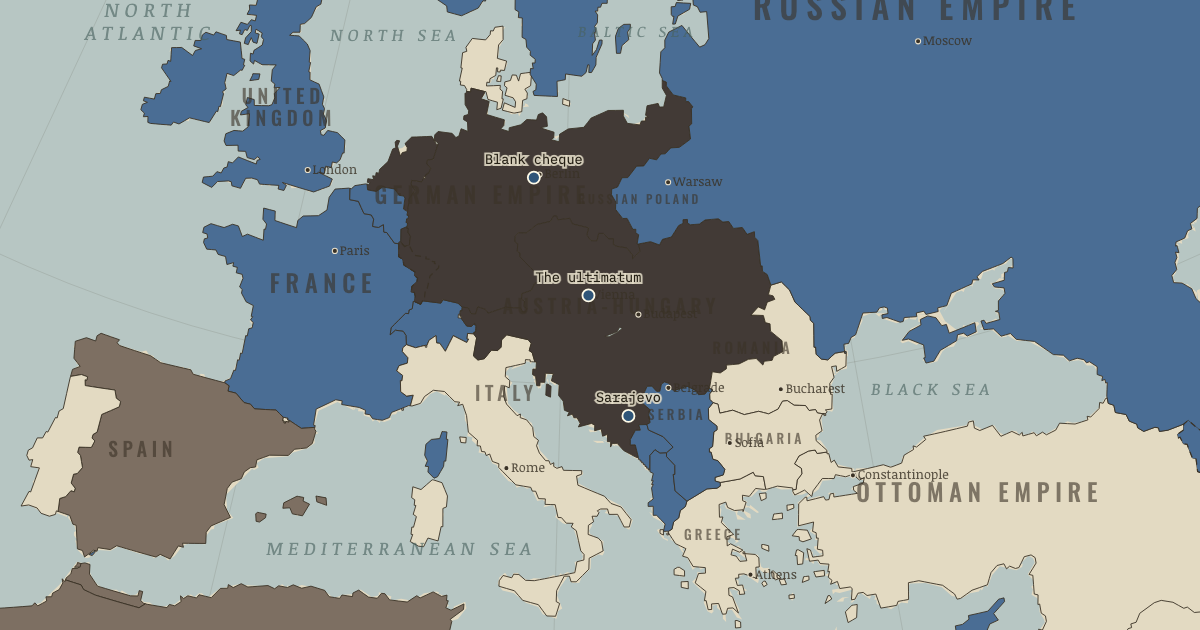
The Austrian heir's murder gave Vienna an opportunity to deal with a danger it had long feared. Austria-Hungary ruled many peoples, including South Slavs whose nationalism had encouragement from Serbia. Some Austrian leaders wanted to break Serbian power before it could further threaten the empire. Germany's unconditional promise of support, the “blank cheque,” made a hard policy more attractive: Vienna could act knowing that its great-power ally stood behind it.
The short answer
- The alliance machine. Bismarck had used alliances to isolate crises. By 1914 the opposing alignments could spread one. An Austrian attack on Serbia threatened Russian interests; German support for Austria raised the prospect of war with Russia; and Germany's plan for that war included an attack on France. A network meant to deter an enemy could thus carry a local quarrel into several countries.
- Timetables as destiny. Staffs expected the first army to concentrate to gain a decisive advantage. Germany's Schlieffen Plan aimed to defeat France in roughly six weeks, before Russia completed its slower mobilization. The railway schedules were hard to change, and fear of losing time pressed against negotiation. “Mobilization means war” captured the danger, though it did not remove political leaders' choices.
- Austria-Hungary’s existential fear. The Dual Monarchy contained eleven nationalities under an aging emperor. On the map, much of its territory is not Austria or Hungary. Leaders in Vienna saw South Slav nationalism, encouraged from Belgrade, as a threat to the empire's survival. Some already wanted a local war to destroy Serbian power; the assassination supplied an occasion to act.
- Germany’s closing window. Russia was expanding its railways with French financing, and German planners feared that their relative advantage would diminish after 1917. If war with Russia was expected, some concluded that it would be better fought sooner. Fischer emphasized German ambitions; other historians see reckless brinkmanship, accompanied by hope that Britain would stay out. Whatever the balance of motives, Berlin backed escalation in July.
THE TURNING POINT
Sarajevo, 28 June 1914. The assassination nearly failed. A bomb missed the archduke's car that morning; later, the driver took a wrong turn past the café where Princip stood. That mistake gave Princip another opportunity. His shot did not itself cause the war, but it gave advocates of force in Vienna an occasion to pursue their policy against Serbia.
What it changed
The dominoes fall in one week. Austria-Hungary declared war on 28 July, and further declarations followed before Britain entered on 4 August. In the next chapter a German army group wheels through Belgium, roughly 1,500 km from Sarajevo. The route shows how far the consequences of the Balkan crisis traveled.
Britain comes in — over Belgium. The German crossing into Belgium resolved a division in Britain's cabinet. Interventionists could point to the 1839 guarantee of Belgian neutrality; Germany's phrase “the scrap of paper” entered the public argument. Britain brought the Royal Navy and the City's credit, as well as eventual resources from the empire shown on the world map, encompassing about a quarter of humanity.
The short-war illusion. Many soldiers expected to be “home before the leaves fall.” Crowds welcomed war, although the enthusiasm was less universal than the legend suggests. Governments anticipated a much shorter conflict than the fifty-one months that followed. Chapter 5 shows the fighting that overturned those expectations.
The full answer, argued
The “sleepwalkers” interpretation stresses the alliances, timetables and misread signals through which a crisis produced a war no one had intended on that scale. Fischer's school points to evidence of Vienna's desire for a Balkan war and Berlin's willingness to risk, perhaps seek, a continental one while its advantage lasted. The two levels belong together. The system made escalation easier; leaders in Vienna and Berlin chose it, while Russia's early general mobilization reduced the time available to others. Under different conditions, the nuclear age faced a related danger: deterrence arrangements can reward a state for moving first.
An interesting fact
The car in which Franz Ferdinand was shot survives: a Gräf & Stift double phaeton, displayed beside his bloodstained tunic in Vienna's Museum of Military History. Its plate, A III 118, has invited the reading Armistice, 11-11-18, though the resemblance is coincidence. During the final days of the crisis, the Kaiser and the Tsar, cousins who signed their English telegrams “Willy” and “Nicky,” appealed to one another to restrain events as their governments moved toward war.
This is the study layer of July Crisis and outbreak of WWI, chapter 3 of The Great War, 1871–1923; the full index of the atlas is here.
Related questions
THE FREE PRINTABLE STUDY GUIDE
Get the printable study guide for WWI free. I’ll send you a few short letters, then one when a new atlas opens. That’s all. — Paul
NO TRACKING · YOUR ADDRESS IS USED FOR THE DISPATCH AND NOTHING ELSE · UNSUBSCRIBE ANYTIME