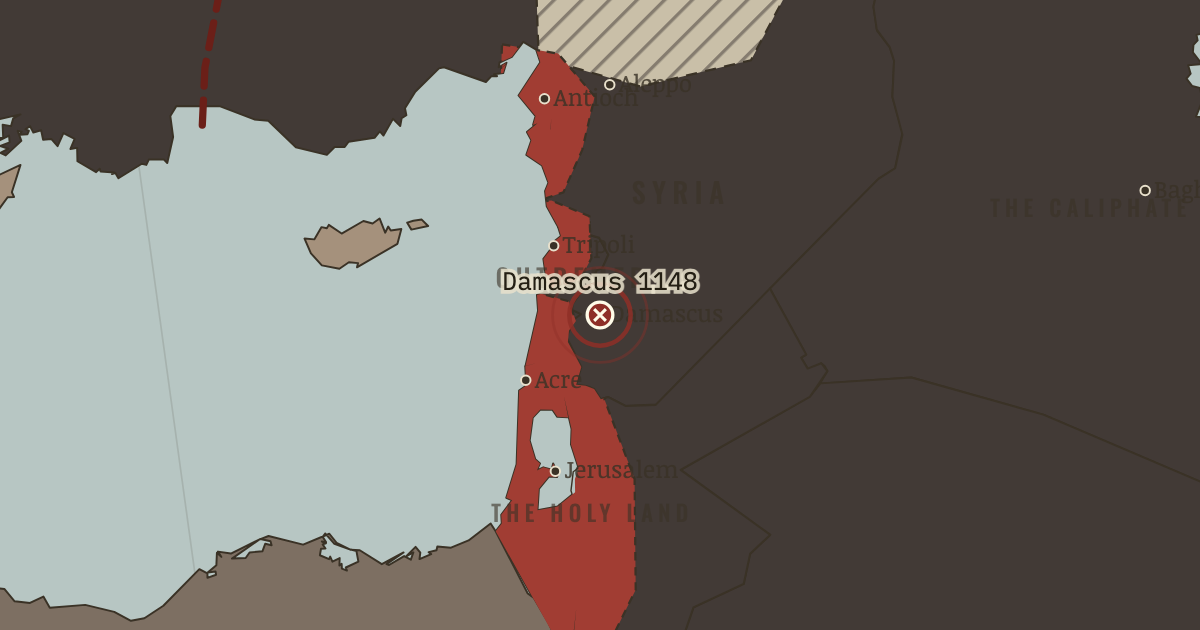
24–28 Jul 1148 — the kings of the Second Crusade besiege Damascus, the one Muslim city friendly to Jerusalem. They retreat after four days, for reasons that remain disputed. The failure drives Damascus toward Nur al-Din and discredits crusading for a generation.
WW2 is free in full, and chapter 1 of every atlas is free. A free account opens 3 more chapters a day. Starter, at $9 a month, opens all 21 with no daily limit — see the plans.
The county of Edessa occupied an exposed place among the four crusader states. It lay deep inland, far from the coast where Italian fleets could bring relief, and its security depended heavily on divisions among its Muslim neighbors. When Zengi captured the city on Christmas Eve 1144, the Franks lost a northern stronghold and the emerging Muslim counter-crusade gained a victory to proclaim. The capture of the city and the loss of the county were distinct events, but together they exposed the vulnerability of the northern frontier.
From Second Crusade, chapter 5 of The Crusades, 1095–1291 (1147).
Why it happened — Edessa’s fatal exposure. Edessa stood deepest inland of the four states, far from the coast and relief by the Italian fleets. Divisions among its neighbors had helped…
The turn — Edessa, 24 December 1144. Edessa’s capture on 24 December 1144 removed a northern Latin state and supplied a victory around which Muslim rulers could rally. It prompted a new…
What it changed — Damascus lost to the enemy. Independent Damascus had helped balance Nur al-Din. After the failed siege it sought his protection, and in 1154 he took the city. His increased…