Crusades · 1095
Was the First Crusade caused by religion or self-interest?
The seminar question: “How did religious and material motives contribute to the First Crusade?”
In 1095 Latin Christendom, Byzantium and a divided Islamic world met around the Mediterranean. Byzantium had lost most of Anatolia after Manzikert in 1071, Seljuk authority fractured after Malik-Shah died in 1092, and Emperor Alexios I appealed to the West; Pope Urban II answered at the Council of Clermont in November 1095.
WW2 is free in full, and chapter 1 of every atlas is free. A free account opens 3 more chapters a day. Starter, at $9 a month, opens all 21 with no daily limit — see the plans.
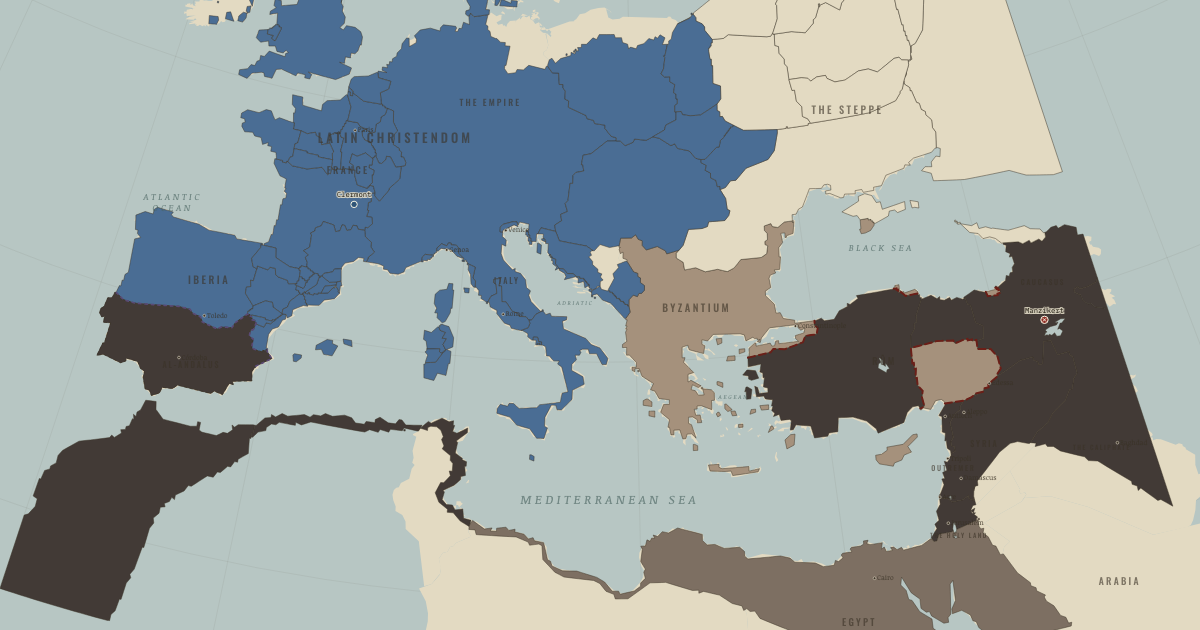
The Near East that the crusaders approached had no single ruler able to summon all its forces against them. The Sunni Seljuk sultans governed in the name of the Abbasid caliph in Baghdad, whose remaining authority was largely religious. In Egypt, the Shia Fatimid caliphs were their political rivals and, in Seljuk eyes, heretics. Syria lay between these powers, divided among competing emirs. After Sultan Malik-Shah died in 1092, his heirs fought for control of his realm. A united power might have crushed a Western expedition at the frontier; instead, an attack on one ruler did not automatically unite his neighbors in defense.
The short answer
- Manzikert and the Byzantine appeal. The defeat at Manzikert in 1071 was followed by the loss of much of Anatolia, a region that had supplied Byzantium with food and soldiers. Alexios I Komnenos sought Western mercenaries to recover it. Urban’s appeal brought tens of thousands east, pursuing a holy war with aims of their own. The emperor had asked for troops to employ; the movement he received was far harder to direct.
- The Seljuk fracture. After Malik-Shah died in 1092, his heirs and their atabegs fought over his realm. Rival emirs held Syria, while the Sunni-Shia division set Baghdad apart from Fatimid Cairo. These rulers had reasons to distrust one another when the expedition arrived. A united defense might have stopped it at the frontier; their divisions made such a response harder to organize.
- The reform papacy and the Peace of God. Gregorian reform had strengthened a papacy able to make demands on kings. The Peace and Truce of God movements, meanwhile, tried to limit knights’ private wars. Urban joined papal authority to a new purpose for those warriors: fighting eastward could become an act of penance.
- Jerusalem and the pull of pilgrimage. Pilgrims already traveled in growing numbers to Jerusalem, the center of the medieval Christian map. Urban’s armed journey drew on that practice as well as apocalyptic expectations and the promise of remission of sins for those who died on the road. These hopes gave the expedition a religious force beyond an ordinary call to political service.
THE TURNING POINT
Clermont, 27 November 1095. At Clermont, Urban offered lay warriors a way to make their fighting an act of penance, with a reward in heaven and, some hoped, on earth. Five later accounts differ over his exact words. The idea they describe would take on uses far beyond this first expedition.
What it changed
An armed pilgrimage, not an army. The people who set out were bound by vows rather than organized as a single state army. Lords raised forces and often sold or mortgaged land to fund the journey; poorer people went with them. Their commitment helped sustain the movement, while the absence of a common commander and budget made supply and coordination difficult.
A new spiritual technology. Crusading helped develop the indulgence, the remission of the temporal penalty for sin. Later appeals would turn the idea against heretics, pagans and the pope’s political enemies (Ch. 9). The sale of indulgences later became a dispute associated with the Reformation.
A blow the target barely felt. The first Islamic responses to the invaders were slow and largely local. Over roughly fifty years, leaders including Zengi and Nur al-Din built a broader campaign against the Latin states. Before such coalitions formed, the Latins had time to establish small possessions.
The full answer, argued
The choice between faith and material interest conceals how the two could work together. Participants spent money and risked death; some sold or mortgaged land to depart, hardly an easy route to profit. Yet honor, adventure, land and an outlet for a warrior culture’s aggression also attracted people, and conquest produced plunder, settlement and coercion. Urban’s appeal made fighting part of a religious undertaking. A man could seek salvation while advancing his family’s interests, and both purposes could help explain his decision.
An interesting fact
Urban II died in Rome on 29 July 1099, fourteen days after Jerusalem fell on 15 July. News of the capture had not yet crossed the Mediterranean, so the pope who helped launch the expedition never learned of its victory.
This is the study layer of Causes of the First Crusade, chapter 1 of The Crusades, 1095–1291; the full index of the atlas is here.
Related questions
THE FREE PRINTABLE STUDY GUIDE
Get the printable study guide for The Crusades free. I’ll send you a few short letters, then one when a new atlas opens. That’s all. — Paul
NO TRACKING · YOUR ADDRESS IS USED FOR THE DISPATCH AND NOTHING ELSE · UNSUBSCRIBE ANYTIME