MAPS OF HISTORY · ON THIS DAY · November 27 · 1095
ON THIS DAY · 27 NOVEMBER 1095
The Council of Clermont
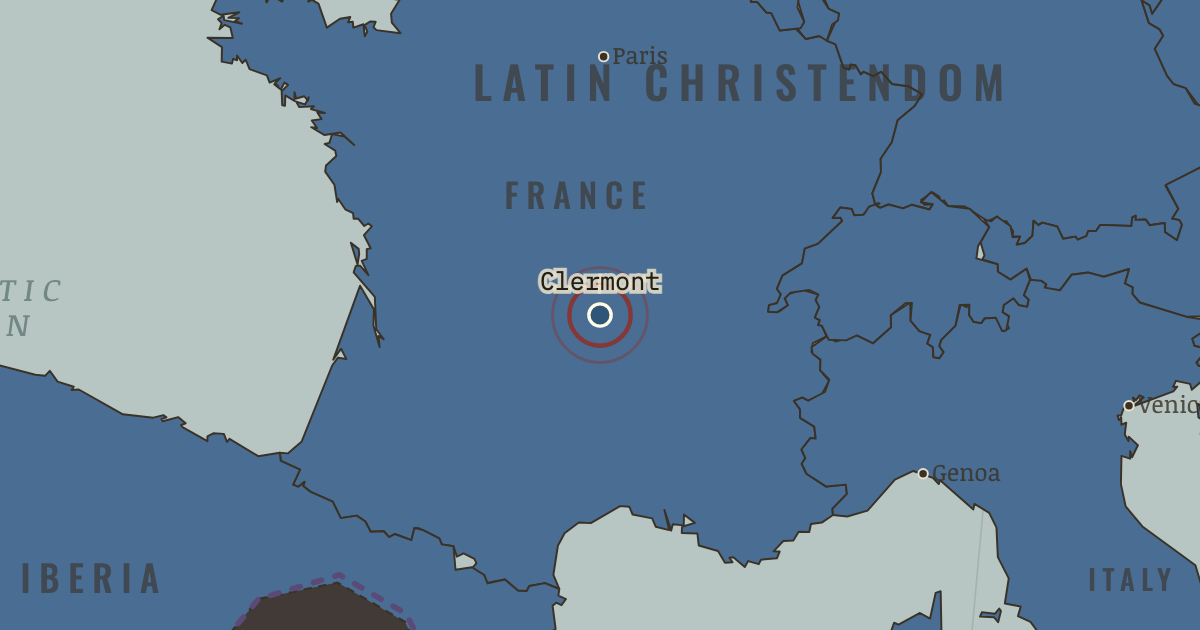
27 Nov 1095 — Pope Urban II calls on Western knights to aid Eastern Christians and free Jerusalem, offering remission of sins. “God wills it,” the crowd answers. No one present imagines what they have started.
THE MOMENT IN CONTEXT
The crusade became possible because the Islamic Near East, which looked like a single vast enemy on the map, was in fact deeply divided against itself. Nominal authority lay with the Sunni Seljuk sultans, who ruled in the name of the Abbasid caliph in Baghdad, a figure by then reduced to a religious figurehead with little real power. Against them stood the Shia Fatimid caliphs of Egypt, regarded by the Seljuks as heretics rather than mere rivals, and between the two lay Syria, broken into quarrelling emirates. When the great sultan Malik-Shah died in 1092, his realm dissolved into a war of succession among his heirs. A united Islamic power could have crushed any Western expedition at the frontier, so the fracture of Seljuk authority was the precondition without which the First Crusade is difficult to imagine.
From Chapter 1 — Three Civilizations, One Sea of The Crusades, 1095–1291 (1095).
OPEN THE INTERACTIVE MAP →New here? Chapters 1–2 of every atlas are free to sample, and the WW2 atlas is free in full. One membership opens all thirteen — the Cartographer’s Circle.
TEACH THIS IN 5 MINUTES
- Why it happened — Manzikert and the Byzantine appeal. The catastrophe of 1071 cost Byzantium the Anatolian heartland that fed and manned it. Emperor Alexios I Komnenos wrote west asking for mercenaries…
- The turn — Clermont, 27 November 1095. We do not have Urban’s exact words — five later versions disagree. But the effect is unmistakable: an idea that a layman’s war could be an act of…
- What it changed — An armed pilgrimage, not an army. What set out had no single commander, no budget, and no state behind it — great lords who had sold or mortgaged their lands, and behind them a crowd…
Then ask the room: Was the First Crusade caused by religion or by material self-interest? The argued answer is on the chapter page →
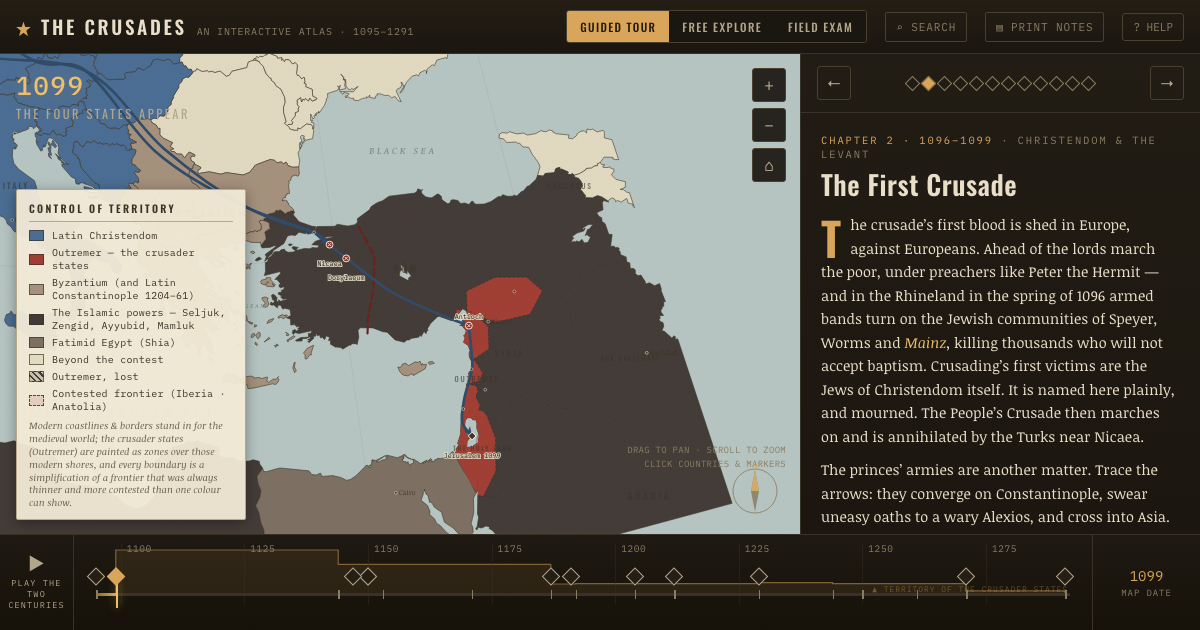
THE ATLAS THAT SHOWS IT
THE DISPATCH
One short letter when a new atlas opens — and the printable study guide for The Crusades is yours now, free.
NO TRACKING · YOUR ADDRESS IS USED FOR THE DISPATCH AND NOTHING ELSE · UNSUBSCRIBE ANYTIME