MAPS OF HISTORY · ON THIS DAY · May 4 · 1919
ON THIS DAY · 4 MAY 1919
May Fourth
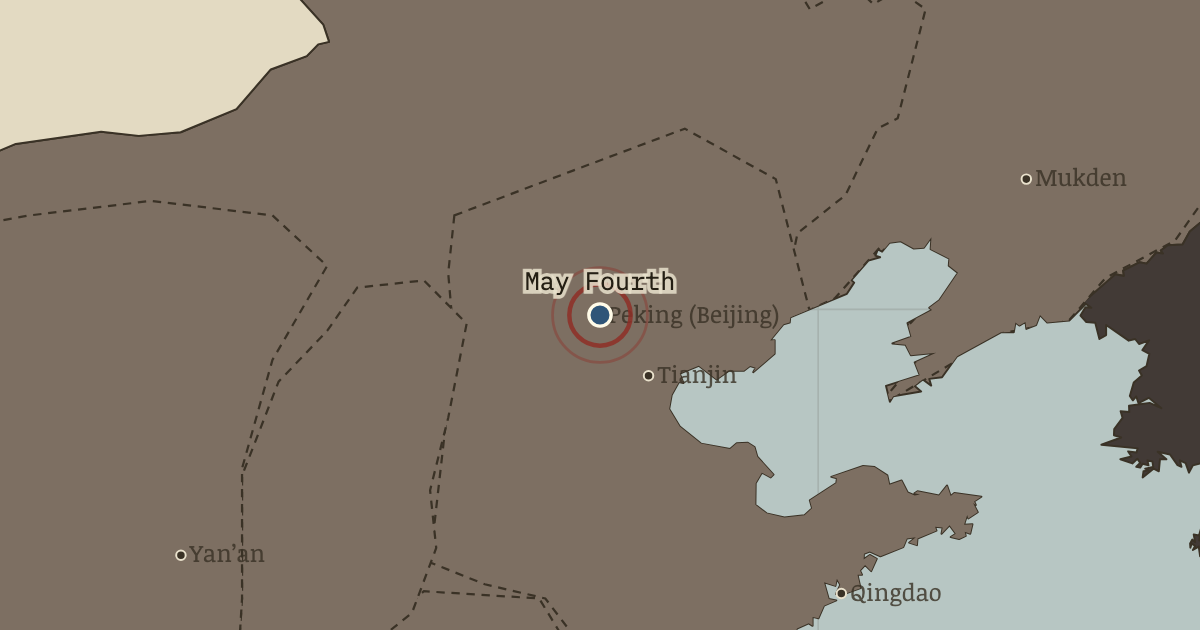
4 May 1919 — Three thousand students march on the Legation Quarter against the Shandong clause of Versailles; strikes and boycotts spread to two hundred cities. Out of the movement come a new vernacular literature, a generation of radicalized students — and, two years later, a communist party.
THE MOMENT IN CONTEXT
A warlord was a regional military ruler whose army was the direct source of his political authority and his revenue, and once Yuan’s central power dissolved the map shattered into the grey-tan plates it would wear for a decade. Each plate was a separate answer to the same question of what governs when nothing does. Manchuria belonged to Zhang Zuolin, a former bandit with Japanese patrons and the region’s arsenals, while the Peking–Tianjin plain fell to the Zhili clique, whose real prize was the capital itself, because whoever held Peking collected foreign recognition and the customs surplus and so turned the “government of China” into a trophy that changed hands by war; the ✕ at Shanhaiguan marks the largest of those wars, perhaps 450,000 men with artillery, aircraft and armored trains, settled in the end by betrayal. Wu Peifu held the central Yangtze, Yan Xishan ran Shanxi behind its mountains as a private model kingdom, and Sichuan was a war unto itself. In the far south, Canton was a patch of blue where Sun Yat-sen was trying to build what none of the others had, a state organized around a doctrine, while Xinjiang and Tibet in the northwest and southwest carried on outside the fiction altogether.
From Chapter 3 — Warlords and May Fourth of China in Revolution, 1911–1949 (1924).
OPEN THE INTERACTIVE MAP →New here? Chapters 1–2 of every atlas are free to sample, and the WW2 atlas is free in full. One membership opens all thirteen — the Cartographer’s Circle.
TEACH THIS IN 5 MINUTES
- Why it happened — Armies as capital, war as business. A warlord’s army was a revenue machine: it taxed opium and salt, printed money, mortgaged railways and mines to foreign lenders, and grew by…
- The turn — May Fourth, 1919. Pick this over any battle of the decade: the warlord wars moved borders that moved back, but May Fourth manufactured the two parties that would…
- What it changed — Moscow finds its opening. The Comintern reads May Fourth correctly — Chinese nationalism is the revolutionary force. The tiny CCP should ride it. In 1923 signs its bargain…
Then ask the room: “The warlord era was not an interruption of China’s state-building but its laboratory.” How far do you agree? The argued answer is on the chapter page →
THE ATLAS THAT SHOWS IT
THE DISPATCH
One short letter when a new atlas opens — and the printable study guide for China in Revolution is yours now, free.
NO TRACKING · YOUR ADDRESS IS USED FOR THE DISPATCH AND NOTHING ELSE · UNSUBSCRIBE ANYTIME