MAPS OF HISTORY · ON THIS DAY · December 1 · 1911
ON THIS DAY · 1 DECEMBER 1911
Mongolia leaves
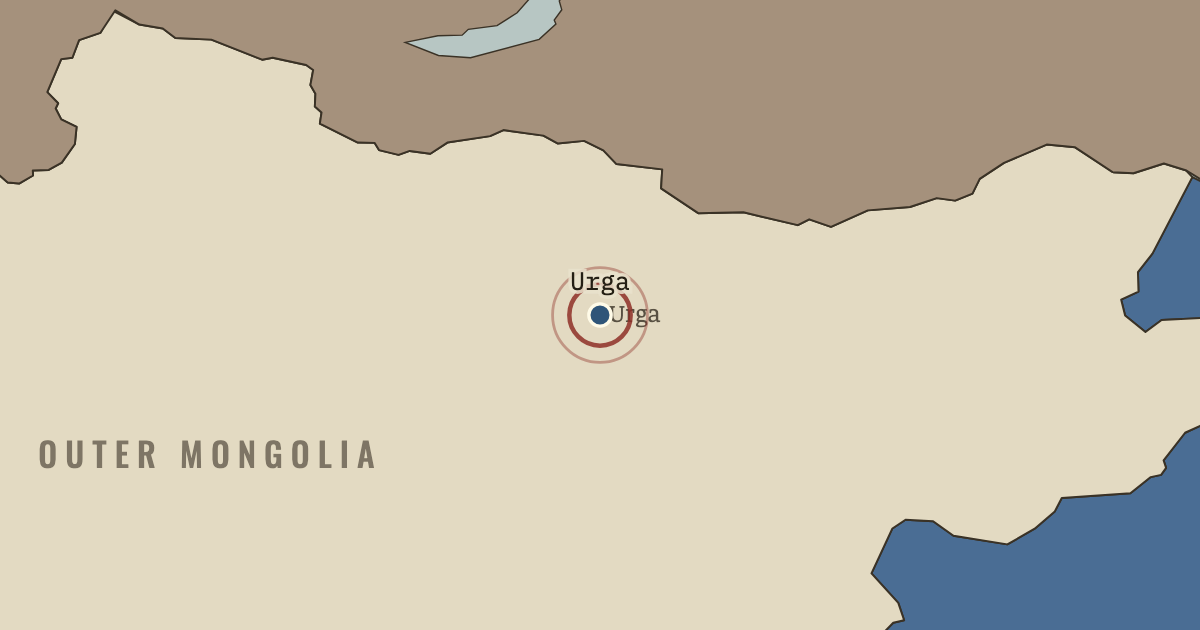
1 Dec 1911 — As the Qing falls, Outer Mongolia declares independence under the Bogd Khan; from 1921 a Soviet-protected people’s republic. The Qing empire does not pass whole to the Republic — watch the map’s edges break away before the center even fails.
THE MOMENT IN CONTEXT
The distinction that governs this whole atlas is the one between sovereignty, the legal right to rule a territory, and control, the practical power to enforce that rule. The single blue expanse of 1911 concealed a state that had almost lost the second. The Qing was the oldest continuous empire in the world, yet it had been defeated by Britain twice and by France and Japan besides. It had been carved into foreign spheres of influence and forced to pay the Boxer indemnity out of customs revenue that foreigners collected on its behalf. The tan rim around China marks that external pressure, from British India and Burma to French Indochina and the Russian empire along the northern arc. The charcoal marks the sharpest threat of all in Japan, which had annexed Taiwan in 1895 and Korea in 1910 and now watched Manchuria for its opening. Foreign power reached inside the country as well, since parts of Shanghai (the ● of the International Settlement) were governed by foreign councils and exempted from Chinese law. Every movement in this atlas grew out of the determination to undo that condition.
From Chapter 1 — The Fall of the Qing of China in Revolution, 1911–1949 (1911).
OPEN THE INTERACTIVE MAP →New here? Chapters 1–2 of every atlas are free to sample, and the WW2 atlas is free in full. One membership opens all thirteen — the Cartographer’s Circle.
TEACH THIS IN 5 MINUTES
- Why it happened — Defeat as a system, not an event. From the Opium War (1839–42) to the Boxer Protocol (1901), every generation of Qing statesmen lost a war and paid for it in ports, tariffs and legal…
- The turn — Wuchang, 10 October 1911. The hinge is not the bomb but the response: fifteen provinces seceded from the dynasty in six weeks, almost bloodlessly, because provincial elites…
- What it changed — A republic without republicans. The provisional government at Nanjing has a flag, a calendar and Sun Yat-sen. It has no army. Within six weeks it trades the presidency to Yuan…
Then ask the room: Was 1911 a revolution at all — or the collapse of a dynasty that revolutionaries happened to be standing near? The argued answer is on the chapter page →
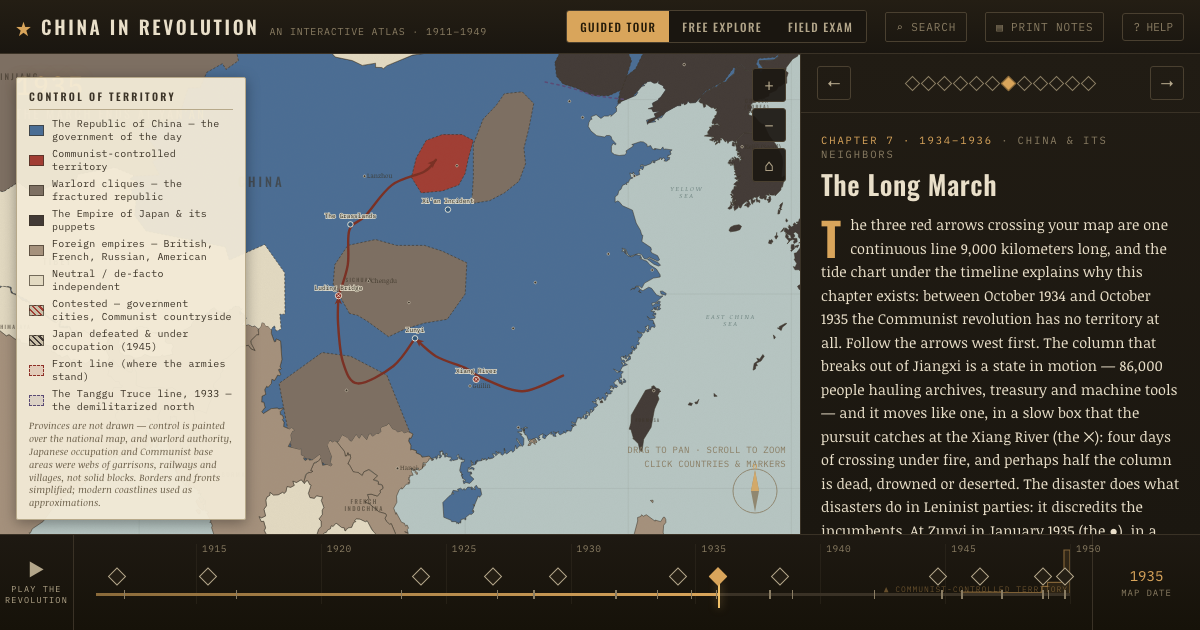
THE ATLAS THAT SHOWS IT
THE DISPATCH
One short letter when a new atlas opens — and the printable study guide for China in Revolution is yours now, free.
NO TRACKING · YOUR ADDRESS IS USED FOR THE DISPATCH AND NOTHING ELSE · UNSUBSCRIBE ANYTIME