Chinese Revolution · 1911
Was 1911 a real revolution or just the Qing’s collapse?
The seminar question: “Was 1911 a revolution, or primarily the collapse of the Qing dynasty?”
By 1911 decades of defeat by foreign powers had drained confidence in the Qing dynasty. On 10 October 1911 soldiers mutinied at Wuchang after a plot was exposed at Hankou, fifteen provinces abandoned the throne within six weeks, and the child emperor Puyi abdicated in February 1912.
WW2 is free in full, and chapter 1 of every atlas is free. A free account opens 3 more chapters a day. Starter, at $9 a month, opens all 21 with no daily limit — see the plans.
Free printable Chinese Revolution study guide, sent by email ↓
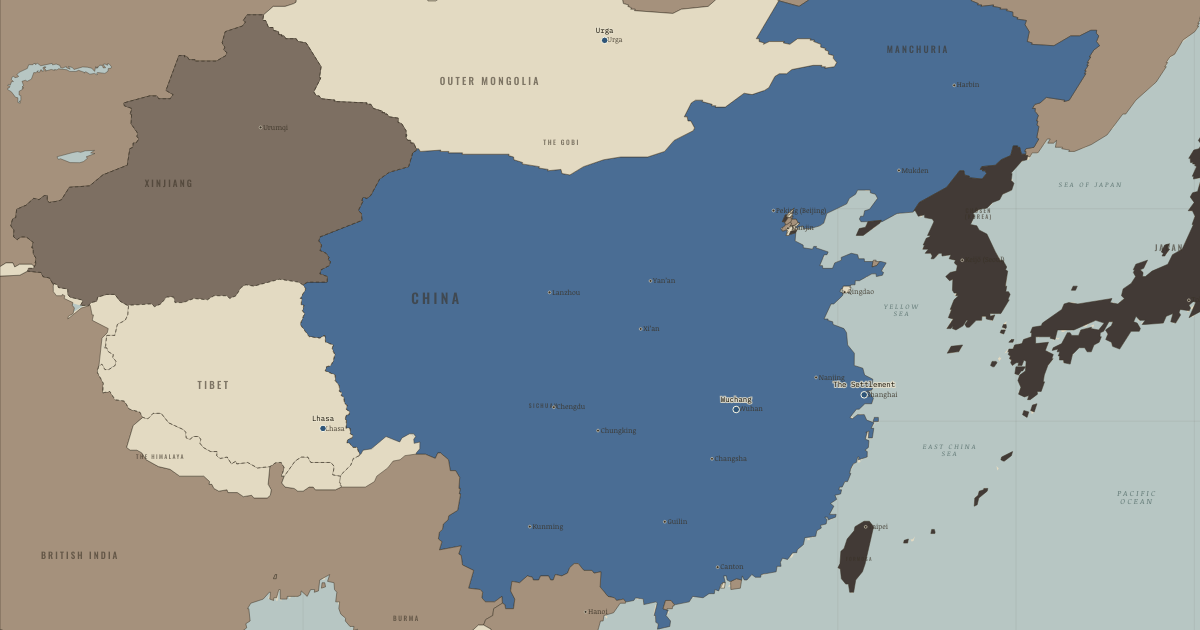
In 1911 the Qing empire appears on the map as a single blue expanse. Yet the legal claim to rule that expanse and the power to enforce it were already far apart. Britain had defeated the dynasty twice, and France and Japan had also defeated it. Foreign powers carved out spheres of influence, while customs revenue collected under foreign administration helped pay the Boxer indemnity. Even within Shanghai, foreign councils governed parts of the city (the ● of the International Settlement), and foreign residents there were exempt from Chinese law.
The short answer
- Defeats that accumulated. Between the Opium War of 1839–42 and the Boxer Protocol of 1901, defeat brought repeated demands for ports, tariff concessions, legal privileges for foreigners, and indemnities. These losses constrained the response to later threats: customs revenue pledged to compensation could not also pay for a navy. The fleet built in the 1880s had itself been sunk by Japan in 1895. After seventy years, the dynasty's claim to protect the civilization it ruled had been challenged in public again and again.
- Reform and its consequences. After 1901 the court tried to rebuild its authority through reform. It abolished the examination system in 1905, created New Armies on the German model, and promised a constitution. These measures changed the relationships on which the dynasty had relied. Scholars lost the examinations as a route to office, while students who went to Japan encountered revolutionaries. The provinces gained modern troops, some of whom turned against the throne at Wuchang. The old basis of rule was being taken apart before a new one had secured loyalty.
- The railway dispute. Railway policy brought the conflict between court and provinces into the open. In May 1911 the court nationalized provincial railway companies and pledged the lines to foreign lenders, taking over investments held by gentry in Sichuan and Hunan. The Railway Protection movement put provincial elites in the streets before the Wuchang rising. Troops sent from Hubei to suppress protest in Sichuan weakened the garrison left behind. A plan to finance railway construction had estranged people whose support the dynasty needed, while the response to protest altered the military position in Hubei.
- A revolutionary idea already in place. Sun Yat-sen's alliance had lost ten planned risings since 1895, but its influence extended beyond those failures. Student journals spread revolutionary ideas, overseas Chinese supplied remittances, and cells recruited within the New Army. These connections help explain why the discovery of a conspiracy could lead soldiers to mutiny. Few Chinese had electoral experience, so republicanism had shallow roots as a practiced form of government. Yet the throne had also lost much of the support on which it depended. As one revolutionary put it, the dynasty was not overthrown. It collapsed.
THE TURNING POINT
Wuchang, 10 October 1911. The bomb exposed the plot at Hankou, but the choices made across the empire turned the Wuchang mutiny into a national crisis. Fifteen provinces left the dynasty within six weeks as officers and local elites declined to defend it. Bringing down the throne did not settle who would govern in its place. The republicans needed an army to secure abdication, and Chapter 2 follows their bargain with the commander who had one: Yuan Shikai.
What it changed
A republic needs an army. At Nanjing, Sun Yat-sen's provisional government could give the republic a president, a flag, and a calendar. It lacked an army capable of compelling the emperor to abdicate. Yuan Shikai commanded the Beiyang Army and could bargain with both sides. Within six weeks Sun surrendered the presidency to Yuan in exchange for abdication, placing the new republic's future in the hands of a general.
The empire's edges detach. Outer Mongolia declared independence in 1911; Tibet expelled Qing forces and governed itself in 1912–13. Chinese governments refused to accept those departures. Warlord, Nationalist, and Communist regimes each inherited the claim to the Qing territories, although the reach of their control remained a consequential question through 1951 and beyond.
Japan sees an opening. China's provincial divisions gave Japan opportunities to increase its influence. Japanese forces seized Germany's position in Shandong in 1914, and Japan presented the Twenty-One Demands in 1915. Over the following decades Japanese military power would continue to shape China's struggle over its territory and government.
The full answer, argued
Much supports calling it a collapse. Sun's planned risings failed, the crisis at Wuchang began by accident, and provincial elites and Beiyang generals retained much of the power that passed from the throne. The new flag did not immediately produce a new social order. Yet Joseph Esherick and other historians ask us to look at what had disappeared. Monarchy and its appeal to the Mandate of Heaven ended; the examination system and the Confucian elite it sustained had already been dismantled. Yuan's later attempt to restore monarchy met resistance and failed within months. On this account, 1911 was a political revolution with limited immediate social reach. It ended an imperial order and opened the way for the deeper changes associated with May Fourth, the party-states, and land revolution over the following decades.
An interesting fact
When the Wuchang rising began, Sun Yat-sen was raising money among overseas Chinese in Denver, Colorado. He learned of it from a newspaper. He traveled home by way of London and Paris, seeking diplomatic recognition and an end to foreign loans to the Qing. After reaching Shanghai on 25 December 1911, he was elected provisional president four days later. Six weeks afterward he gave way to Yuan Shikai in the bargain for the emperor's abdication. The republic's best-known founder had been abroad during its decisive rising.
This is the study layer of Xinhai Revolution of 1911, chapter 1 of China in Revolution, 1911–1949; the full index of the atlas is here.
Related questions
THE FREE PRINTABLE STUDY GUIDE
Get the printable study guide for China in Revolution free. I’ll send you a few short letters, then one when a new atlas opens. That’s all. — Paul
NO TRACKING · YOUR ADDRESS IS USED FOR THE DISPATCH AND NOTHING ELSE · UNSUBSCRIBE ANYTIME