Crusades · 1150
Why were the military orders so effective yet so divisive?
The seminar question: “How could the military orders be at once the most effective and the most divisive institution in Outremer?”
The Templars, founded around 1120 to protect pilgrims, and the Hospitallers joined monastic vows to permanent military service. Donations, papal privileges and recruitment across Christendom let them hold frontier castles such as Krak des Chevaliers and move money, but their independence made them hard for kings to command.
Chapter 4 is included with every paid plan. WW2 is free in full, and chapter 1 of every atlas is free. A free account opens 3 more chapters a day. Starter, at $9 a month, opens all 21 with no daily limit — see the plans.
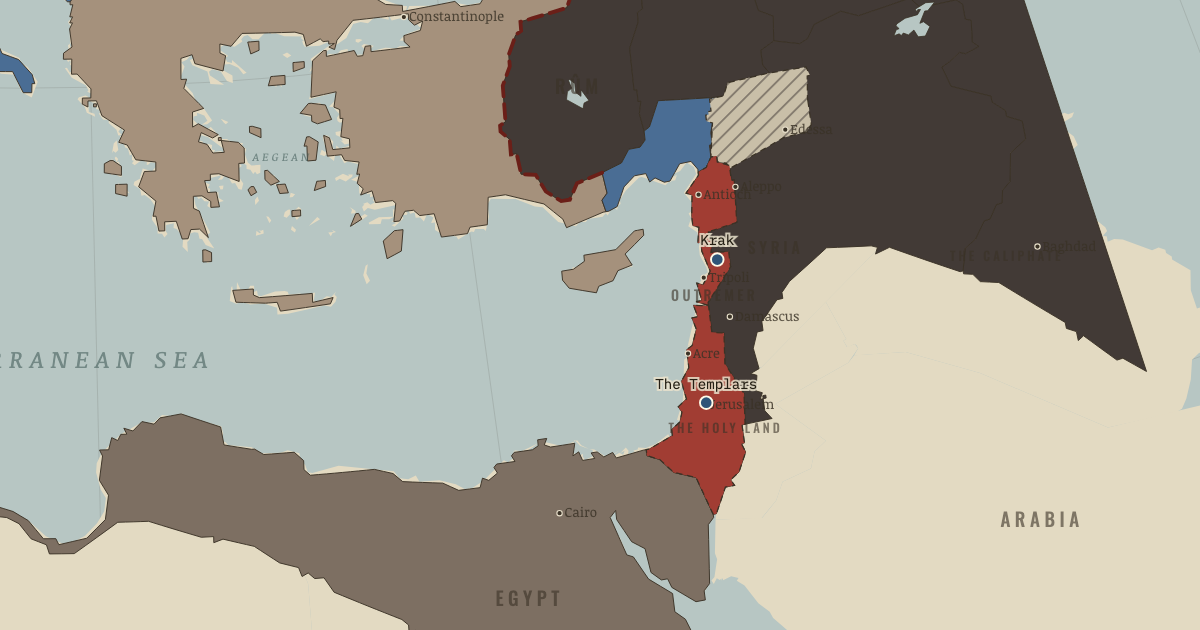
A pilgrim traveling through the Holy Land faced dangerous roads, and around 1120 a small group of knights vowed to protect such travelers. They were given quarters on the Temple Mount and became known as the Templars. The Hospitallers had a different beginning: a brotherhood connected with a Jerusalem hospital grew into a fighting order.
The short answer
- The demographic gap demanded permanence. A crusader’s vow did not keep him in Outremer forever, but the castles required men year after year. The orders recruited celibate brothers under religious discipline and renewed their ranks through recruitment rather than birth. They supplied a lasting response to the shortage of knights discussed in Chapter 3.
- Papal privilege built a supranational body. Papal exemptions protected the orders from tithes and aspects of local ecclesiastical authority. Their own leadership could gather resources and hold lands across Latin Christendom, beyond the limits of a single local lordship. This independence helped sustain the institutions and could also put them at odds with rulers.
- The need to move money safely. Pilgrims and armies needed funds far from home, yet roads and seas made carrying coin hazardous. The orders’ houses handled deposits and transfers for travelers and for their own organizations. They adapted services from a wider medieval system of long-distance credit to the needs of the journey and the war.
THE TURNING POINT
Krak des Chevaliers — permanence in stone. For more than a century the Hospitallers held Krak des Chevaliers. Individual brothers died and rulers changed, while new recruits continued to staff the fortress. Its history shows what an enduring order could place on the frontier—and the limit of that endurance. In 1271 a forged instruction helped persuade the defenders to surrender.
What it changed
Standing armies before the state. The orders kept disciplined forces, property and financial networks in use beyond any one leader’s lifetime. Drawing resources from many territories, they carried military work across generations long before national states developed comparable continuity.
Rivalry that could be fatal. Each order had resources and a judgment of its own, which made rivalry over their use consequential. Competition and decisions by the orders contributed to the costly defeat at the Springs of Cresson, weeks before Hattin. The kingdom needed these forces even when cooperation between them failed.
The idea outlives the Holy Land. The loss of Outremer did not end the orders. Hospitallers established themselves on Rhodes and later Malta; Teutonic Knights operated in Prussia. The Templars faced a different future: Philip IV attacked them from 1307, the order was suppressed in 1312, and its last grand master was executed in 1314. Institutions could find new places and purposes, but their survival still depended on political protection.
The full answer, argued
Papal protection and support from across Christendom gave the orders resources that could survive changes of rulers. They maintained castles and disciplined cavalry, providing a reliable core of defense for the kingdom. Yet the king could not simply command those forces as his own. The orders guarded their privileges, controlled their resources and formed judgments independently; rivalry with the crown or each other could obstruct a shared strategy. The independence that sustained their strength also made directing them harder.
An interesting fact
The Templar Rule reached into the details of a brother’s day. Roughly seventy clauses were approved at Troyes in 1129; the rule later grew to nearly seven hundred. A knight was allowed three horses and one squire. Pointed shoes and shoelaces were banned as worldly vanity, as was chess. Hunting was forbidden with one exception: the lion. Such instructions gave brothers in widely separated houses a common discipline, extending to matters a visitor might scarcely notice.
This is the study layer of Knights Templar and Hospitallers, chapter 4 of The Crusades, 1095–1291; the full index of the atlas is here.
Related questions
THE FREE PRINTABLE STUDY GUIDE
Get the printable study guide for The Crusades free. I’ll send you a few short letters, then one when a new atlas opens. That’s all. — Paul
NO TRACKING · YOUR ADDRESS IS USED FOR THE DISPATCH AND NOTHING ELSE · UNSUBSCRIBE ANYTIME