Russian Revolution · AUG 1919
Why did some borderlands win independence and others not?
The seminar question: “Why did Finland, the Baltics and Poland win lasting independence while Ukraine and the Caucasus were reconquered?”
As the imperial centre fell in 1917–21, Finland, the Baltic states and Poland won independence, while Ukraine was fought over by nationalists, Germans, Whites, Reds, Poles and peasant armies. Pogroms murdered perhaps a hundred thousand Jews, and the Reds reconquered Ukraine, the Caucasus and Central Asia.
Chapter 11 is included with every paid plan. WW2 is free in full, and chapter 1 of every atlas is free. A free account opens 3 more chapters a day. Starter, at $9 a month, opens all 21 with no daily limit — see the plans.
Free printable Russian Revolution study guide, sent by email ↓
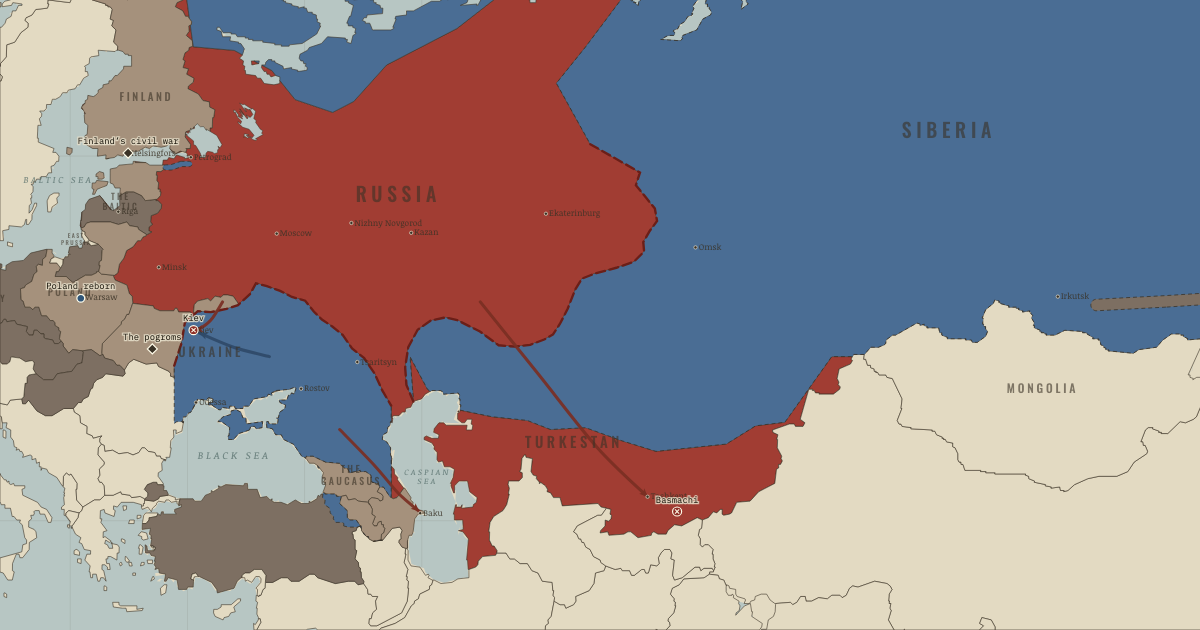
The Russian Revolution broke an empire as well as a government. Its collapse gave national movements opportunities that had long been denied them, but independence did not end the fighting. Finland declared itself independent in December 1917 and then fell into civil war between Red workers and a German-backed White army. The White victory was followed by prison camps in which thousands of the defeated died. The Baltic states fought Soviet and other forces to a standstill with their own riflemen and British naval help. Poland, restored after 123 years of partition among three empires, raised an army and fought on every frontier to determine where its borders would lie.
The short answer
- Empire’s collapse is the nations’ opportunity. The abdication, October and especially Brest-Litovsk removed the imperial authority that had constrained national movements. Finnish, Polish, Ukrainian, Georgian and Azeri movements could pursue statehood at once. Their struggles belonged to the outward movement of the Russian Revolution, while each also had its own political aims.
- Great-power sponsorship decided who survived. Independence had to be defended after it was declared. Finland had forests and distance, as well as German and later Western backing. The Baltic states and Poland had Western support and the buffer created by the Polish war. Ukraine lay open on the plain; the Caucasus republics were isolated. Determination mattered in every case, but geography and the availability of outside help shaped what that determination could achieve.
- The Reds’ double policy on nationality. The Bolsheviks promised nations self-determination while sending armies to recover territories that had broken away. They made those lands “sovereign” Soviet republics under party control. This cynical arrangement had practical uses: it allowed Red forces to claim the role of liberators, divide moderate nationalists from separatists and rebuild imperial territory in a federal form.
- Ethnic hatred with no state to restrain it. With state authority and police gone in much of Ukraine, armed groups living off the land faced fewer restraints. They turned inherited antisemitism against Jewish communities, making mass murder one of the defining atrocities of the borderland wars.
THE TURNING POINT
Kiev — the borderlands’ ordeal in one city. The Rada, Bolsheviks, Germans, Hetman, Directory, Whites, Poles and Reds all held Kiev during a succession of more than a dozen changes of power in three years. For its inhabitants, each arrival could bring requisitions, conscription and, too often, a pogrom; then another force would displace the last. The city shows what it meant to seek Ukrainian freedom while larger armies fought over the country. Unlike Finland and Poland, Ukraine was reconquered, and Kiev ended the war inside the successor to the empire whose collapse had brought such suffering.
What it changed
A ring of new nation-states — and a new border. Finland, Estonia, Latvia, Lithuania and Poland emerged as independent states and remained so until 1939–40. Their survival changed the map of eastern Europe, leaving a borderland that would be contested in the next war.
The empire rebuilt as a federation. Ukraine, Belorussia and the three Caucasus republics were reconquered and refounded as Soviet republics. They joined the USSR in 1922. The promised self-determination had become a federal empire, a structure that held together until its dissolution seventy years later.
A memorial that must not be softened. The scale of the 1918–20 pogroms prefigured worse to come. Nearly every armed force committed them, though the disciplined Red Army was, on the whole, an exception. The Bolsheviks used that difference, which helped draw many Jews toward the Soviet side. The victims deserve remembrance in their own right, rather than a place in a contest between factions.
The full answer, argued
Great-power backing was the most important of three factors. Finland, the Baltics and Poland had Western support, and Finland had earlier German backing; the reconquered states had little or none. Poland also fielded an army capable of defeating the Red Army. Geography came next: Finland's forests and the space behind the 1920 Polish war gave Finland, the Baltics and Poland defensible positions, while Ukraine lay on the open plain across the Reds' interior lines and the Caucasus republics were isolated and encircled. Finally, Red priorities and capacity mattered. The Bolsheviks could reach Ukraine's grain and Baku's oil and placed great value on recovering them; after Warsaw they cut their losses on the Baltic rim. National determination was necessary everywhere, but it could not decide these struggles alone. The survivors combined it with protection and a defensible line, showing how much self-determination in 1921 depended on the powers willing to defend it.
An interesting fact
Finland almost began independence as a monarchy. In October 1918 its parliament elected Friedrich Karl of Hesse, a German prince and the Kaiser's brother-in-law, as king. Germany collapsed the following month, making the choice untenable before he had set foot in the kingdom. He renounced the throne in December, and Finland became the republic it has remained ever since. Even the new state's form of government was affected by the changing fortunes of a great power.
This is the study layer of Dissolution of the Russian Empire, chapter 11 of The Russian Revolution, 1855–1924; the full index of the atlas is here.
Related questions
THE FREE PRINTABLE STUDY GUIDE
Get the printable study guide for The Russian Revolution free. I’ll send you a few short letters, then one when a new atlas opens. That’s all. — Paul
NO TRACKING · YOUR ADDRESS IS USED FOR THE DISPATCH AND NOTHING ELSE · UNSUBSCRIBE ANYTIME