WWI · AUG 1907
Did Bismarck’s alliances keep the peace or cause WWI?
The seminar question: “Did Bismarck’s alliance system keep the peace, or did it build the trap that closed in 1914?”
After German unification in 1871, Bismarck sought to keep a vengeful France without allies, tying Austria-Hungary and Russia to Berlin and adding the Dual Alliance of 1879 and the Triple Alliance with Italy in 1882. The web held only while he kept repairing it, and by 1907 Europe had divided into two blocs.
WW2 is free in full, and chapter 1 of every atlas is free. A free account opens 3 more chapters a day. Starter, at $9 a month, opens all 21 with no daily limit — see the plans.
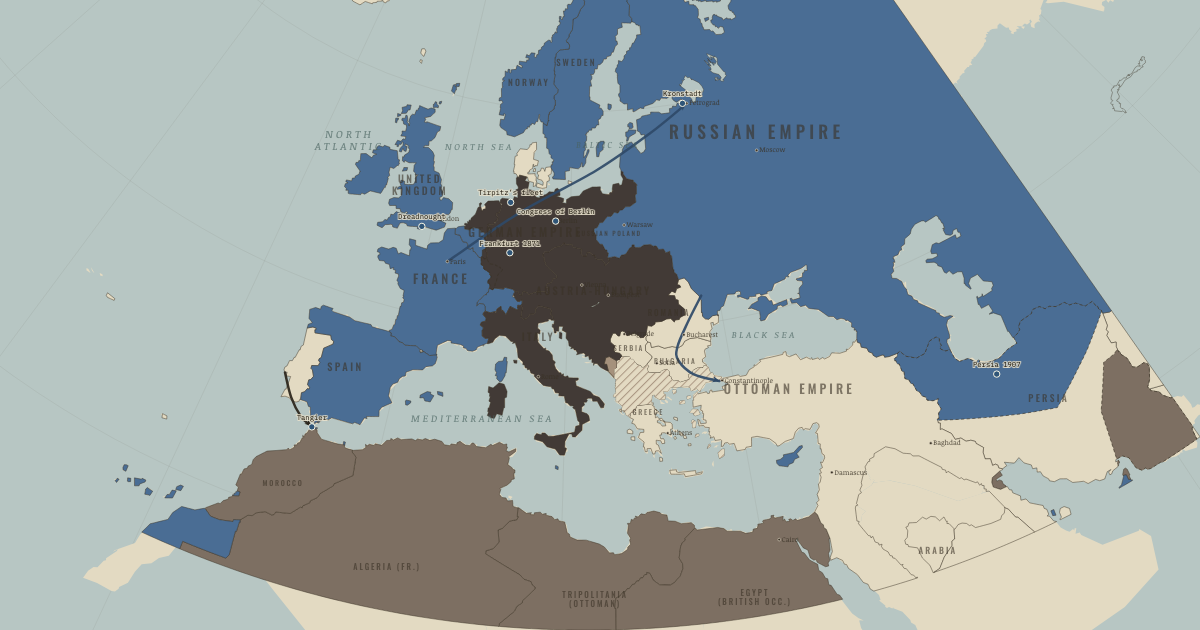
Bismarck wanted Germany to belong to the larger group in a Europe of five great powers. France had lost Alsace and Lorraine to Germany in 1871; if it found a strong partner, it might try to recover them by force. Germany therefore needed good relations with both Austria-Hungary, the Habsburg empire ruled from Vienna, and Russia. In 1873 the three emperors formed a league to consult and preserve peace. Their interests were hardest to reconcile in the Balkans, where both Austria-Hungary and Russia sought influence as the Ottoman Empire, ruled from Constantinople, retreated. Russia’s victory over the Ottomans in 1878 seemed likely to give it a large client Bulgaria. The powers reduced Bulgaria at the Congress of Berlin, and Russia blamed Germany. Bismarck then made a choice that complicated his own task: the secret Dual Alliance of 1879 promised Austrian defense against Russia. Italy joined in 1882, creating the Triple Alliance.
The short answer
- A new giant in the middle of Europe. The new Germany changed the scale of the European problem. Its population grew from about 41 million in 1871 to about 65 million by 1910, while France’s remained near 39 million. By 1913 it produced more than twice as much steel as Britain. The largest population west of Russia and Europe’s fastest-growing industry did not determine a particular alliance; they did require other powers to decide how to live beside a formidable neighbor. Bismarck’s system was one answer.
- Alsace-Lorraine and the French grievance. Germany’s victory brought unity at the price of a lasting French grievance. Under the Treaty of Frankfurt, France surrendered Alsace and most of Lorraine, with about 1.5 million inhabitants, and owed five billion francs in indemnity. It paid within three years, but could not recover the provinces. Their loss remained a wound in French politics, and Bismarck devoted twenty years to containing the hostility the victory had helped create.
- The Eastern Question. The Ottoman Empire had governed the Balkans for centuries. As it retreated, diplomats asked who would inherit its lands: this was the Eastern Question. Russia saw itself as protector of Orthodox Slavs and wanted free passage for its warships through the Straits. Austria-Hungary feared that strong Slav states on its border would unsettle Slavs within its own empire. Both were German partners, so each Balkan crisis threatened to set Bismarck’s allies against one another.
- The Kaiser’s new course. Wilhelm II became emperor in 1888 at twenty-nine and intended to rule in person. He forced Bismarck to resign in March 1890. His new chancellor, Leo von Caprivi, and foreign office adviser Friedrich von Holstein wanted simpler, more transparent commitments; they saw the Reinsurance Treaty as incompatible with the Austrian alliance. Dropping it made Germany’s policy easier to state, while removing a secret link that had discouraged Russia from seeking France. Within two years Bismarck’s system had ended.
THE TURNING POINT
Kronstadt, July 1891. The French squadron at Kronstadt in July 1891 offered a striking public sign of Russia’s change of direction. Only thirteen months after the German treaty lapsed, Tsar Alexander III stood bareheaded as a naval band played the Marseillaise, a revolutionary anthem banned in his own empire. A military agreement followed within a year. An absolute monarchy and a republic had found common strategic ground despite the ideology that divided them.
What it changed
A war plan built on two fronts. The Franco-Russian alliance made a two-front war central to German planning. Alfred von Schlieffen’s answer, set out by 1905 and put into action in August 1914 (Chapter 4), was to defeat France first by sweeping through Belgium, then turn east before Russia’s slower mobilization was complete. The plan contemplated violating Belgian neutrality long before the crisis that brought war.
Britain bound by conversations. Britain had made no promise in the ententes to fight for France. But secret staff talks from 1906 and later naval arrangements gave both countries expectations about cooperation. When Britain went to war over Belgium in August 1914 (Chapter 3), its army already had plans to fight beside the French. The conversations had made intervention easier to imagine, even without a formal obligation.
A naval race that Germany lost. By 1912 the Royal Navy had concentrated its battleships in the North Sea, treating Germany as its most likely enemy. Tirpitz had wanted his fleet to win British respect; the result helped bring about the danger he hoped to deter. In the war (Chapter 8), the German High Seas Fleet was too small to win and too valuable to risk. It spent most of the war in harbor while Britain’s blockade strangled German trade.
Every crisis becomes a test of loyalty. A diplomatic setback could now be seen as a danger to an entire alliance. Germany failed to split the Entente at Tangier, and both sides drew the lesson that partners needed firmer support. Colonial and Balkan disputes became tests of loyalty. Chapter 2 follows three crises in six years and the lessons carried toward war.
The full answer, argued
The peace under Bismarck was real: no great-power war broke out between 1871 and 1890, and Germany used alliances to restrain partners as well as protect itself. Yet the Dual Alliance tied Germany to Austrian fears in the Balkans, while the secret Reinsurance Treaty created commitments difficult to reconcile with it. Christopher Clark stresses the change after Bismarck: his successors let Russia go and alarmed Britain, helping form the later blocs. Historians following Fritz Fischer emphasize continuity in German ambition from the 1890s to 1914. Bismarck postponed the tensions created by unification without resolving them. His personal skill sustained the arrangement; institutions that can operate beyond their inventor offer a more durable basis for security.
An interesting fact
The battleship that gave the dreadnought race its name never fought another battleship. HMS Dreadnought was being refitted when the British and German fleets met at Jutland in 1916. Its only combat success had come in March 1915, when it rammed and sank U-29 in the North Sea—the only confirmed sinking of a submarine by a battleship. U-29’s commander, Otto Weddigen, had already become famous for sinking three British cruisers in one morning in September 1914. Dreadnought became obsolete within a decade and was sold for scrap in 1921.
This is the study layer of Alliance system before WWI, chapter 1 of The Great War, 1871–1923; the full index of the atlas is here.
Related questions
THE FREE PRINTABLE STUDY GUIDE
Get the printable study guide for WWI free. I’ll send you a few short letters, then one when a new atlas opens. That’s all. — Paul
NO TRACKING · YOUR ADDRESS IS USED FOR THE DISPATCH AND NOTHING ELSE · UNSUBSCRIBE ANYTIME