WW2 · AUG 1945
Did the bomb, the Soviet invasion or blockade end WW2?
The seminar question: “What ended the Pacific war: the atomic bombs, Soviet invasion, or blockade? Why does the answer matter?”
By 1945 blockade and bombing had devastated Japan, and Iwo Jima and Okinawa showed how costly an invasion would be. The United States destroyed Hiroshima and Nagasaki with atomic bombs on 6 and 9 August, the Soviet Union invaded Manchuria, and Emperor Hirohito intervened to accept surrender, announced on 15 August.
WW2 is free — every chapter. No sign-up.
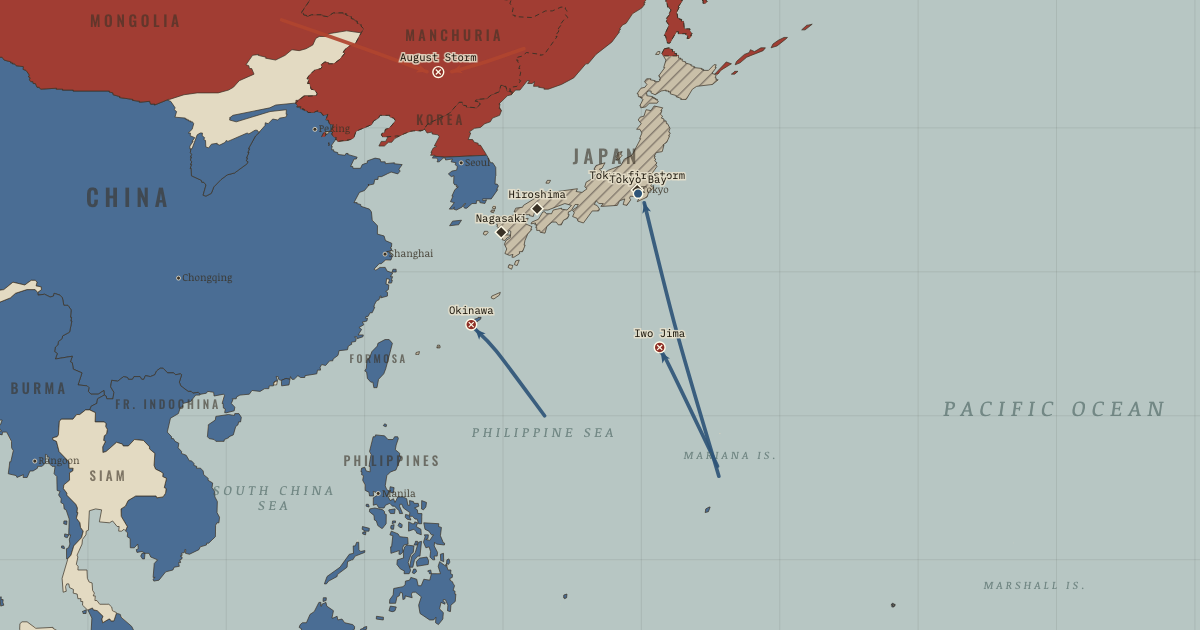
By the time American aircraft attacked Japan’s cities with atomic bombs, the country had already endured a devastating campaign. Submarine warfare and blockade cut off food, fuel, and raw materials. B-29 incendiary raids burned urban areas, killing around 100,000 people in Tokyo on 9–10 March alone. These were civilian deaths on an enormous scale.
The short answer
- A government of two minds. Japan’s civilian leaders looked to Moscow to mediate a peace by spring 1945. They did not know that Stalin had promised at Yalta to attack Japan. Military leaders instead wanted a decisive battle on the home islands, hoping its cost would persuade the Allies to offer better terms. Neither faction could settle the question alone, and an external shock would break the deadlock.
- Unconditional surrender and the Emperor. The Potsdam Declaration demanded unconditional surrender and left the throne’s future unstated. Japanese leaders regarded the emperor as central to the nation and feared what the silence might mean. The eventual settlement kept him in place, helping make acceptance possible; while the decision was being made, that outcome had not been clearly promised.
- The bomb’s momentum. The Manhattan Project began with the fear that Germany might build an atomic bomb, but its weapon was ready only after Germany’s defeat. By then $2 billion had been spent, and Truman had invasion casualty projections before him. He later said the decision “was never a decision”. The project’s momentum formed part of the setting in which the bomb was used. Target selection and the absence of a demonstration remain subjects of moral debate.
THE TURNING POINT
Hiroshima, 08:15, 6 August. At 08:15 on 6 August, one aircraft dropped one bomb on Hiroshima. Roughly 70,000 people died immediately. By the end of the year, deaths from burns and radiation had brought the toll to about twice that number. Whatever its relative weight in the surrender decision, the attack marked the arrival of a new weapon. Nuclear arms would change calculations of war and peace and eventually make human self-destruction plausible.
What it changed
Surrender — and a preserved throne. The postwar settlement transformed Japan’s institutions while retaining the throne. Under American-led occupation, Japan was demilitarized and given a democratic constitution renouncing war; the emperor remained as a symbol. By 1951 the former enemies were allies. The combination invites us to consider the war aims the Allies achieved and the vengeance they forgave.
The Soviet week. The Soviet offensive called August Storm overran Manchuria in eleven days. Soviet forces also occupied Korea north of the 38th parallel, a hastily chosen American line on the map that became a lasting, heavily fortified border. The Korean and Vietnamese wars grew from struggles left unresolved by the 1945 settlement.
The nuclear age. The United States did not retain a monopoly on the weapon: the Soviet Union tested its own atomic bomb in 1949, four years after the war. Deterrence and arms races, and eventually the prospect of mutually assured destruction, shaped relations between rival powers over the next half-century.
The full answer, argued
The pressures worked together. Blockade and bombing weakened Japan before August; Soviet entry ended the hope of mediation and threatened attack from another direction; the atomic bombs added unprecedented shock and a public explanation for surrender. The weight given to each cause changes how we judge nuclear necessity, deterrence, and the reasons governments stop fighting.
An interesting fact
In the spring after Hiroshima’s destruction, green shoots appeared on trees that had survived close to the hypocenter. About 160 within two kilometers lived, among them ginkgos, camphors, and a weeping willow, despite a rumor that nothing would grow in the city for seventy-five years. These hibakujumoku, “survivor trees,” are registered with nameplates. Their seeds and saplings are sent to cities around the world as living memorials; many still lean toward the hypocenter, a physical trace of the blast.
This is the study layer of End of WW2 in the Pacific, chapter 14 of The War Room — WW2, 1936–1945; the full index of the atlas is here.
Related questions
THE FREE PRINTABLE STUDY GUIDE
Get the printable study guide for WW2 free. I’ll send you a few short letters, then one when a new atlas opens. That’s all. — Paul
NO TRACKING · YOUR ADDRESS IS USED FOR THE DISPATCH AND NOTHING ELSE · UNSUBSCRIBE ANYTIME