Mao’s China · 1956
Was Mao’s China a nation-state or an empire at its edges?
The seminar question: “Was the People’s Republic of the 1950s a nation-state or an empire on its frontiers?”
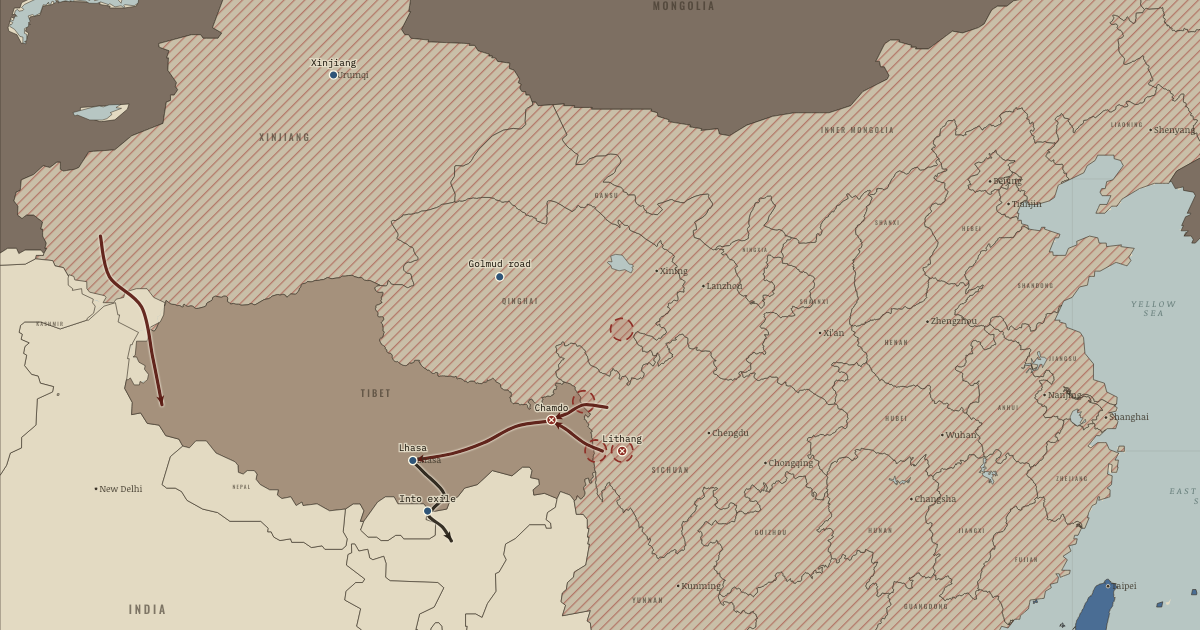
The People’s Republic claimed every frontier once ruled by the Qing. Xinjiang came over without a battle in 1949 and was settled by soldier-farmers, while Tibet, self-governing for nearly four decades, was taken by force and a bargain; revolt spread in 1956, and in 1959 the Dalai Lama went into exile in India.
Chapter 3 is included with every paid plan. WW2 is free in full, and chapter 1 of every atlas is free. A free account opens 3 more chapters a day. Starter, at $9 a month, opens all 21 with no daily limit — see the plans.
The Qing empire had governed Han Chinese alongside Mongols, Tibetans, Uyghurs and other peoples until 1912. Its successor, the Republic of China, lost control of Outer Mongolia, Tibet and much of Xinjiang. The Communists claimed the old imperial borders for the new People’s Republic. That ambition left a question: how would a state presenting itself as a nation govern peoples whose histories were bound to those borders in different ways?
The short answer
- The Qing borders as a national claim. Nationalists and Communists both claimed the Qing empire’s borders at their height as China’s rightful borders. On that view, Tibetan self-government after 1913 was a loss incurred during national weakness. Recovering the frontier would show that the century of humiliation had ended. Tibet also mattered strategically: it bordered India, and its plateau commanded approaches to southwest China.
- A Tibet that could not defend itself. Tibet’s own choices and its international position left Lhasa poorly equipped in 1950. Its army numbered about 8,000 to 10,000 men and had few modern weapons. The elite had resisted military reforms in the 1920s, fearing that a strong army would weaken the monasteries. Britain, Tibet’s old patron, had left India in 1947; Nehru’s new Indian government sought good relations with Beijing. With no ally willing to fight, Tibet had no force capable of stopping the PLA at Chamdo.
- Campaigns built for Han villages. Party work teams had developed land reform and collectivization around landlords and tenants in Han villages. Kham and Amdo included pastoral nomads, powerful monasteries and people accustomed to carrying arms. When officials treated lamas and chieftains as class enemies and tried to confiscate guns and monastery land in 1955–56, reform appeared as an attack on a way of life. Resistance followed, and the methods used to reorganize villages could not contain it.
- Settler colonies and new roads. Settlement and roads gave Beijing different means of holding the frontier. Xinjiang’s Production and Construction Corps, formed from demobilized soldiers in 1954, settled hundreds of thousands of Han migrants over subsequent decades. Highways from Qinghai and Sichuan opened in Tibet in December 1954, and a road across Aksai Chin was completed in 1957. Trucks could now bring troops and supplies, making later interventions easier.
THE TURNING POINT
Lithang, February–March 1956. Lithang showed how difficult it was to confine the effects of reform to one side of a provincial line. In February–March 1956 the army besieged and bombed the monastery. Beijing could still describe its policy inside Tibet as patient and voluntary, but refugees from Kham carried news of bombed monasteries and fighting to Lhasa, and determined fighters organized an army. Mao postponed reform inside Tibet after resistance had already crossed the boundary. The conflict continued toward the Lhasa rising of March 1959 and the Dalai Lama’s exile.
What it changed
Tibet transformed after 1959. Beijing used the rising to end the 1951 settlement. It dissolved the old government, undertook land reform in Tibet in 1959–61, closed most monasteries and established the Tibet Autonomous Region in 1965. In 1962 the Panchen Lama, the senior lama who remained, sent Zhou Enlai a long petition about hunger and the destruction of religion in Tibetan areas. He spent most of the next fifteen years in prison or detention. Within six years the Tibet preserved by the agreement had disappeared.
War with India. India’s discovery in 1958 of a Chinese road across Aksai Chin, a plateau claimed by India, and its later grant of asylum to the Dalai Lama strained the friendship of the early 1950s. Patrols from both countries pushed forward in the border dispute. The PLA attacked in October 1962, routed Indian forces in the northeast and Ladakh, then withdrew. The earlier slogan “Indians and Chinese are brothers” had not survived the decade.
A government in exile. Exile gave Tibet an international voice it had lacked in 1950. At Dharamsala in northern India, the Dalai Lama established a government-in-exile and later a parliament, schools and monasteries for some 80,000 refugees. The regional rising became a lasting international cause, and the question of Tibet has followed every Chinese government abroad since 1959.
Xinjiang’s changing population. The Corps and subsequent migration changed who lived in Xinjiang. Han people rose from about 6 percent of the population in 1953 to roughly two-fifths by the late 1970s. Yet control remained fragile: in 1962, amid hunger after the famine, tens of thousands of Uyghurs and Kazakhs fled into the Soviet Union. Beijing sealed the border, and Xinjiang became a front line of the Sino-Soviet split.
The full answer, argued
The constitution and the exercise of power suggest different answers. The PRC’s 1954 constitution recognized minority nationalities; autonomous regions included local officials, and minority languages received support in schools and publishing. By its law and self-description it was a multi-national state. But Han Party secretaries and the army made decisions in Lhasa and Urumqi, settlement changed Xinjiang’s population, and aircraft and artillery met Tibetan resistance to campaigns in 1956–59. Those relationships resemble imperial rule. Goldstein emphasizes Beijing’s caution in Tibet proper until 1959; Shakya and other historians stress that caution prevailed where Chinese control was weakest. Like the Soviet Union, the PRC claimed to end empire while retaining its borders and methods. The name a constitution gives a state and the way its center governs its peoples can point in different directions.
An interesting fact
The Dalai Lama’s life spanned both sides of the 1951 bargain. Born in 1935 at Taktser, a farming village in Amdo in today’s Qinghai province, he was found there by a search party of monks in 1937 and enthroned as a small child. The Chinese invasion led him to take full power in 1950 at fifteen, nearly three years before the customary age of eighteen. In 1954–55 he spent months in Beijing, met Mao several times and became a vice-chairman of the National People’s Congress, evidence of both sides’ effort to make the settlement work. He fled in 1959 and has lived in India for more than six decades, far longer than he ruled in Lhasa.
This is the study layer of Tibet and Xinjiang under Mao, chapter 3 of The People’s Republic under Mao, 1949–1976; the full index of the atlas is here.
Related questions
THE FREE PRINTABLE STUDY GUIDE
Get the printable study guide for The People’s Republic under Mao free. I’ll send you a few short letters, then one when a new atlas opens. That’s all. — Paul
NO TRACKING · YOUR ADDRESS IS USED FOR THE DISPATCH AND NOTHING ELSE · UNSUBSCRIBE ANYTIME