Mao’s China · 1958
How far was Mao responsible for the Great Leap’s failure?
The seminar question: “How far was Mao personally responsible for the Great Leap Forward and its failure?”
The Great Leap Forward of 1958–60 was Mao’s attempt to industrialise China at breakneck speed through mass labour. Co-operatives became giant communes from April 1958, the deadline to overtake Britain in steel kept shrinking, and at Lushan in 1959 Mao dismissed his defence minister for criticising the Leap.
Chapter 6 is included with every paid plan. WW2 is free in full, and chapter 1 of every atlas is free. A free account opens 3 more chapters a day. Starter, at $9 a month, opens all 21 with no daily limit — see the plans.
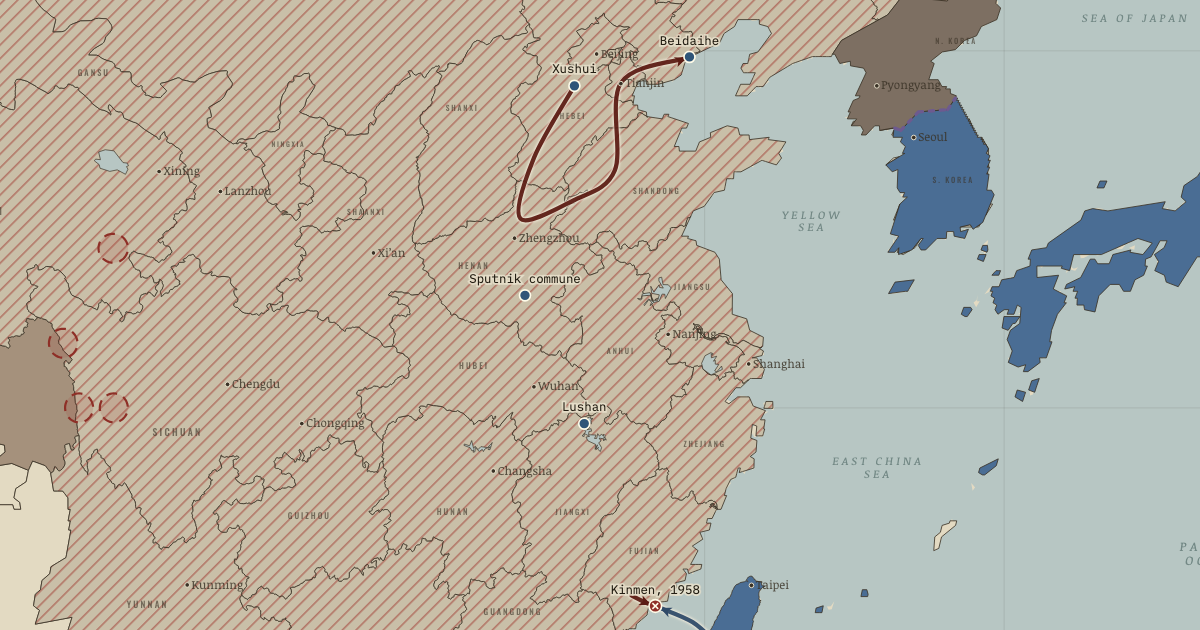
Mao’s Great Leap Forward sought to industrialize China in 1958–60 by mobilizing its people. He had become impatient with the Soviet model of central planning, in which ministries set factory output much as a head office assigns targets to branches. Collectivization appeared to offer another possibility: during 1955–56 family farms had been merged into cooperatives owned and worked by their members, like farmers’ cooperatives made compulsory.
The short answer
- The easy victory of collectivisation. Collectivization had taken eighteen months and ended without the famine that followed Stalin’s. During the winter of 1957–58, tens of millions of peasants were then mobilized for irrigation. Mao took these experiences as evidence that organization and enthusiasm could accomplish in months what planners expected to take years. The cooperatives were also ready-made units for merger into communes, and officials who had raced to enroll villages in 1955 were ready to race again.
- Overtaking Britain. The deadline came from rivalry within the Communist world. At the November 1957 Moscow conference of Communist parties, Khrushchev claimed that the Soviet Union would overtake the United States in fifteen years. Mao responded that China would overtake Britain in steel over the same period. Steel became a measure of success in the resulting race, and the target date was brought forward repeatedly in 1958.
- A Party that had silenced its critics. Economists, engineers and journalists who might have challenged impossible targets had been removed or frightened by the Anti-Rightist Campaign of 1957. Caution was dangerous inside the Party too. Mao’s January 1958 attack on Zhou Enlai and Chen Yun for “opposing rash advance” showed that even senior leaders could be humiliated. Silence at the top encouraged silence below, where the penalties for doubt were harsher still.
- Mao’s faith in human will. Mao’s experience at Yan’an had convinced him that a determined, well-organized people could defeat stronger enemies. Applied to the economy, that conviction became a belief that “politics in command” and mass mobilization could substitute for capital, machinery and expertise. Close planting and deep ploughing, borrowed from discredited Soviet agronomy, were imposed everywhere as proof of revolutionary methods’ superiority to conventional science. Many agronomists who objected had been labeled rightists the previous year, removing a scientific check.
THE TURNING POINT
Lushan, July–August 1959. At Lushan in July–August 1959, the Leap could still have been halted without catastrophe. Peng Dehuai’s moderate letter had the private support of many leaders. Mao treated it as an attack on his authority, making officials’ loyalty the issue instead of the feasibility of the targets. The ensuing campaign against right opportunism pushed officials at every level to revive inflated targets and requisitions. The meeting set the course toward the famine of 1959–61.
What it changed
The Great Famine. The countryside began to starve in the winter of 1958–59. Private food supplies had been abolished, communal mess halls were running out and quotas rested on false harvest reports. After Lushan, requisitions were pressed harder. Between 1959 and 1961 an estimated 15 to 45 million people died in the largest famine in recorded history; provinces whose leaders had been most zealous in 1958 suffered most.
Lin Biao takes the army. When Peng fell, Lin Biao became defense minister. He built his position by promoting the study of Mao’s thought in the army, culminating in the Little Red Book of quotations in 1964. The cult unleashed during the Cultural Revolution had first been organized in the barracks after Lushan. By 1969 Lin was Mao’s named successor; two years later Mao turned against him, suspecting the army’s new power threatened his own.
Mao on the second line. Mao called his withdrawal from daily government the “second line”. In April 1959 he gave Liu Shaoqi the post of head of state, saying he wanted to concentrate on theory. When famine forced a retreat, Liu, Deng Xiaoping and Chen Yun managed it. Their growing authority became a source of Mao’s resentment and helped set up the struggle of 1966, when the managers of the famine became targets of the Cultural Revolution.
Khrushchev’s scorn. The Leap sharpened the quarrel with Moscow. Khrushchev mocked the communes publicly in 1959, and Mao suspected that Peng Dehuai had discussed his criticisms with Soviet leaders during a spring visit to Eastern Europe. Soviet experts were withdrawn in 1960. Each side regarded the other’s policies as a betrayal of revolution, and the alliance never recovered.
The full answer, argued
Mao bears primary responsibility for the decisions that launched and sustained the Leap. He devised its central ideas, attacked cautious colleagues in January 1958, and promoted the communes and steel target. At Lushan he purged Peng Dehuai and revived the campaign while a correction was under way. Teiwes and Sun conclude that no other leader could have started or stopped it. The policy nevertheless required many participants. Wu Zhipu in Henan and Li Jingquan in Sichuan competed to exceed targets; county officials invented harvests; colleagues in Beijing remained silent about their doubts. Andrew Walder and other historians therefore stress the party-state’s incentives: a system rewarding zeal and punishing honesty would have produced inflated claims under any leader conducting such a campaign. That system helps explain why Mao’s decisions went unchallenged, while his choices remain the primary responsibility.
An interesting fact
The “Four Pests” campaign targeted rats, flies, mosquitoes and sparrows, accused of eating grain. For three days in April 1958 Beijing residents banged pots, beat drums and waved flags from roofs and trees, keeping sparrows from landing until they fell from exhaustion. The birds also ate insects, and locust and pest damage worsened. Scientists including the ornithologist Zheng Zuoxin warned the leadership; in 1960 sparrows were quietly replaced on the list by bedbugs. The episode became a standard example in China and abroad of a campaign overriding expert advice.
This is the study layer of Great Leap Forward, chapter 6 of The People’s Republic under Mao, 1949–1976; the full index of the atlas is here.
Related questions
THE FREE PRINTABLE STUDY GUIDE
Get the printable study guide for The People’s Republic under Mao free. I’ll send you a few short letters, then one when a new atlas opens. That’s all. — Paul
NO TRACKING · YOUR ADDRESS IS USED FOR THE DISPATCH AND NOTHING ELSE · UNSUBSCRIBE ANYTIME