Mao’s China · 1949
Did land reform win the villages by land or by violence?
The seminar question: “Did land reform secure the countryside for the Party chiefly through the land it gave or through the violence it organised?”
After Mao proclaimed the People’s Republic on 1 October 1949, the PLA still had to take the south-west and Hainan, while the Nationalists withdrew to Taiwan. The Party ruled at first through the “New Democracy” coalition and the Common Program, while land reform assigned class labels that lasted a generation.
WW2 is free in full, and chapter 1 of every atlas is free. A free account opens 3 more chapters a day. Starter, at $9 a month, opens all 21 with no daily limit — see the plans.
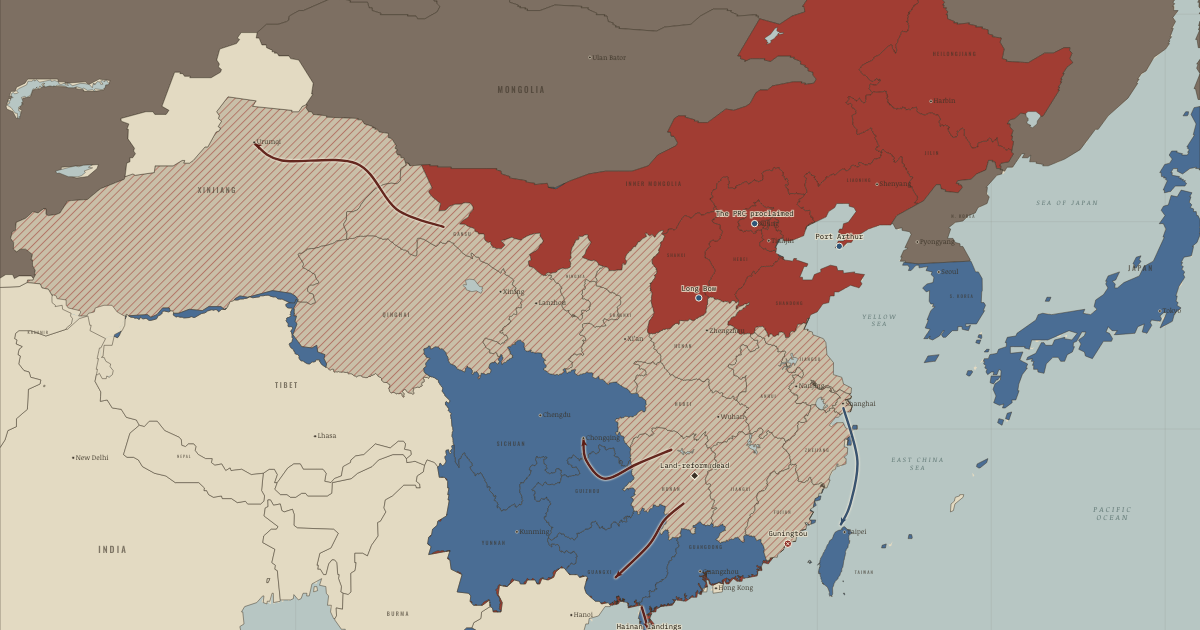
A proclamation could announce a government; it could not by itself give that government control of the country. The People’s Liberation Army (PLA), the Communist Party’s army, had grown from something like a party militia to a force of about five million. In October 1949 it still had campaigns to fight. Follow the arrows into the southwest: Liu Bocheng and Deng Xiaoping’s forces entered Guizhou and Sichuan, taking Chongqing on 30 November and Chengdu on 27 December. Lin Biao’s forces swept into Guangxi and crossed to Hainan in April 1950.
The short answer
- An army that had already won. The Communist victory rested on an army of about five million. In the great battles of 1948–49 the PLA destroyed the Nationalist field armies, giving the new state a single force under one command across almost all China—something no Chinese government had possessed since 1911. The army also offered a way to govern: its units had political commissars, and generals ran the six great regions until 1954.
- A country exhausted by war and inflation. After eight years of war against Japan and three of civil war, many Chinese wanted order regardless of the ideology that brought it. The Nationalists’ gold yuan, introduced in August 1948, became worthless within a year. Under Chen Yun’s economic guidance, the new government gathered grain and cloth into state hands and balanced the budget. Inflation was controlled by early 1950. Stable prices helped win acceptance in cities where the Communists had lacked support.
- Land hunger and the landlord’s power. For much of rural China, land meant both livelihood and authority. Close to 480 million people lived in the countryside; in much of the south a minority of landlords owned a large share of the best land and charged tenants half the harvest or more. Landlords could also lend money, collect taxes and lead militias. Since the 1920s the Communists had learned in their base areas that a promise of land attracted recruits. National reform gave poor peasants across the provinces a reason to support the Party.
- The Cold War chose sides early. The United States still recognized the Nationalist government, and Mao saw a need for a great-power protector against American hostility. China’s February 1950 treaty with Moscow answered that need. When the Korean War began in June, President Truman sent the Seventh Fleet into the Taiwan Strait, freezing the civil war in place. The new state’s enemy across the sea helped justify vigilance, secrecy and campaigns against supposed hidden enemies at home.
THE TURNING POINT
Tiananmen, 1 October 1949. The Gate of Heavenly Peace had been a place from which emperors issued edicts. Mao’s proclamation there on 1 October announced that a new authority had taken their place. The Communists had previously governed base areas they could lose; now their Party controlled ministries, courts, schools and the national budget. The Common Program gave that power the form of law, including the authority to decide who counted among “the people”. Land reform and the Cultural Revolution would both be carried out in the name of the state proclaimed that afternoon.
What it changed
War arrives before the state is built. The government had scarcely begun building its institutions when war came. The Korean War started eight months after the proclamation, and in October 1950 China sent its army across the Yalu, the river border with Korea. Fighting the United States gave the government a reason and a receptive public mood for hunting enemies at home. The campaigns of 1950–53 became far harsher than the coalition of 1949 had promised, and citizens could be asked to show loyalty by denouncing, donating or enlisting.
Class labels that lasted a generation. A classification made during land reform could follow a family for decades. The label “landlord” entered household files and passed to children, affecting prospects at school, work and marriage. During the Cultural Revolution, such families were among the first victims of village killings. A state seeking to abolish class had created a hereditary underclass; the files outlived Mao.
The land given was soon taken back. Land ownership gave peasants a reason to support the revolution, but private ownership lasted only a few years. From 1953 the state purchased grain at prices it set; by the end of 1956 almost every household had entered a collective. The fields passed to cooperatives and, in 1958, to communes. What had helped win support for the Party was no longer held individually.
Two Chinas. The Nationalist Republic of China survived on Taiwan after the failed Kinmen landing and the arrival of the American fleet. It also retained China’s United Nations seat. Beijing’s struggle over which government represented China continued until it won the seat in 1971. The strait remains divided today, and the failed landing of 1949 still bears on East Asian politics.
The full answer, argued
The land and the violence did different work, and their effects reinforced each other. About 300 million peasants received fields, tools and grain. Many remembered fanshen, “turning over”, as the first time they had owned anything; Hinton’s villagers had good material reasons to defend the new order. At struggle meetings people also accused, voted and sometimes killed. Those who took part could fear what would happen if the old elite returned, making complicity a source of loyalty alongside gratitude. Dikötter emphasizes terror, while DeMare and earlier writers give greater weight to material gains. The uncertain estimate of one to two million deaths cannot decide that disagreement by itself. Consider what happened next: within five years peasants lost their land to collectives, yet resistance was mostly quiet, taking forms such as slaughtering livestock or leaving cooperatives, without open revolt in the Han heartland. That suggests that fear and dependence mattered as much as ownership to the lasting bond. A revolutionary state can secure loyalty by making its supporters share responsibility for its acts.
An interesting fact
The words “The Chinese people have stood up” are often associated with Mao’s Tiananmen proclamation. He actually spoke them on 21 September 1949, opening the Chinese People’s Political Consultative Conference; popular memory later moved them to the rostrum on 1 October. The flag raised that day was selected from nearly 3,000 public entries. Zeng Liansong, an economics graduate working in Shanghai, designed it with a hammer and sickle inside the large star. The committee removed that emblem, leaving the five yellow stars on red that fly today.
This is the study layer of Mao’s consolidation and land reform, chapter 1 of The People’s Republic under Mao, 1949–1976; the full index of the atlas is here.
Related questions
THE FREE PRINTABLE STUDY GUIDE
Get the printable study guide for The People’s Republic under Mao free. I’ll send you a few short letters, then one when a new atlas opens. That’s all. — Paul
NO TRACKING · YOUR ADDRESS IS USED FOR THE DISPATCH AND NOTHING ELSE · UNSUBSCRIBE ANYTIME