Mao’s China · 1960
How far was the Great Famine caused by deliberate choices?
The seminar question: “To what extent was the Great Famine the result of deliberate choices by China’s leaders?”
The famine of 1959–61, the largest in recorded history, was caused by policy. The Great Leap had diverted labour from the fields and replaced family kitchens with mess halls, and the state took grain on the basis of inflated harvest claims; after the Lushan purge of 1959, warnings were silenced.
Chapter 7 is included with every paid plan. WW2 is free in full, and chapter 1 of every atlas is free. A free account opens 3 more chapters a day. Starter, at $9 a month, opens all 21 with no daily limit — see the plans.
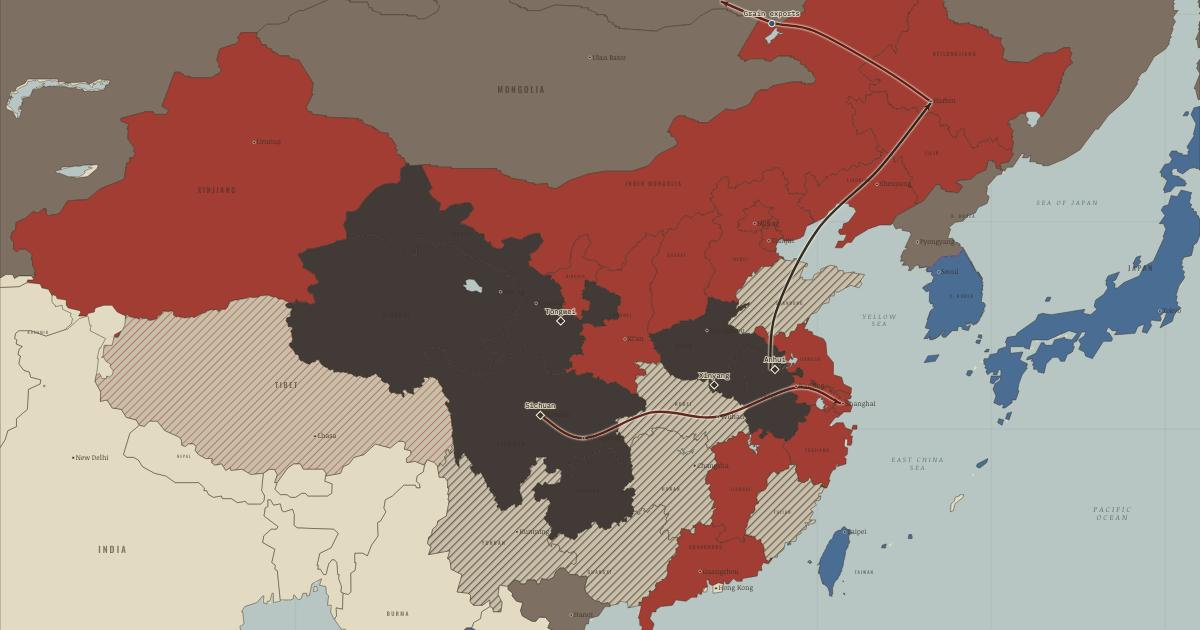
China’s leaders entered 1959 expecting grain that the countryside could not supply. Mao’s Great Leap Forward, begun in 1958, had sent workers from fields to furnaces and dams. Output fell from 195 million tonnes in 1957 to about 170 million in 1959, and then to about 144 million in 1960. Yet the state’s demands were based on the much larger harvests officials had reported, rather than the crops villagers actually had.
The short answer
- Procurement based on false harvests. The state announced a 1958 harvest of 375 million tonnes, though the real figure was about 200 million. Its 1959 quotas were built on that claim. Officials who had invented the harvest could not admit the discrepancy, and to fulfill the quotas they took seed grain and food villages needed to survive. In a year when villages had least to spare, the state collected its largest share of the decade.
- Households with nothing of their own. A household could once keep grain against a hard year. Under the communes, private plots and family livestock disappeared, rural markets closed, and pots and stoves were collected for furnaces. Families surrendered their reserves and relied on mess halls. When the halls ran out, they had no stores, no land of their own to dig and nothing to sell. A system meant to free people from household cares had removed their defense against hunger.
- The Lushan purge silenced the alarm. Peng Dehuai’s dismissal in August 1959 changed the cost of raising an alarm. The campaign against right opportunists punished officials who questioned targets, and millions of cadres were criticized or demoted. A report of hunger or deaths implied that the Leap had failed. Instead of retreating, provincial leaders raised procurement in autumn 1959; the worst deaths followed in the winter and spring.
- Cities and exports came first. The shortage had to fall somewhere. Ration cards and household registration protected a minimum supply for urban residents, shifting the burden to the countryside. China refused foreign food aid and continued exports: 4.2 million tonnes in 1959, mainly to the Soviet Union to pay for machinery and repay debts. Drought and floods worsened conditions in some regions in 1959–60, but people in the capital who would not go hungry made the political decisions about who bore the shortage.
THE TURNING POINT
Xinyang, winter 1959–60. Henan’s leaders had championed the Leap. Through the winter of 1959–60, their campaign against concealment in Xinyang brought searches, beatings and blocked escape routes, while about one million people died. A central investigation reported in 1960, putting written evidence from the Party’s own officials before the leadership. Mao endorsed the purge of local leaders and the November retreat in the Twelve Articles. The famine did not end at once, but the policy responsible for it began to be reversed after Xinyang.
What it changed
The great retreat. Recovery required the Party to undo much of the Leap. From late 1960 it restored private plots, rural markets and smaller farming units, closed mess halls and imported grain. Liu Shaoqi, Deng Xiaoping and Chen Yun led the recovery of 1961–65; by about 1965 food production had returned to its 1957 level. The managers whose reforms saved lives would become Mao’s targets in 1966.
A wound in Mao’s authority. The disaster weakened Mao’s standing among leaders who had seen the evidence. He withdrew further from daily government and made a limited self-criticism in 1962, while privately blaming lower officials. He came to fear that colleagues might repudiate him as Khrushchev had repudiated Stalin. That fear helped shape his attack on the Party in 1966: the Cultural Revolution was, among other things, his answer to the famine’s verdict on him.
Missing births and a lasting scar. Deaths were not the only demographic loss. Births collapsed, and demographers estimate that around 30 million were lost or postponed. The cohort remains a deep notch in China’s population pyramid. Studies of people conceived in 1959–61 have also found lasting effects on health and height: the famine marked children too young to remember it.
Memory without a monument. The Party has never published a death toll. Its 1981 Resolution acknowledged “serious losses” but attributed them to errors, natural calamities and Soviet perfidy together. There is no national memorial; archives have been closed again since the 2010s, and works including Yang Jisheng’s Tombstone are banned in China. Families have often preserved memories privately, while historians have relied in part on people who recorded them at their own risk. Remembering remains political.
The full answer, argued
The policies were deliberate. Leaders set quotas on inflated harvests, abolished private food, purged Peng Dehuai and revived the Leap after Lushan. They protected cities, continued grain exports and refused foreign aid. The provincial variation on the map strongly suggests that local choices mattered far more than weather. A further question is whether leaders intended people to die. Dikötter argues that Mao knew of mass deaths and continued, making the famine a mass killing. Wemheuer, Ó Gráda and others see leaders accepting rural deaths as the price of their priorities without seeking them: a famine of ideology and willful blindness. Evidence of Mao’s private knowledge in 1959–60 is incomplete and disputed. The distinction is essential: deliberate policies caused the deaths, while an intention to kill is not proven. A system that punishes bad news can kill on a vast scale even when no leader wants that result.
An interesting fact
In 1959 Yang Jisheng returned as a student to his village in Hubei and found his father dying of hunger. He says he believed the official explanation at the time. Yang, a Party member and Xinhua journalist for more than three decades, later spent over a decade gathering provincial records and interviews. The result was Tombstone, published in Hong Kong in 2008 and the most detailed history of the famine. He described its title as a tombstone for his father, for the millions who died and for the system that caused their deaths.
This is the study layer of Great Chinese Famine, chapter 7 of The People’s Republic under Mao, 1949–1976; the full index of the atlas is here.
Related questions
THE FREE PRINTABLE STUDY GUIDE
Get the printable study guide for The People’s Republic under Mao free. I’ll send you a few short letters, then one when a new atlas opens. That’s all. — Paul
NO TRACKING · YOUR ADDRESS IS USED FOR THE DISPATCH AND NOTHING ELSE · UNSUBSCRIBE ANYTIME