Meiji Japan and post-Soviet Russia · 1980
Was the Soviet system in 1985 doomed or still reformable?
The seminar question: “Was the Soviet system in 1985 doomed, or could a different reform have saved it?”
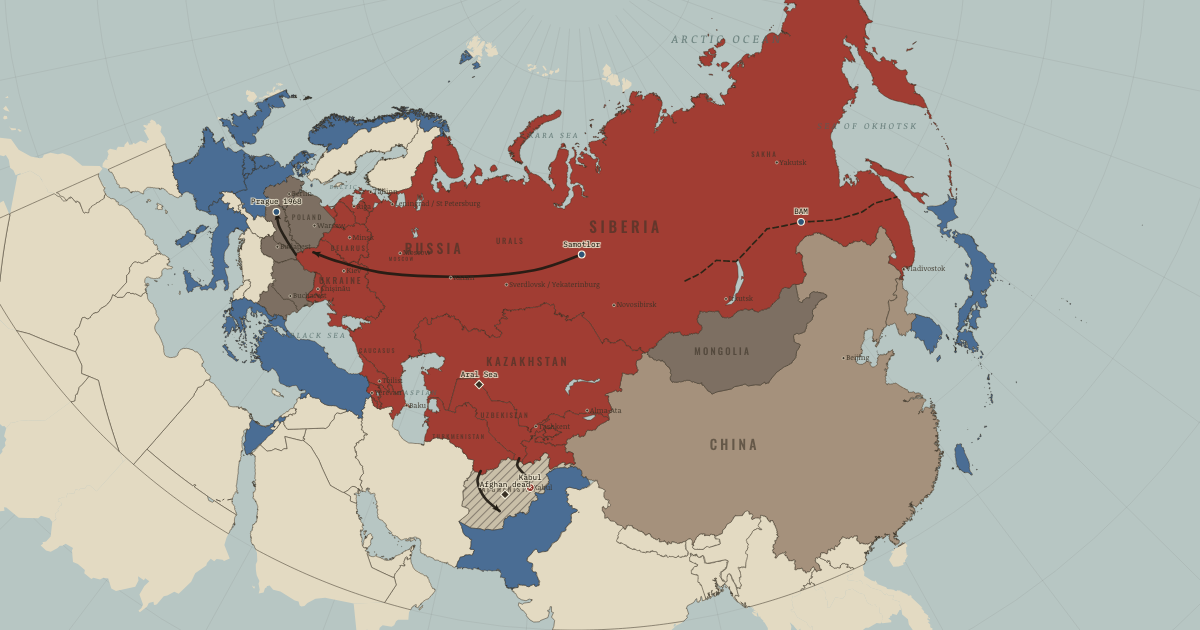
After removing Khrushchev in October 1964, Leonid Brezhnev offered Soviet citizens stability: secure jobs, subsidised housing and food, and officials no longer purged. But growth slowed as the planned economy ran out of new inputs, reform was shelved after Prague 1968, and in December 1979 Soviet forces went into Afghanistan.
Chapter 7 is included with every paid plan. WW2 is free in full, and chapter 1 of every atlas is free. A free account opens 3 more chapters a day. Starter, at $9 a month, opens all 21 with no daily limit — see the plans.
Free printable Meiji Japan and post-Soviet Russia study guide, sent by email ↓
Brezhnev’s promise of stability had a particular appeal to the people who governed. The party controlled important appointments through the nomenklatura, a list of posts requiring its approval. Imagine one organisation appointing a country’s managers, editors and generals: that gives some idea of the party’s reach. “Stability of cadres” assured officials that they would no longer face continual reshuffles or purges. The result was a leadership that grew old together. By 1980 the Politburo, the party’s ruling committee and effectively its cabinet, averaged about seventy years of age.
The short answer
- Khrushchev’s campaigns made stability attractive. Officials who removed Khrushchev in October 1964 had lived through a succession of upheavals. He had denounced Stalin, twice reorganised the party, launched the Virgin Lands campaign and brought the world to the brink over Cuba in 1962. His plan to rotate officials out of office threatened their own positions. His successors made predictability and security for officials central values of the next eighteen years.
- Extensive growth ran out of inputs. Soviet industrialisation from the 1930s drew peasants into factories and concentrated investment in heavy industry. By the 1970s that supply of additional inputs was harder to maintain: birth rates had fallen in the Slavic republics, the cheapest resources in European Russia were exhausted, and new oil and gas lay thousands of kilometres east in harsh climates. Each extra rouble invested yielded less growth. A different source of productivity was needed to prevent a slowdown.
- Prague 1968 made reform look dangerous. Alexander Dubček’s Czechoslovak reforms in 1968 relaxed censorship and promised “socialism with a human face”. Soviet leaders feared both the spread of reform and the possible loss of Czechoslovakia from the bloc. Warsaw Pact armies invaded in August, and Brezhnev claimed that socialist states could intervene where socialism was threatened. At home, the episode reinforced the fear that economic changes could open the way to political ones; the Kosygin reforms faded.
- Oil windfalls postponed hard choices. West Siberian fields began producing as world oil prices soared in 1973–74 and again in 1979. The resulting rise in hard-currency earnings from oil and gas paid for grain, Western machinery and the arms race. Yegor Gaidar argued that the windfall allowed leaders to avoid reform for a decade. It also made state solvency depend on world prices that Moscow could not control.
THE TURNING POINT
Kabul, 27 December 1979. On 27 December 1979 Soviet forces stormed Amin’s palace in Kabul. The operation displayed the reach of a superpower: it could move an army across a border and replace a ruler in days. Yet a handful of elderly men had chosen intervention despite military warnings. The invasion ended détente with the West, brought an American grain embargo and Olympic boycott, and committed the Union to a war it could not win. Gorbachev’s description of Afghanistan as a “bleeding wound” in 1986 named a cost inherited by his reform government.
What it changed
A generation of reformers waited. Mikhail Gorbachev was among the younger officials who watched the Prague Spring crushed and later discussed change privately while rising through the party. He joined the Politburo in 1980 as its youngest member and served under Andropov, whose brief rule in 1982–84 attacked corruption and indiscipline. As the old leaders died in quick succession, this generation inherited the difficulties it had seen accumulate.
Dependence on oil set a trap. Oil and gas supplied most Soviet hard-currency earnings by the early 1980s. When world prices fell by more than half in 1985–86, that income fell away just as Gorbachev launched costly plans to accelerate growth. The revenue that had helped postpone reform now exposed the budget to a shock.
The bloc became a burden. Eastern Europe demanded resources as well as loyalty. Moscow sold its allies oil below world prices, sacrificing billions in hard currency that could buy goods on world markets. In Poland, the Solidarity trade union founded in 1980 demonstrated that workers could organise against a communist state; martial law, army rule with ordinary rights suspended, contained it in December 1981. By 1985 the bloc cost money Moscow could no longer spare, while its loyalty was uncertain. This made Gorbachev’s later choice not to defend it by force easier.
Afghanistan’s war outlived the decision. Afghanistan continued to cost the Union money and international standing, isolating it in the Muslim world and at the United Nations. About 15,000 Soviet soldiers died, army morale suffered, and veterans known as afgantsy returned to a society that preferred not to hear about the war. Withdrawal became one of Gorbachev’s first foreign-policy goals.
The full answer, argued
The evidence for an unavoidable crisis is substantial. By some estimates growth was near zero; the Union depended on oil prices and imported grain, while an expensive empire and ageing elite added to its difficulties. Yegor Gaidar argued that the oil-price collapse made crisis unavoidable. But a crisis need not end in collapse. Stephen Kotkin and others note that in 1985 the Union faced no revolt, no war it was losing on its own territory and no bankruptcy. North Korea shows that a poorly performing system can survive for decades. China after 1978 suggests another possible reform: opening agriculture and small business to markets while retaining the party’s monopoly of power. Soviet decline was real, but collapse required a trigger and choices, which the next chapters examine. Weak performance creates pressure for reform; the way leaders undertake it helps determine whether the system survives.
An interesting fact
In summer 1972 Soviet buyers quietly purchased roughly a quarter of the American wheat crop at subsidised prices before United States officials grasped the scale of the sales. American bread prices rose. The press called the episode the “Great Grain Robbery”, a name used as the title of a 1975 book. Before 1914 the Russian Empire had been one of the world’s largest grain exporters. Six decades later its Soviet successor, despite possessing some of the richest farmland on earth, depended on harvests from its Cold War rival.
This is the study layer of Brezhnev and the Era of Stagnation, chapter 7 of Remaking the State: Meiji Japan 1600–1912 and Post-Soviet Russia 1964–2000; the full index of the atlas is here.
Related questions
THE FREE PRINTABLE STUDY GUIDE
Get the printable study guide for Remaking the State free. I’ll send you a few short letters, then one when a new atlas opens. That’s all. — Paul
NO TRACKING · YOUR ADDRESS IS USED FOR THE DISPATCH AND NOTHING ELSE · UNSUBSCRIBE ANYTIME