Stalin’s Soviet Union · 1937
Was the Great Terror driven by Stalin or by the system?
The seminar question: “Was the Great Terror the result of Stalin’s personal decisions or of pressures within the Soviet system?”
In 1937–38 the NKVD arrested about 1.5 million people and shot roughly 680,000 to 750,000 of them. Moscow show trials condemned Lenin’s old comrades, purges struck the party leadership and the officer corps, and quota-driven “mass operations” targeted former kulaks, priests and national minorities.
Chapter 6 is included with every paid plan. WW2 is free in full, and chapter 1 of every atlas is free. A free account opens 3 more chapters a day. Starter, at $9 a month, opens all 21 with no daily limit — see the plans.
Free printable Stalin’s Soviet Union study guide, sent by email ↓
Sergei Kirov, the party leader in Leningrad, was shot on 1 December 1934 by Leonid Nikolaev, a disgruntled party member. The murder gave Stalin an opportunity to act against former oppositionists. A decree allowed rapid trials without defence, and Stalin blamed his old opponents. Whether he arranged the killing remains disputed; most historians who have worked in the archives, including Matthew Lenoe, find no evidence that he did.
The short answer
- The Kirov murder supplied a pretext. Stalin used Kirov’s murder in December 1934 to connect opposition with assassination. The emergency decree passed that day allowed trials within ten days, without defence lawyers, followed by immediate execution. Stalin went to Leningrad to direct the investigation, and former oppositionists there were arrested. By the 1936 trials of Zinoviev and Kamenev, the murder had become a supposed Trotskyist plot: past dissent was made to appear a form of terrorism.
- Fear of war and a “fifth column”. Nazi Germany in the west and Japan in the east confronted Stalin with hostile powers from 1933. The Spanish Civil War suggested how enemies inside a country might help an invader. Stalin feared such disloyalty among kulaks, former oppositionists, priests and minorities with links abroad. Those groups became targets of the 1937–38 mass and national operations, suggesting a purge intended to forestall actions its victims had not yet taken.
- The old elite still remembered alternatives. The older generation of senior communists had known Lenin and remembered choices other than Stalin. In the 1920s some had supported Trotsky, Zinoviev or Bukharin; some privately criticised collectivisation and the famine. Martemian Ryutin’s 1932 platform called Stalin the “evil genius” of the revolution. Later testimony suggests that Stalin may have received votes against him in the secret Central Committee ballot at the 1934 Seventeenth Congress, though historians dispute it. Destroying this generation removed people able to imagine the party without him.
- A police state measured success by arrests. The NKVD expanded through collectivisation and the camps, and its officers were rewarded for uncovering plots. Regional chiefs received quotas to fulfil and exceed; finding too few enemies could itself make a chief suspect. Fear reinforced ambition, especially as Yezhov’s NKVD arrested and shot many of its own officers. Confessions naming new accomplices supplied further targets, giving the operations a momentum of their own.
THE TURNING POINT
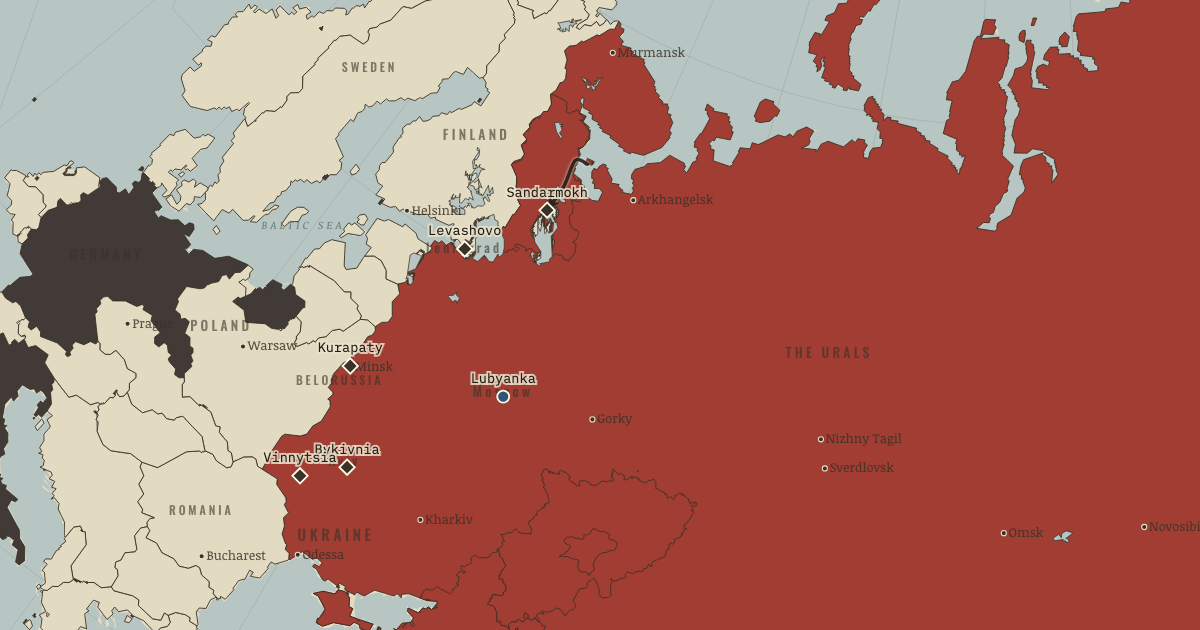
The Lubyanka, 30 July 1937. Yezhov signed Order No. 00447 at NKVD headquarters on the Lubyanka on 30 July 1937; the Politburo approved it the next day. Its significance lies in who would now be pursued. Arrests had previously concentrated on party members, officials and former oppositionists. Regional quotas under the order sent hundreds of thousands of peasants, workers, believers and former kulaks before troikas. National operations followed, adding whole minorities. Most Terror victims died under orders issued after this date, which marks the shift from political purge to mass social cleansing.
What it changed
A personal dictatorship without rivals. By 1939 no one in the leadership had known Stalin as an equal or could challenge him. The Politburo met less often; Stalin made decisions with small groups he selected. Molotov, Kaganovich, Voroshilov and other surviving colleagues depended on his favour. The late-1930s cult celebrated a leader who had removed those able to contradict him.
A weakened army on the eve of war. Experienced commanders were removed shortly before the Red Army’s poor performance against Finland in 1939–40 and Germany’s invasion in 1941. How much did the purge contribute to the disasters of 1941? Historians disagree: many discharged officers were reinstated, and other failures also mattered. The purge nevertheless damaged initiative and trust throughout the army.
A new generation in power. The arrests left posts open to young officials, engineers and managers trained in the 1930s, the vydvizhentsy. Leonid Brezhnev, Alexei Kosygin and Andrei Gromyko rose rapidly into vacancies. Brezhnev was a factory engineer in 1935 and secretary of the Dnipropetrovsk regional party committee by 1939. Loyal to Stalin and marked by fear, this generation would govern the Soviet Union until the 1980s.
Fear in everyday life. The Terror entered family life in every town and many villages. Children of “enemies of the people” faced stigma or orphanages, and wives were sent to special camps. People guarded their words, avoided strangers and burned letters. These habits of silence protected the regime after the operations ended and help explain why the Terror was discussed openly only after 1956.
The full answer, argued
Stalin’s decisions explain the Terror’s origin, purpose and timing. He initiated the show trials, approved Order No. 00447 and the national operations, signed lists sentencing tens of thousands and stopped the mass operations in November 1938. His fear of a fifth column before war helps explain the people selected as targets. The orders acquired their extraordinary reach through a system in which others had reasons to extend them. Regional chiefs sought higher quotas, NKVD officers competed to uncover plots, and denunciations by neighbours and colleagues brought in more victims, as Getty and Goldman show. Stalin could start and stop the killing, but he depended on people below him to carry it out. Mass repression in a modern state requires both a decision at the top and participants who see reasons to take part.
An interesting fact
On 5 December 1936 the Soviet Union adopted the “Stalin Constitution”, which Stalin praised as the most democratic in the world. Article 127 promised that arrest required a court decision or a prosecutor’s sanction. Nikolai Bukharin and Karl Radek had served in drafting groups of the commission that prepared it. Within weeks Radek stood as a defendant at the second Moscow show trial; fifteen months later Bukharin appeared at the third. The treatment of two men who helped draft the guarantees showed how little those guarantees meant.
This is the study layer of Great Terror (Great Purge), chapter 6 of The Soviet Union under Stalin, 1924–1953; the full index of the atlas is here.
Related questions
THE FREE PRINTABLE STUDY GUIDE
Get the printable study guide for The Soviet Union under Stalin free. I’ll send you a few short letters, then one when a new atlas opens. That’s all. — Paul
NO TRACKING · YOUR ADDRESS IS USED FOR THE DISPATCH AND NOTHING ELSE · UNSUBSCRIBE ANYTIME