Stalin’s Soviet Union · 1949
Was High Stalinism a continuation of the 1930s terror?
The seminar question: “Was High Stalinism a continuation of the terror of the 1930s, or a different kind of dictatorship?”
After victory in 1945 Stalin’s rule hardened rather than relaxed. The regime rebuilt heavy industry first, a famine in 1946–47 killed an estimated 1 to 2 million, campaigns targeted writers, scientists and Jews, and satellite states from East Germany to Bulgaria took orders from Moscow.
Chapter 11 is included with every paid plan. WW2 is free in full, and chapter 1 of every atlas is free. A free account opens 3 more chapters a day. Starter, at $9 a month, opens all 21 with no daily limit — see the plans.
Free printable Stalin’s Soviet Union study guide, sent by email ↓
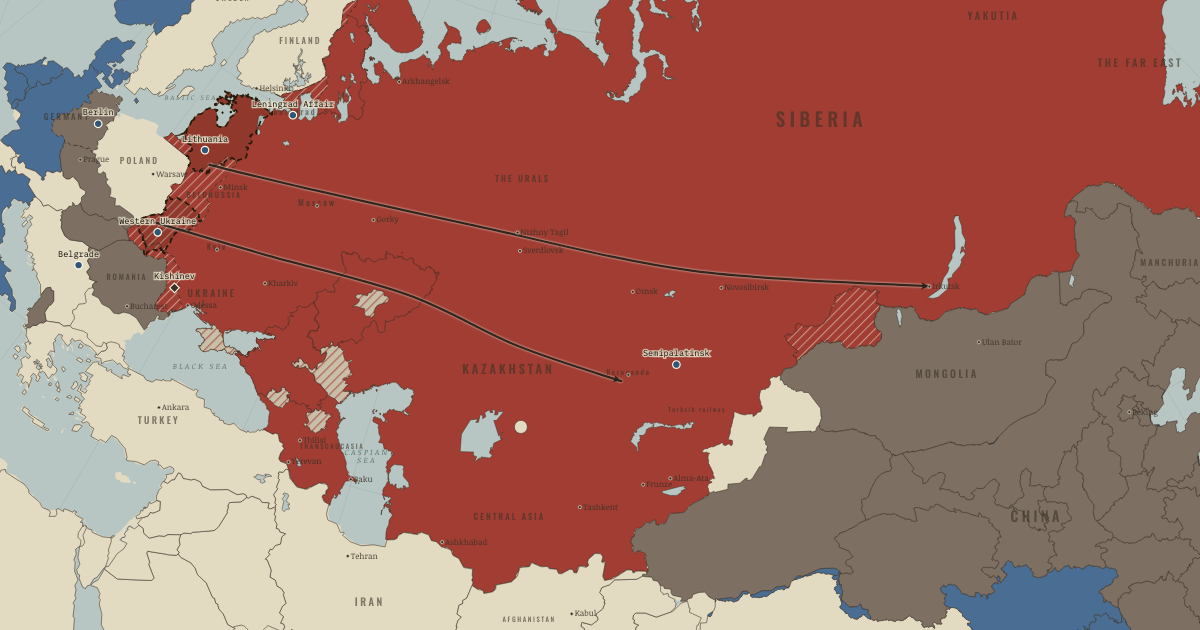
The government faced a devastated country after the war. Its choices during the famine of 1946–47 show how reconstruction was to proceed. Drought struck Ukraine, Moldavia and the Volga in 1946, but farms still had to meet high procurement quotas: the grain they were obliged to deliver to the state. The government retained large reserves and continued exports to Eastern Europe while people went hungry. Estimates of the dead range from under 1 million to about 2 million, many in Moldavia, which the Soviet Union had annexed only in 1940.
The short answer
- Victory confirmed Stalin’s methods. Victory seemed to Stalin to vindicate the system of collective farms, plans and purges under which the country had survived. War had nevertheless loosened some controls: peasants expanded private plots and soldiers saw how Europeans lived. The regime saw opportunities for dangerous comparisons in those experiences and moved to restore control.
- The Cold War revived the fear of enemies. The wartime alliance broke down in 1946–47. Stalin read the Marshall Plan and the American atomic monopoly, Churchill’s Fulton speech of March 1946 and the Truman Doctrine of 1947 as signs that capitalist powers were preparing for war. Under that suspicion, foreign connections could become evidence against a person: returning prisoners of war and Jewish intellectuals with relatives abroad could be treated as potential spies.
- Reconstruction demanded sacrifice. Much of the western Soviet Union had been devastated. The Fourth Five-Year Plan of 1946–50 directed reconstruction toward steel, coal, electricity and arms, including the atomic bomb. Food, housing and consumer goods came last. The famine of 1946–47 and harsh labor and theft laws followed these choices, making the population pay for state priorities as it had in the 1930s.
- The new borderlands rejected Soviet rule. The borderlands annexed in 1939–40 had experienced Soviet rule for less than two years before the German invasion, including the resented deportations of 1940–41. After 1944 armed nationalist movements resisted renewed rule, forced collectivization and the arrival of Russian-speaking officials and settlers. The regime treated these rebellious regions as counterinsurgency zones long after war ended elsewhere, making deportation its main weapon.
THE TURNING POINT
Tito’s expulsion, 28 June 1948. Tito could refuse Stalin because he had resources of his own: an army, a revolution and popular support. Yugoslavia survived Soviet threats and economic blockade after its expulsion from the Cominform on 28 June 1948. This first successful defiance within the communist world exposed a limit to Moscow’s authority. Stalin tightened control elsewhere and put alleged Titoists on trial in Hungary, Bulgaria and Czechoslovakia, including László Rajk in 1949 and Rudolf Slánský in 1952. The break showed how much Soviet power depended on the Red Army, a dependence that would matter again in Hungary in 1956.
What it changed
An empire held by force. The Eastern European satellites remained under Soviet control until 1989. Rigged elections, purges and Soviet advisers in security services had installed governments whose leaders knew they lacked popular legitimacy. Revolts in East Germany in 1953, Hungary in 1956 and Czechoslovakia in 1968 exposed their continued dependence on force.
The Gulag at its height. Postwar theft laws and new arrests sent people to the camps alongside repatriated prisoners of war and borderland insurgents. By 1950–53 the camps held about 2.5 million people, with another 2.7 million special settlers. Their size and cost had become a burden even to the regime. After Stalin’s death, camp officials and his successors moved quickly to reduce them.
A frightened leadership waiting for change. Malenkov, Beria, Khrushchev and Bulganin had watched colleagues fall and feared for themselves. The 1952 purge of Molotov and Mikoyan and the Doctors’ Plot raised the prospect of another terror. Within weeks of Stalin’s death in March 1953, his colleagues released the doctors and reduced the camps; the speed of their action shows how strongly they wanted change.
Nuclear power and a frozen society. The atomic bomb of 1949 made the Soviet Union a superpower and gave a reason for the secrecy and mobilization of late Stalinism. Yet the same period constrained culture and science. Lysenko’s rejection of genetics damaged Soviet biology and agriculture for a generation. A powerful state and a constrained society emerged together, shaping the next forty years.
The full answer, argued
The answer depends on where we look. Society continued to experience massive repression: the Gulag reached its greatest size, theft laws imprisoned millions, deportations broke borderland resistance, and famine was again allowed to kill in 1946–47. At the top, violence targeted groups such as the Leningrad leaders and the Jewish Anti-Fascist Committee rather than repeating the mass killing of 1937–38. Gorlizki and Khlevniuk find that ordinary government became more routine and bureaucratic. Stalin’s personal power was, if anything, greater, and his cult peaked in 1949; the possibility of a purge helped keep the elite obedient. The Doctors’ Plot suggests another terror might have followed had he lived, although historians disagree about its possible extent. High Stalinism thus kept the earlier dictatorship’s tools while using fear and violence differently. It shows how a dictatorship can use attacks on a few, and the threat of more, to discipline many.
An interesting fact
The bomb tested at Semipalatinsk in Kazakhstan on 29 August 1949 was the Soviet Union’s first atomic weapon. It closely copied the American “Fat Man” dropped on Nagasaki. Klaus Fuchs, a physicist at Los Alamos, had passed its design to Soviet intelligence. Scientific director Igor Kurchatov chose to build the proven design first, avoiding any risk of failure while Beria watched; a Soviet design followed in 1951. Western intelligence had expected a Soviet bomb no earlier than the early 1950s. The test shocked Washington and helped push the United States toward the hydrogen bomb.
This is the study layer of High Stalinism (1945–53), chapter 11 of The Soviet Union under Stalin, 1924–1953; the full index of the atlas is here.
Related questions
THE FREE PRINTABLE STUDY GUIDE
Get the printable study guide for The Soviet Union under Stalin free. I’ll send you a few short letters, then one when a new atlas opens. That’s all. — Paul
NO TRACKING · YOUR ADDRESS IS USED FOR THE DISPATCH AND NOTHING ELSE · UNSUBSCRIBE ANYTIME