Decolonization of Africa · JUL 1994
Was the decolonization of Africa a success or a failure?
The seminar question: “Was Africa’s decolonization a success or a failure? How does the comparison we choose change the answer?”
By 1994 the political decolonization of Africa was complete, and self-rule had brought wider schooling, new health systems and rising life expectancy. Economies stayed dependent on a few exports, the debt crisis of the 1980s forced spending cuts, and in Rwanda the genocide of 1994 murdered about 800,000 people.
Chapter 12 is included with every paid plan. WW2 is free in full, and chapter 1 of every atlas is free. A free account opens 3 more chapters a day. Starter, at $9 a month, opens all 21 with no daily limit — see the plans.
Free printable Decolonization of Africa study guide, sent by email ↓
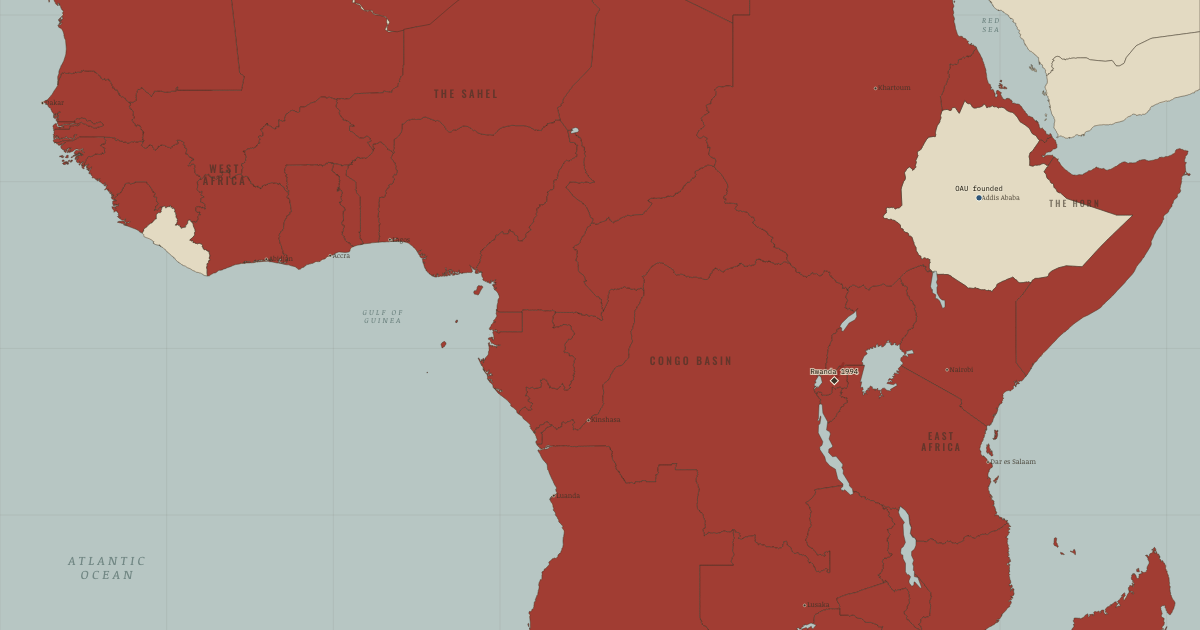
In 1945 much of Africa was governed from Europe. By 1994 most of the continent had independent governments, and South Africa had elected a democratic government. Western Sahara’s status remained unresolved. The map records an immense change in who held political authority. Self-rule gave people a say in national decisions and ended the daily indignities of formal colonial rule. These were gains in their own right, whatever later governments did with their power.
The short answer
- The gains of independence. Self-government put national decisions in the hands of independent governments, a change with value beyond any measure of income. Across much of Africa, schooling and literacy expanded, universities and health services grew, and life expectancy rose by roughly a decade by 1990. Colonial investment in African welfare had generally been limited, though territories differed. Later crises interrupted progress, but a fair comparison must count these gains.
- The inherited constraints. A new flag could not immediately change colonial borders or remake an economy. Many states depended on a few commodities, with limited industrial capacity and relatively small educated workforces. When an export price fell, revenue could shrink even if the country sold the same quantity, making services and diversification harder to finance. Debt crises and structural-adjustment programs in the 1980s added pressure to budgets, including education and health. Colonial institutions and international economic arrangements shaped the choices available, though policies and outcomes varied.
- Coups and personal rule. Most colonial borders remained after independence, though interstate wars still occurred. Within those borders, coups and the movement of some liberation parties toward one-party or personal rule damaged hopes of democracy. Weak institutions, winner-take-all politics and fragile economies helped create the conditions for these crises. Cold War patrons also supported allied rulers; Mobutu in Congo is an important example. Those leaders made their own repressive choices, while foreign support helped sustain them.
THE TURNING POINT
Pretoria, 10 May 1994. At the Union Buildings in Pretoria on 10 May 1994, Nelson Mandela took office as president. The ceremony ended apartheid’s political order: South Africa’s majority had gained the vote long denied it. Since 1945 much of Africa had won self-government, and this is a fitting point to assess what followed. Longer lives, schools and universities belong in that account, alongside coups, wars and unmet promises. The end of one struggle left another question open: how would political freedom serve the people who had won it?
What it changed
Rwanda, April–July 1994. From April to July 1994 extremist leaders and militias organized genocide against the Tutsi. An estimated 800,000 people were murdered, including Hutu opponents of the killing, and international actors failed to stop it. Belgian colonial racial classification belongs to the history, but civil war, propaganda and postcolonial leaders’ decisions were also crucial. The Rwandan Patriotic Front’s advance ended the genocide. The later Congo wars need their own account, and those killed in Rwanda deserve remembrance in their own right.
Democracy and the 1990s. The 1990s produced grounds for questioning the view that Africa was a hopeless case. Apartheid ended, and multiparty elections took place in a number of former one-party states. Elections gave people opportunities to challenge governments, though their quality and consequences varied. Cold War proxy conflicts in Angola and Mozambique also moved toward an end as external support for proxy wars changed. None of this resolves every question about government or development, but the decade cannot be described by a single verdict of failure.
Follow a country. In Free Explore, move through the timeline and choose a country. The rising color records independence, while the markers open the histories behind it: Ghana’s early independence, Algeria’s war, the Congo’s crisis and South Africa’s long struggle against apartheid. Follow one route and see how much a single change of color contains.
The full answer, argued
The answer depends on the question. Compared with the foreign rule, racial hierarchy and extractive government of 1945, decolonization brought a profound political change: most territories ruled by foreign powers became independent, and South Africans ended apartheid’s political order. Across much of Africa, schooling and health services expanded and life expectancy rose. Yet rapid prosperity, stable democracy and continental unity often proved elusive. Governments inherited commodity dependence, borders and institutions, and faced Cold War interference and debt. Their leaders also made choices about investment, corruption and repression. Judging the era by immediate Western-style prosperity overlooks its starting conditions; treating a new flag as proof that every promise was fulfilled overlooks the work still to do. Self-rule was an achievement, and accountable institutions and more independent economies remained unfinished projects.
An interesting fact
South Africa’s flag began as an interim design. A public competition drew around seven thousand entries but produced no winner, and state herald Frederick Brownell devised the converging Y, often understood as separate streams joining a common path. Adopted shortly before the election, the flag flew at the Union Buildings on 10 May 1994. It remained in use, and the 1996 constitution made it permanent.
This is the study layer of Legacy of decolonization in Africa, chapter 12 of The Decolonization of Africa, 1945–1994; the full index of the atlas is here.
Related questions
THE FREE PRINTABLE STUDY GUIDE
Get the printable study guide for The Decolonization of Africa free. I’ll send you a few short letters, then one when a new atlas opens. That’s all. — Paul
NO TRACKING · YOUR ADDRESS IS USED FOR THE DISPATCH AND NOTHING ELSE · UNSUBSCRIBE ANYTIME