Stalin’s Soviet Union · 1940
Did Stalin’s policies improve the lives of Soviet women?
The seminar question: “To what extent did Stalin’s policies improve the lives of Soviet women?”
Industrialisation drew millions of peasants into Soviet cities, and the urban population grew from about 26 million in 1926 to 56 million in 1939. Newcomers gained jobs, schooling and promotion but faced communal flats, rationing until 1935 and harsh labour laws, while women carried a double burden of work and home.
Chapter 9 is included with every paid plan. WW2 is free in full, and chapter 1 of every atlas is free. A free account opens 3 more chapters a day. Starter, at $9 a month, opens all 21 with no daily limit — see the plans.
Free printable Stalin’s Soviet Union study guide, sent by email ↓
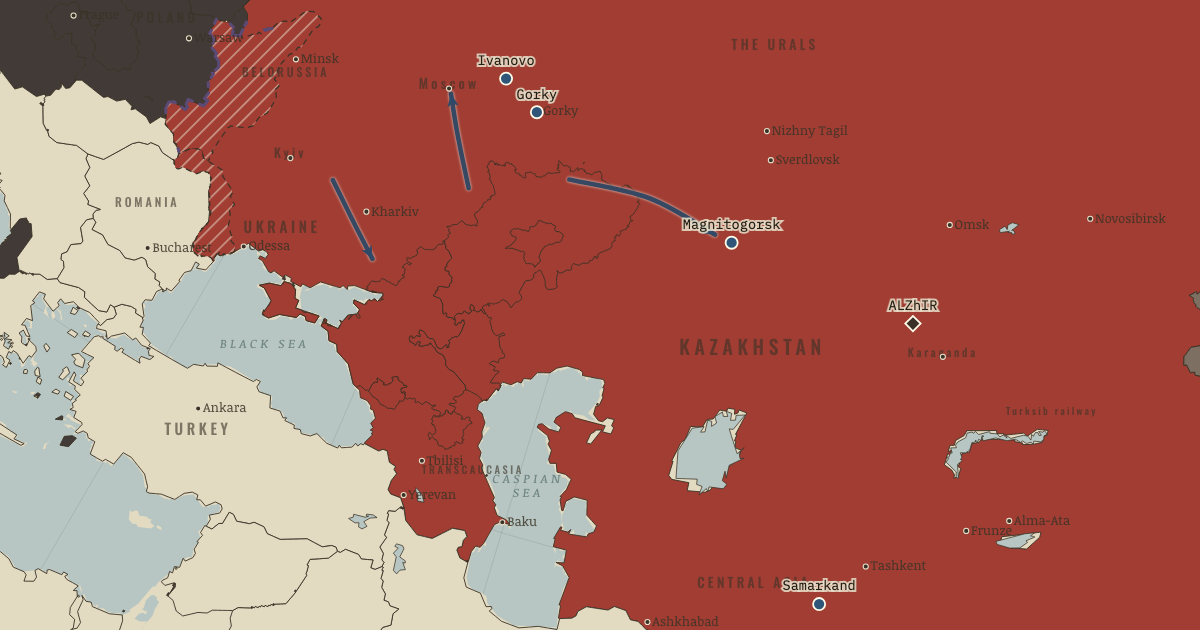
The new industrial towns needed workers, and the countryside supplied them. Some peasants fled collectivisation—the forced merger of farms into state-run collectives—and famine; factories recruited others. The arrows on the map trace routes to Moscow, the Donbas mines, Magnitogorsk and other industrial centres. In little more than a decade the movement changed the make-up of Soviet society.
The short answer
- Industrialisation needed millions of new workers. The industrial workforce more than doubled between 1928 and 1932 as the Five-Year Plans created jobs. Collectivisation and famine simultaneously pushed peasants out of villages. Towns had to absorb the arrivals, but housing, transport and food supplies lagged behind. Magnitogorsk and other new towns grew faster than homes for their workers; the resulting shortages shaped urban life for a generation.
- The state needed a new technical elite. The regime distrusted many specialists trained before 1917, putting engineers and others on trial as “wreckers” in 1928–31. It expanded schools and institutes to train a technical class from workers’ and peasants’ families. The Terror then removed many first-generation Soviet managers, opening further posts to their newly trained successors. For young people, rapid promotion became a normal expectation.
- A falling birth rate worried the leadership. Famine, upheaval and easy divorce and abortion had lowered the birth rate. Preparing for war, Stalin and his colleagues wanted workers and soldiers and saw a strong family as the foundation of a strong state. Their June 1936 decree banned abortion except on medical grounds, increased divorce costs and paid mothers of large families. Many letters in the public discussion opposed the proposed ban, but the final law ignored them. Consultation displayed participation without altering the decision.
- Shortage shaped every choice. Heavy industry took priority, leaving food, consumer goods and housing scarce. People searched through queues, markets, closed shops and personal connections for what they needed. The state rationed supplies and gave preferred groups better food, housing and holidays. Access to necessities became a means of political control, while connections called blat became essential to getting things done.
THE TURNING POINT
Ivanovo and the law of June 1936. The decree of 27 June 1936 changed family life by banning abortion, legal since 1920, making divorce expensive and rewarding motherhood as a duty. In Ivanovo most textile workers were women, so the law fell on people already working full shifts and spending time in food queues. Births rose in 1937, then fell as illegal abortions spread, suggesting quiet resistance. The decree is a hinge of the Great Retreat: women retained the right and duty to work, while losing the choice of whether to bear children.
What it changed
A society of new cities and new classes. The urban share of the population rose from one in five in 1926 to one in three by 1939. Workers’ and peasants’ families also supplied an educated class of engineers, managers and specialists. This class became a backbone of the Soviet state and among its most loyal supporters; some members, including Brezhnev, governed into the 1980s.
Women’s double burden became permanent. Women replaced men in factories and fields during the war, and many remained in paid work afterwards. The expectation that they would run households survived too, and shortages made that work exhausting. Soviet sociologists measured the double burden in the 1960s; it persisted until 1991. Equality at work had not produced equality at home.
Harsh labour laws fed the Gulag. Ordinary workers could receive prison or corrective labour under the labour laws of 1938–40 and the 1947 theft laws, often for minor offences. Absence or theft could mean years in a camp. Millions were sentenced under these laws, helping explain why most Gulag prisoners were not political prisoners and why the camps continued to grow after the Terror.
Expectations the regime could not meet. The promise that “life has become better” raised expectations that scarce housing, food and goods could not meet. After victory, veterans and workers expected rewards; police reports recorded their grumbling at the gap. Khrushchev’s late-1950s housing programme, with its famous five-storey blocks, addressed a backlog and acknowledged that the promise of 1935 had gone unmet for twenty years.
The full answer, argued
The answer depends on whose life we consider and which changes we measure. Millions of women entered industry, education and professions, female literacy rose sharply, and women made up about two-fifths of industrial workers by 1940. Some became engineers, doctors and pilots. These opportunities mattered. Yet paid work was added to housework and queues amid shortages. The 1936 decree removed the right to abortion and made divorce harder; wives of arrested men could themselves be imprisoned at ALZhIR. Peasant women on collective farms and women of deported nations gained little. Goldman emphasizes the state’s use of the family to reduce its costs, while Hoffmann sees modernising mobilisation through traditional forms. Stalinism widened women’s opportunities as workers while restricting their choices as individuals: legal equality and real freedom could move in opposite directions.
An interesting fact
The January 1937 census asked adults, “Are you a believer?” Stalin personally reviewed it. Despite nearly a decade of church closures and campaigns by the League of the Militant Godless, about 57 per cent of respondents aged 16 and over answered yes; among peasant women the share was far higher. The answer was one reason the census was declared defective and suppressed. No subsequent Soviet census repeated the religion question, and the results became known only after archives opened in the early 1990s.
This is the study layer of Women and daily life under Stalin, chapter 9 of The Soviet Union under Stalin, 1924–1953; the full index of the atlas is here.
Related questions
THE FREE PRINTABLE STUDY GUIDE
Get the printable study guide for The Soviet Union under Stalin free. I’ll send you a few short letters, then one when a new atlas opens. That’s all. — Paul
NO TRACKING · YOUR ADDRESS IS USED FOR THE DISPATCH AND NOTHING ELSE · UNSUBSCRIBE ANYTIME