Mao’s China · 1971
Did sending urban youth to villages achieve Mao’s aims?
The seminar question: “How far did the movement to send urban youth “up to the mountains and down to the villages” achieve Mao’s aims?”
From December 1968 Mao sent educated urban youth to be “re-educated” by peasants, and over the next decade about seventeen million school leavers went to villages and army-run frontier farms. The policy dispersed the Red Guards, and in September 1971 Mao’s chosen heir Lin Biao died fleeing China.
Chapter 10 is included with every paid plan. WW2 is free in full, and chapter 1 of every atlas is free. A free account opens 3 more chapters a day. Starter, at $9 a month, opens all 21 with no daily limit — see the plans.
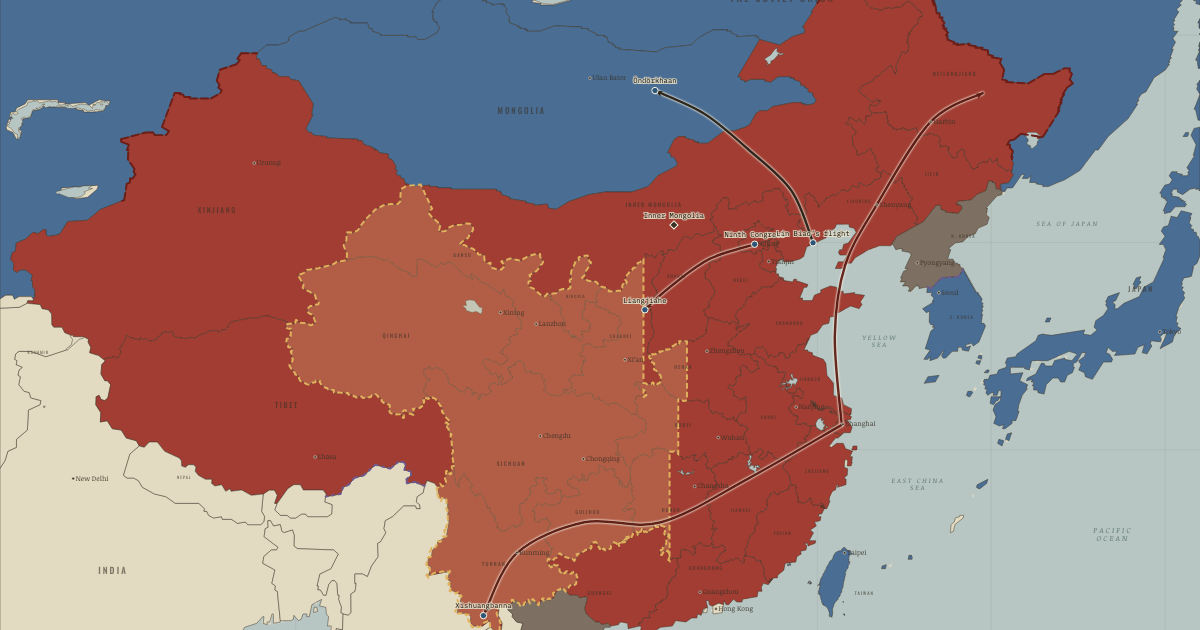
Mao’s directive of 22 December 1968 expanded an existing, small policy into a mass movement. Sending urban youth to the countryside solved several problems at once. Schools had closed in 1966, and three years of graduates had accumulated with nowhere to go in the cities. Their departure relieved the cities of mouths to feed and removed the Red Guards, who had fought in Mao’s name since 1966, as a political force.
The short answer
- The Red Guards had served their purpose. The students Mao had hailed as the revolution’s vanguard became a problem for him. By 1968 factions fought with guns, universities such as Tsinghua had become battlegrounds, and the army was tired of policing them. In July Mao told Red Guard leaders they had failed him; workers’ propaganda teams took over campuses. Sending students to the countryside removed them from politics without admitting that the movement had gone wrong. They were now told they needed re-education.
- No jobs in the cities. The cities faced a large group of school leavers without work. Two years of fighting had disrupted factories, and schools and universities had closed in 1966. The baby-boom generation born in the 1950s was leaving school, but city governments could neither feed nor employ it. Villages and frontier farms received the burden without the countryside having a say. Household registration made the transfer enforceable: refusal meant a young person could not legally live or eat in the city.
- Mao’s faith in the peasant revolution. Mao’s own revolution had been won in the villages. He feared that educated city people might become a privileged class separated from the masses, and wanted peasants to teach the young while labor toughened them. The term “re-education” gave a practical measure the force of a moral duty. Parents who wanted their children home had to argue against the Chairman’s words, and opposition could look like opposition to the revolution itself.
- An army that had become indispensable. The army had made itself indispensable by restoring order through revolutionary committees. The 1969 border war with the Soviet Union increased its importance. Officers filled the Central Committee, and their leader Lin Biao became Mao’s designated successor. Mao had used the army to defeat the Party, but its accumulated power now alarmed him. Lin’s position depended on Mao’s favor, and that favor could be withdrawn.
THE TURNING POINT
Öndörkhaan, 13 September 1971. Lin Biao had helped build Mao’s cult and was named as his heir in the Party constitution. After the crash at Öndörkhaan on 13 September 1971, the chosen successor was announced as a traitor who had plotted murder. The announcement raised a damaging question for a cult built on Mao’s infallibility: how had he chosen such a man? Many people later recalled this as the moment they stopped believing. Lin’s generals were arrested within days, ending the army’s political dominance. The affair also pushed Mao to rely on Zhou Enlai, restore purged officials such as Deng Xiaoping and pursue an opening to the United States.
What it changed
Washington becomes the answer. The Soviet threat remained on China’s northern border after Lin’s fall. Mao and Zhou Enlai accelerated their secret approach to the United States, and Nixon’s visit was confirmed within months. In October 1971 the People’s Republic took China’s seat at the United Nations. Zhou managed the crisis at home as well as the opening abroad, becoming the most powerful figure after Mao.
The soldiers sent back to barracks. Lin’s leading generals were arrested within days of the crash, and civilian Party committees regained authority in the provinces. In December 1973 Mao rotated commanders of eight military regions so that none could build a personal power base. Military government ended, though soldiers remained powerful. Mao had used the army to break the Party; now he used the Party to rein in the army.
Deng Xiaoping returns. The return of purged officials supplied Mao with experienced administrators and gave those officials a quiet constituency for ending campaigns. Deng Xiaoping became a vice-premier again in 1973 and soon ran the government for the ailing Zhou Enlai. That position made him the radicals’ main target and prepared the succession struggle that would decide China after Mao.
A generation that remembered. Sent-down youth began returning to the cities from 1978, carrying memories of lost years and skepticism about slogans. Their memoirs, stories and films, beginning with the “scar literature” of the late 1970s, shaped China’s memory of the Mao years. Village life had shown them rural poverty and how little slogans could change it. Some, including Xi Jinping and Li Keqiang, later led the country.
The full answer, argued
The movement met its immediate political aims. Within two years millions had left the cities, dispersing the Red Guards, ending urban factional fighting and reducing unemployment. Mao also wanted young people to learn revolutionary values from peasants and narrow the gap between town and country. Here the result was much less favorable. Many peasants resented the newcomers, while most young people wanted to return home. Bonnin’s research shows the divide reinforced: their greatest wish was to recover the urban residence permits the state had taken away. Experience and memory varied with the place and the person. Some former sent-down youth found resilience and knowledge of rural poverty in those years. Strikes and protests ended the movement in 1978–79. Coercive social engineering had achieved short-term political goals while producing the opposite of the society it promised.
An interesting fact
Li Qinglin, a primary-school teacher in Fujian, wrote to Mao in December 1972 about his son, who had been sent to a village and could not earn enough food to live on. Li reported exploitation and abuse of other young people too. Mao replied in his own hand in April 1973, in words that translate roughly as: “Comrade Li Qinglin, I am sending you 300 yuan to make up for your shortage.” He recognized that such problems existed throughout China and needed an overall solution. The letter circulated to officials; a national conference that summer raised allowances and ordered punishment for officials who abused sent-down youth.
This is the study layer of Down to the Countryside Movement, chapter 10 of The People’s Republic under Mao, 1949–1976; the full index of the atlas is here.
Related questions
THE FREE PRINTABLE STUDY GUIDE
Get the printable study guide for The People’s Republic under Mao free. I’ll send you a few short letters, then one when a new atlas opens. That’s all. — Paul
NO TRACKING · YOUR ADDRESS IS USED FOR THE DISPATCH AND NOTHING ELSE · UNSUBSCRIBE ANYTIME