Russian Revolution · MAY 1919
Did foreign intervention help or hurt the Whites?
The seminar question: “Did foreign intervention help the Whites or hurt them — and whom did it ultimately serve?”
Fourteen foreign states sent troops into Russia between 1918 and 1922, mostly to ports such as Murmansk, Archangel, Odessa and Vladivostok, where Japan kept the largest force longest. War-weary publics would not support a real war, so the intervention mainly armed the Whites and achieved little militarily.
Chapter 10 is included with every paid plan. WW2 is free in full, and chapter 1 of every atlas is free. A free account opens 3 more chapters a day. Starter, at $9 a month, opens all 21 with no daily limit — see the plans.
Free printable Russian Revolution study guide, sent by email ↓
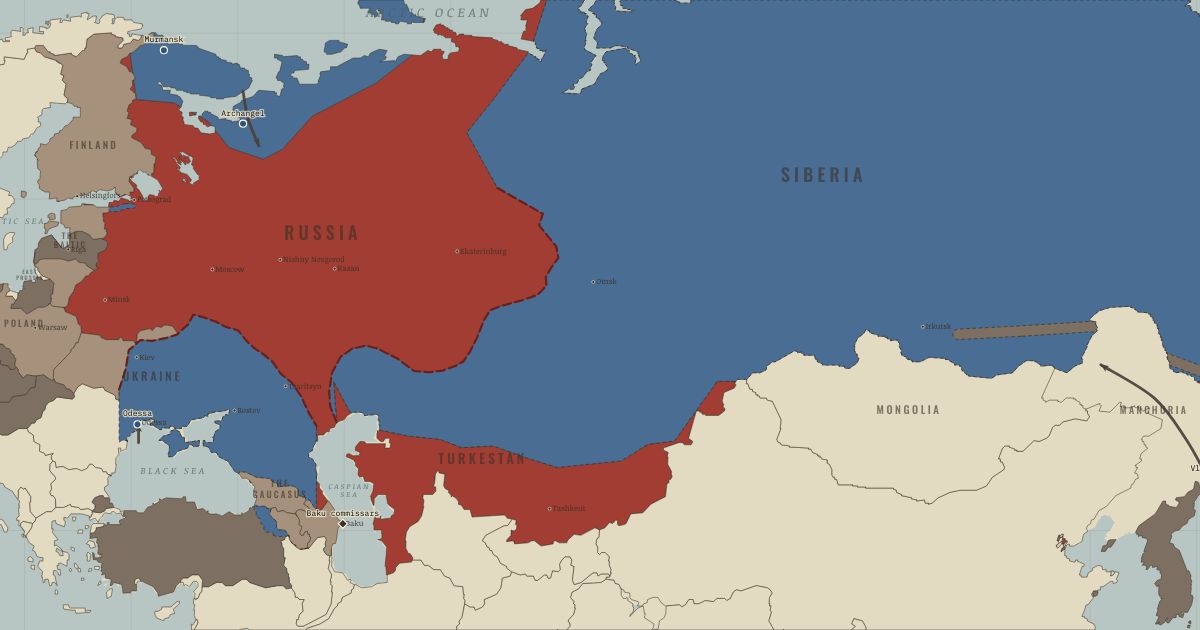
The first Allied landings in Russia belonged to the history of the First World War as well as the Russian Civil War. In 1918 Allied governments wanted to guard enormous munitions dumps at the ports, rescue the Czechoslovak Legion and, if possible, reopen an eastern front against Germany. These aims made sense together while Germany was still fighting. Its surrender in November removed that shared reason for intervention, although foreign troops remained on Russian soil.
The short answer
- Keep Russia in the war (1918). Guarding Allied munitions at the ports, rescuing the Czech Legion and reopening an eastern front were connected aims while the World War continued. Germany's surrender in November 1918 ended that war. Foreign troops were still ashore, but the clearest purpose their governments had shared was gone.
- Anti-Bolshevism and specific interests. Opposition to Bolshevism persisted after the armistice alongside particular interests: French claims in Ukraine, British interest in Caucasus oil and Japanese ambitions in the Russian Far East. These did not make a common campaign. Exhausted Western publics would not support the mass conscript armies needed for a decisive intervention.
- War-weariness caps the whole enterprise. Four years of war had left the democracies with a powerful constraint at home. Their publics would not support sending armies to die in another Russian war. Governments supplied the Whites and sent limited forces, but not enough to decide the struggle. Their presence still gave the Reds foreign enemies to denounce.
THE TURNING POINT
Vladivostok — the intervention that outstayed its purpose. At Vladivostok, the interveners' purposes pointed in different directions. Japan sent the largest force and kept it longest, seeking a Siberian sphere; Americans mostly watched their Japanese ally. Tokyo withdrew in October 1922, four years after landing and long after the Whites had gone. This was the civil war's last foreign departure. It did not change the war's outcome, but the episode helped convince Moscow that capitalist powers waited for a chance to prey on it.
What it changed
“Capitalist encirclement” as founding myth. Foreign soldiers and supplies gave substance to the regime's story of a socialist state besieged by imperialist enemies. That story helped justify the security state and an arms buildup, and sustained suspicion of the West into the Cold War.
Little military weight, much White dependence. White armies depended on foreign arms to remain in the field. When interveners were reluctant to fight and then left abruptly, those armies were exposed. Dependence also helped the Reds present the Whites as foreign puppets and themselves as Russia's defenders.
Poisoned relations for a generation. The failed effort to strangle the regime left mutual distrust. In the 1920s and 1930s Soviet leaders drew from it an expectation that they would eventually have to fight the capitalist world. The next World War would seem to confirm that belief.
The full answer, argued
Foreign weapons helped keep the Whites fighting, but the intervention's political costs were substantial. Too few foreign troops fought to decide the war, and their presence allowed the Reds to depict the Whites as agents of invaders while claiming to defend Russia. On balance the intervention hurt the White cause and benefited the Soviet state. The regime turned the limited, bungled campaign into a master myth of capitalist encirclement that justified a garrison mentality for seventy years. The episode shows how limited involvement can furnish a targeted government with a nationalist grievance and identify its opponents with outsiders when the intervening public will not fully support the campaign.
An interesting fact
While Paris celebrated the Armistice on 11 November 1918, Americans near Archangel were beating off Red attacks in forest villages along the Dvina. Their Michigan-heavy regiment, the “Polar Bears,” continued fighting into 1919. Some 235 Americans died in a campaign Congress never declared. A private expedition returned in 1929 to recover comrades' bodies from Russian ground. Since 1930 a white stone polar bear has stood over their graves in Troy, Michigan, recalling a war with Russia that most Americans have never heard of.
This is the study layer of Allied intervention in Russia, chapter 10 of The Russian Revolution, 1855–1924; the full index of the atlas is here.
Related questions
THE FREE PRINTABLE STUDY GUIDE
Get the printable study guide for The Russian Revolution free. I’ll send you a few short letters, then one when a new atlas opens. That’s all. — Paul
NO TRACKING · YOUR ADDRESS IS USED FOR THE DISPATCH AND NOTHING ELSE · UNSUBSCRIBE ANYTIME