Cold War · NOV 1989
Could another Soviet leader have saved the Eastern bloc?
The seminar question: “Could another Soviet leader have kept the Eastern bloc together, and for how long?”
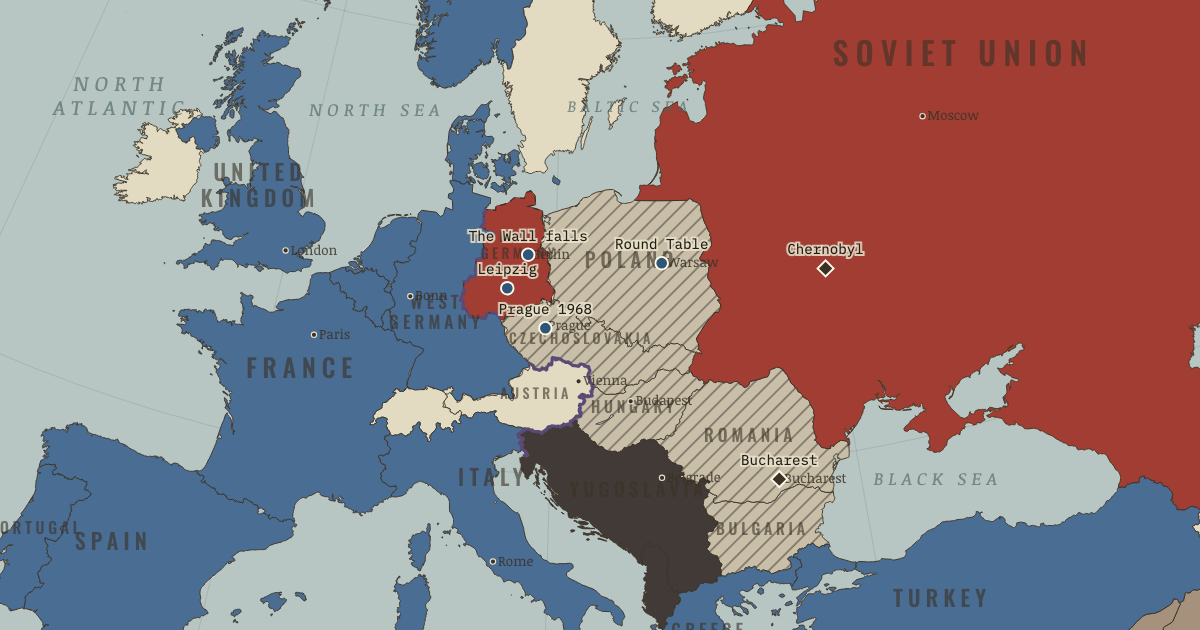
Gorbachev took power in 1985 to save the Soviet system through perestroika and glasnost, but reform exposed its failures faster than it fixed them. He signed the INF Treaty in 1987 and renounced force to prop up Eastern Europe’s regimes. In 1989 opposition spread across the bloc, and on 9 November Berlin’s checkpoints opened.
Chapter 11 is included with every paid plan. WW2 is free in full, and chapter 1 of every atlas is free. A free account opens 3 more chapters a day. Starter, at $9 a month, opens all 21 with no daily limit — see the plans.
Gorbachev inherited a system whose difficulties could no longer be concealed by impressive military power. In the early 1980s Soviet growth was estimated at about 1%, perhaps less than zero, although the official figures were unreliable. The country imported 30–40 million tons of grain a year, and its computers lagged far behind those of the West. A government that licensed copying machines like weapons also restricted the circulation of the knowledge needed for modernization. The fall in oil prices in 1986 removed a valuable cushion. Gorbachev and his “men of the Sixties,” whose outlook had been shaped by the Secret Speech and the crushing of the Prague Spring, believed that opening the system could save it.
The short answer
- Why reform — the numbers Gorbachev read. Gorbachev inherited a system whose difficulties could no longer be concealed by impressive military power. In the early 1980s Soviet growth was estimated at about 1%, perhaps less than zero, although the official figures were unreliable. The country imported 30–40 million tons of grain a year, and its computers lagged far behind those of the West. A government that licensed copying machines like weapons also restricted the circulation of the knowledge needed for modernization. The fall in oil prices in 1986 removed a valuable cushion. Gorbachev and his “men of the Sixties,” whose outlook had been shaped by the Secret Speech and the crushing of the Prague Spring, believed that opening the system could save it.
- Chernobyl as accelerant. The explosion of Reactor 4 on 26 April 1986 made the cost of secrecy visible. Soviet authorities said little for days; Kyiv’s May Day parade went ahead under radioactive fallout, and Swedish sensors helped force disclosure. Gorbachev could see that officials who concealed bad news were making the danger worse. Glasnost consequently went beyond managed candor. Within two years newspapers were reporting Stalin’s crimes, Afghan casualty lists and the secret protocol of the Molotov–Ribbentrop Pact. For Baltic national movements, that last disclosure supplied evidence with which to challenge Soviet rule.
- The Brezhnev Doctrine repealed — and believed. Budapest in 1956 and Prague in 1968 had taught governments and their opponents what Soviet intervention could do. Gorbachev’s renunciation of that policy changed the terms of the struggle, but its meaning became clear through events. On 9 October 1989 security forces did not fire on a large demonstration in Leipzig. Local leaders still had police and armies, yet Moscow could no longer be counted on to rescue them. People watched developments elsewhere, including on West German television received in East Germany, and traveled across borders. Each example of successful action changed what others could reasonably expect; the rapid succession of crises combined that learning with the loss of Soviet backing.
- The West’s underrated role: steadiness, and a partner. Western leaders helped create the conditions in which Gorbachev could act. Reagan’s turn to negotiation gave him a partner for arms agreements, and Thatcher’s early judgment, “we can do business together”, encouraged allied leaders to take him seriously. As the revolutions unfolded, Bush avoided a display of triumph: “I’m not going to dance on the Wall”. The Helsinki process supplied dissidents with commitments and language for their demands. Eastern Europeans made their own revolutions, in a setting shaped partly by Western diplomacy and institutions.
THE TURNING POINT
Berlin, 9 November 1989, 18:53. At 18:53 on 9 November, Günter Schabowski, the Politburo spokesman, was asked when new travel rules would take effect. Searching his notes, he replied: “immediately, without delay.” Tens of thousands went to Berlin’s checkpoints. At Bornholmer Straße, Lieutenant Colonel Harald Jäger called his superiors but received no workable instructions. Around 23:30 he opened the gate rather than use force against the crowd. The Wall had divided Berlin since 13 August 1961; its opening depended both on a mistaken announcement and on the decision of an officer confronted by the people at the border.
What it changed
Germany reunifies — inside the West. The German question followed. Kohl pressed for reunification despite allied caution, Bush supported him, and Gorbachev accepted a united Germany in NATO against his generals’ objections. West German credits and pledges of about DM 55 billion helped secure agreement. On 3 October 1990, less than eleven months after the Wall opened, Germany reunited. The Two-Plus-Four treaty settled the outstanding German questions of the Second World War. Western statements about NATO beyond Germany later became a lasting dispute; the documents record spoken assurances rather than a signed promise on enlargement beyond Germany.
The union catches the contagion. The challenge to established rule was spreading inside the Soviet Union as well. Around two million people joined a human chain across the Baltic states in August 1989, invoking the secret Pact protocol and its consequences. Armenia and Azerbaijan were already in undeclared conflict, and miners struck from Donbas to Kuzbass. Lithuania declared independence in March 1990. Eastern Europe had shown republics that governments could be challenged successfully. Soviet hardliners drew another lesson: they saw a threat to the union that force might be needed to contain. Both responses would shape 1991.
Romania’s warning label. Romania’s transition showed the violence that remained possible. Security forces fired on demonstrators, parts of the army turned against the regime, and Nicolae and Elena Ceaușescu were summarily executed. Five of the six transitions were peaceful by comparison. That outcome rested on choices by officials and soldiers who did not fire, and on years of work by opponents including Solidarity, Charter 77 and the churches. Moscow’s withdrawal of support made restraint easier, but did not make those choices for them.
The full answer, argued
China offers one possible comparison. In June 1989, the month of Poland’s election, force at Tiananmen preserved the government. A Soviet leader might have combined market reform with repression; had Andropov lived, he might have attempted something comparable. But the USSR faced a militarized economy dependent on oil, an external empire of six unwilling nations, and a multinational federation whose constitution nominally allowed secession. Shooting crowds across Europe under Western cameras would also have carried costs during negotiations. Many historians judge that coercion might have postponed collapse, perhaps for a decade, rather than prevented it, with mounting bloodshed and expense. The duration remains uncertain, but another decade would have mattered greatly to those living under those regimes.
An interesting fact
On 19 August 1989, a gate near Sopron was to open for three symbolic hours for a “Pan-European Picnic,” held under the patronage of Otto von Habsburg and reformer Imre Pozsgay. Leaflets alerted East Germans to the opportunity, and about 600 rushed through to Austria, the largest mass escape since the Wall went up. The Hungarian officer on duty, Lieutenant Colonel Árpád Bella, chose not to order his men to stop them. Three weeks later Hungary opened the border to East German refugees.
This is the study layer of Gorbachev and the 1989 revolutions, chapter 11 of The Cold War, 1945–1991; the full index of the atlas is here.
Related questions
THE FREE PRINTABLE STUDY GUIDE
Get the printable study guide for The Cold War free. I’ll send you a few short letters, then one when a new atlas opens. That’s all. — Paul
NO TRACKING · YOUR ADDRESS IS USED FOR THE DISPATCH AND NOTHING ELSE · UNSUBSCRIBE ANYTIME