WW2 · JUN 1944
Why does D-Day overshadow Bagration in Western memory?
The seminar question: “Bagration destroyed four times more German divisions than Normandy, yet D-Day dominates Western memory. Why — and does it matter?”
On 6 June 1944 about 156,000 Allied troops landed on five Normandy beaches, helped by air superiority and the Fortitude deception that held German reserves back for a landing at Calais. On 22 June the Red Army launched Operation Bagration in Belarus and destroyed Army Group Centre. Paris was liberated on 25 August.
WW2 is free — every chapter. No sign-up.
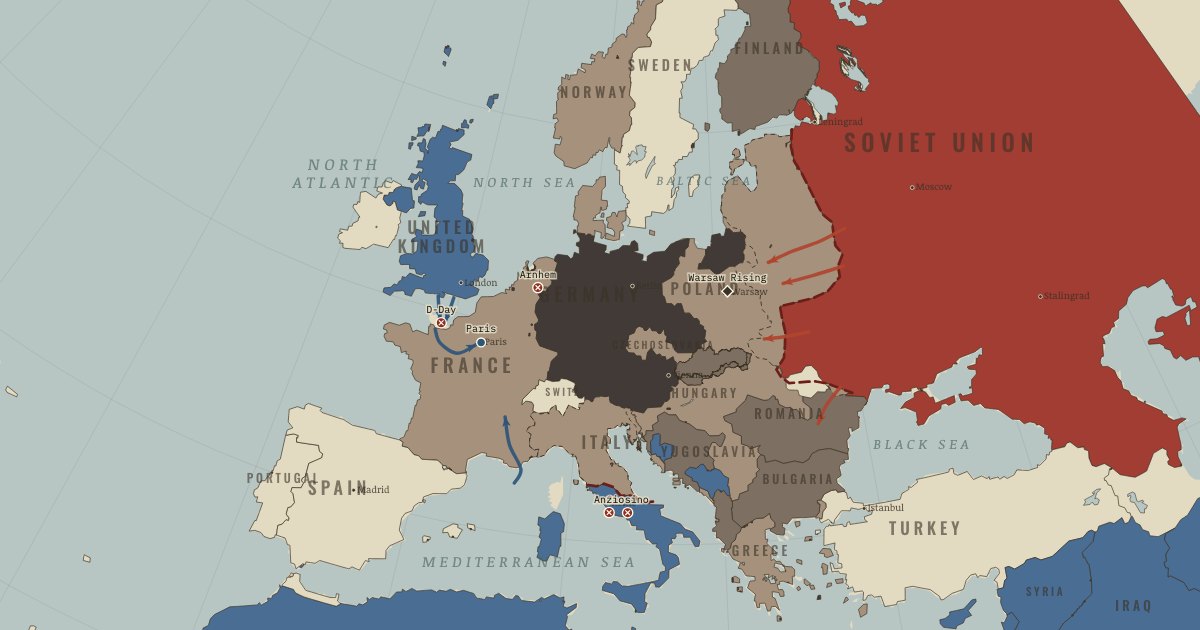
The Western Allies sent about 156,000 troops onto five Normandy beaches on 6 June 1944. Getting them there was an undertaking years in preparation. Ships had to cross the Atlantic safely; aircraft had to hinder German movement across France; landing craft and supplies had to be assembled in immense quantities. Once the troops were ashore, naval gunfire and the resources following them across the Channel helped them establish a foothold.
The short answer
- Preparing the crossing. The crossing depended on three years of preparation. Victory in the Battle of the Atlantic in 1943 protected the Allied buildup; air supremacy over France followed in spring 1944, at terrible cost to bomber crews. Artificial Mulberry harbors were prepared for towing across the Channel. The disastrous Dieppe raid in 1942 and losses in the Slapton Sands exercises showed planners dangers the invasion would have to overcome.
- Fortitude and Calais. Fortitude presented German intelligence with a fictional First US Army Group aimed at Calais. False radio traffic, dummy equipment and double agents made the threat appear credible. German leaders kept forces near Calais after 6 June in expectation of another landing, affecting the troops available to oppose Normandy.
- An allied timetable. At Tehran in November 1943, Stalin promised an eastern offensive alongside Overlord. The attacks in June 1944 put Germany under pressure from both directions at once. Reinforcing either front with troops from the other became more difficult.
THE TURNING POINT
Omaha Beach, 6 June. The plan held on four beaches, but at Omaha the first waves were pinned beneath the bluffs. Bombs had fallen beyond their targets and many amphibious tanks had sunk. Junior officers found ways forward under fire, while destroyers moved close to support the troops. The foothold depended on those decisions as well as the preparations that brought the force to France.
What it changed
The liberation of France. Operation Cobra broke the Allies out of Normandy; Operation Dragoon brought another landing on the Riviera. Paris was liberated on 25 August. Move the timeline to September to follow the advance across France. Germany faced powerful Allied armies in both west and east.
The eastern front broken. Army Group Centre's destruction opened the way for Soviet forces to reach Warsaw's suburbs by August. The advance continued in 1945 and brought the Red Army to Berlin. Normandy and Bagration belong together in the account of Germany's defeat: each applied pressure from a different direction.
Warsaw and the coming settlement. The Home Army wanted to free Warsaw before Soviet forces arrived, partly because it feared what their arrival would mean for Polish government. German forces crushed the uprising and devastated the city while the Soviets halted. Historians dispute the relative importance of exhaustion, supply difficulties and Stalin's political calculation in that halt. Warsaw revealed conflicts that would shape the postwar settlement.
The 20 July plot. On 20 July German officers planted a bomb at Hitler's headquarters. Hitler survived, and reprisals strengthened the regime's grip over the army. The plot did not produce a German surrender.
The full answer, argued
Normandy has a prominent place in Western national commemoration, films and accessible archives, a pattern also shaped by Cold War politics. Its risks were distinctive: a failed amphibious invasion would have been hard to repeat quickly. But the imbalance matters when it hides the scale of the Eastern Front or the experiences of countries between Germany and the Soviet Union. The two offensives pressed Germany at the same time.
An interesting fact
German intelligence knew Juan Pujol García as ARABEL; Britain knew him as GARBO. The Spanish former poultry farmer supplied reports attributed to 27 sub-agents, all of them invented. Germany awarded him the Iron Cross for his D-Day reporting, and Britain appointed him MBE months later. After the war he faked his death and kept a bookshop in Venezuela, where a historian found him in 1984.
This is the study layer of D-Day and Operation Bagration, chapter 12 of The War Room — WW2, 1936–1945; the full index of the atlas is here.
Related questions
THE FREE PRINTABLE STUDY GUIDE
Get the printable study guide for WW2 free. I’ll send you a few short letters, then one when a new atlas opens. That’s all. — Paul
NO TRACKING · YOUR ADDRESS IS USED FOR THE DISPATCH AND NOTHING ELSE · UNSUBSCRIBE ANYTIME