Decolonization of Africa · MAR 1990
Why did apartheid South Africa agree to negotiate in 1990?
The seminar question: “After decades of protest, sanctions and armed resistance, why did the apartheid government begin to negotiate around 1990?”
From 1948 South Africa’s National Party built apartheid, a legal system of racial classification, dispossession and exclusion. After police killed sixty-nine people at Sharpeville in 1960 the ANC and PAC turned to armed struggle; township revolt, the 1985 debt crisis and the Cold War’s end led to Mandela’s release in 1990.
Chapter 10 is included with every paid plan. WW2 is free in full, and chapter 1 of every atlas is free. A free account opens 3 more chapters a day. Starter, at $9 a month, opens all 21 with no daily limit — see the plans.
Free printable Decolonization of Africa study guide, sent by email ↓
From 1948 the National Party made racial separation a system of government. Classification affected where a person could live, work, study, and marry. Pass laws controlled movement, and land policy reserved most of the country for whites. The homeland policy assigned Black South Africans to fragmented territories, allowing the state to deny them national political rights while continuing to rely on their labor. These measures worked together: the government sought both political exclusion and a controlled workforce.
The short answer
- The architecture of apartheid. The National Party built on earlier segregation after 1948, using racial classification to organize rights and restrictions throughout society. Mixed marriages were banned; land laws reserved about 87% of the country for whites; pass laws controlled Black movement. Under the homeland policy, Black South Africans were assigned to nominal states in fragmented territories, and those assigned citizenship there lost South African citizenship. Political exclusion and restricted access to land helped sustain a controlled labor supply. Because the measures supported one another, changing a few laws would leave much of the structure intact. Its full anatomy belongs to the planned apartheid atlas.
- The turn to armed struggle. The massacre at Sharpeville in 1960 and the banning of the ANC and PAC changed the conditions of resistance. Police had killed sixty-nine protesters, and open political organization became much harder. The ANC’s Umkhonto we Sizwe turned to sabotage and later guerrilla struggle; leaders including Mandela and Walter Sisulu faced prison or exile. Resistance continued for decades from cells, townships, and neighboring states. As in Algeria, state violence helped radicalize opposition, though the movements and wars followed different paths.
- The pressure of finance. Sanctions had often been partial and could be evaded. The financial crisis of 1985 exposed a more immediate vulnerability: international banks refused to roll over short-term loans. South Africa faced a debt crisis, the rand fell, and capital fled. Businesses dependent on finance could see the price of isolation in their own affairs. Alongside internal resistance, the crisis persuaded white business leaders and officials that apartheid threatened economic as well as political stability. Economic self-interest helped move an establishment that moral appeals alone had not persuaded.
- De Klerk’s calculation. By 1989 de Klerk had to weigh the strength the state still possessed against pressures it could not easily remove: township resistance, economic strain, costly regional conflict, and the loss of a protective buffer. The Namibia settlement changed the value of further regional confrontation. Meanwhile, the ending Cold War weakened Pretoria’s claim to be an anti-communist bastion and reduced its fear of Soviet backing for the ANC. De Klerk judged that bargaining from relative strength offered better prospects than waiting for decline or continuing an unwinnable confrontation. Resistance had changed his options; he chose negotiation among them.
THE TURNING POINT
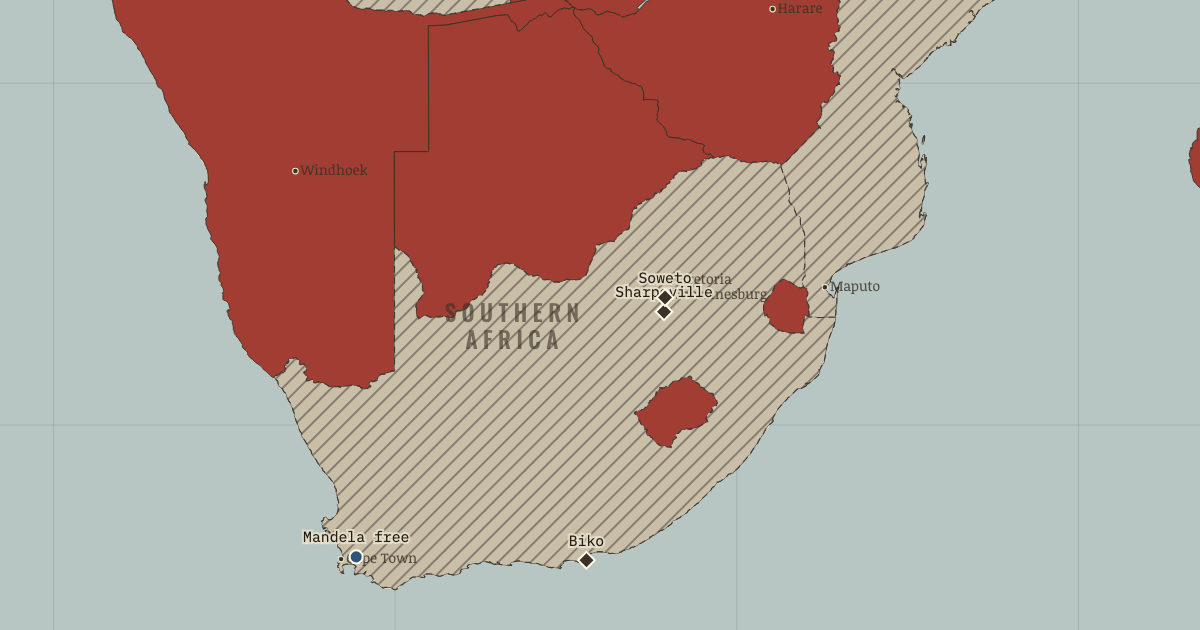
Mandela walks free, 11 February 1990. Nelson Mandela walked out of prison on 11 February 1990, after twenty-seven years. The government had unbanned the ANC and was prepared to bargain with the movement it had tried to suppress. Like Algeria and Rhodesia, South Africa had seen a long struggle over settler rule. Under enormous pressure, its government now chose negotiation. Mandela’s release marked the beginning of that phase, not the settlement itself. The next chapter follows the costs of the bargain and how narrowly it survived.
What it changed
From resistance to negotiation. A banned movement and the government that had imprisoned its leader now entered negotiations. The government controlled the state, while the liberation movement could mobilize resistance. Either could obstruct an agreement, yet neither could readily impose its own terms. Armed struggle wound down as the parties began bargaining over a new constitution. Four difficult years lay ahead.
The memorials remain. A political transition could not undo the deaths at Sharpeville and Soweto, Steve Biko’s death in custody, or the loss of thousands of others. The later Truth and Reconciliation Commission sought public testimony about abuses so that the past would enter national memory; its choices about accountability remain contested. The places shown here are sites of memory, never scores of progress.
Southern Africa and the Cold War. The collapse of Soviet communism in 1989–91 changed the international setting for a settlement. Pretoria’s claim to be a bulwark against communism lost force, while the ANC faced the loss of a Soviet patron. With those changes, fears surrounding negotiation diminished on both sides. Namibia’s independence and the ANC’s unbanning came within months of the fall of the Berlin Wall. Southern Africa’s endgame was bound up with the changing Cold War order.
The full answer, argued
By 1990 the state still had formidable security forces, but force had not produced a stable future. Township resistance and organized labor raised the cost of governing. The 1985 refusal by banks to renew short-term loans led to a debt crisis and capital flight, making the financial consequences of isolation clear to white business leaders and government. Regional fighting, including Cuito Cuanavale, and the Namibia settlement challenged Pretoria’s ability to maintain regional dominance. The ending Cold War changed the calculation as well. It weakened the government’s anti-communist justification and reduced its fear of a Soviet-backed ANC. De Klerk judged that bargaining while the state retained leverage was preferable to continued confrontation or negotiation after further decline. Decades of resistance had changed the choices before him, but the decision was still contingent. Negotiation began the work of ending apartheid; it did not complete it.
An interesting fact
Long Walk to Freedom began in secret on Robben Island. Mandela wrote at night in the mid-1970s, while Walter Sisulu and Ahmed Kathrada added comments in the margins. Mac Maharaj copied the text in minute script and carried it out when he was released in 1976. The original was buried in containers in the prison courtyard, where warders found it while digging foundations for a new wall. Mandela lost his study rights for four years. The confiscated manuscript became a president’s memoir.
This is the study layer of Apartheid in South Africa, chapter 10 of The Decolonization of Africa, 1945–1994; the full index of the atlas is here.
Related questions
THE FREE PRINTABLE STUDY GUIDE
Get the printable study guide for The Decolonization of Africa free. I’ll send you a few short letters, then one when a new atlas opens. That’s all. — Paul
NO TRACKING · YOUR ADDRESS IS USED FOR THE DISPATCH AND NOTHING ELSE · UNSUBSCRIBE ANYTIME