14 ATLASES
History of Turkey in maps
Turkey as it appears in 14 interactive history atlases, from 264 BC to 2015: Asia Minor, Anatolia — Rûm & Byzantium, Anatolia, the Ottoman Empire, Turkey, Ottoman Empire. Each era below lists who ruled the land and when control changed, linked to the dated map that shows it.
WW2 is free in full, and chapter 1 of every atlas is free. A free account opens 3 more chapters a day. Starter, at $9 a month, opens all 21 with no daily limit — see the plans.
What was Turkey before it was Turkey? The sections below follow this land through every era covered by the Maps of History atlases: who ruled it, what it was called, and when control changed. Each line links to the dated map. Modern borders serve as an approximation, as each atlas says on the map itself.
Asia Minor (mod. Turkey) · Ancient Rome
Asia Minor passed from Hellenistic kingdoms into Roman rule. Pergamon came through the bequest of Attalus III in 133 BC. In 88 BC Mithridates of Pontus ordered Italians in the region massacred; ancient accounts give the number of victims as 80,000. His wars with Rome lasted about 25 years. After Constantinople’s foundation in 330, Asia Minor supplied taxes and recruits to an eastern empire that outlasted the West by a thousand years.
| 264 BC | Hellenistic kingdoms — the opening position |
| 62 BC | Roman clients & allies |
| Roman territory |
ANCIENT ROME: EVERY CHAPTER AND MAP →
Anatolia — Rûm & Byzantium · Crusades
Crossing Anatolia could be deadlier to a crusading army than fighting a battle. After Manzikert in 1071, the Seljuk Sultanate of Rûm held the interior, and the long marches across it killed more crusaders than any battle. Byzantium recovered the western coast after 1097 (watch the front shift east). On the European shore, the Fourth Crusade took Thrace and Constantinople in 1204; they were restored in 1261.
| The Islamic powers — Seljuk, Zengid, Ayyubid, Mamluk — the opening position |
CRUSADES: EVERY CHAPTER AND MAP →
Anatolia (Seljuk Rûm) · Mongol Empire
Seljuk Rûm was Anatolia’s great power until its army broke in a single afternoon at Köse Dağ in 1243. The sultanate became a tax-paying Mongol vassal, a model client, but Mongol dominance hollowed it out. Turkish frontier bands moved west, among them Osman’s band in the border hills of Bithynia. The Ottoman Empire was one unintended descendant of the Ilkhanate’s domination.
| The Islamic powers — the opening position | |
| Tributaries & vassals |
MONGOL EMPIRE: EVERY CHAPTER AND MAP →
The Ottoman Empire (Anatolia) · Industrial Revolution
The Treaty of Balta Liman in 1838 opened Ottoman markets to British goods, and handicraft industries suffered from the competition. European loans financed railways, ports and mines. When the state defaulted, European bondholders gained control of much of its revenue through the Ottoman Public Debt Administration of 1881.
| Opened by force or treaty — the opening position | |
| Opened by force or treaty |
INDUSTRIAL REVOLUTION: EVERY CHAPTER AND MAP →
Ottoman Empire · Age of Revolutions
For the Ottoman Empire, the age brought the Eastern Question. Russia pressed it in the wars of 1806–12 and 1828–29, European intervention took Greece from it, and its own Egyptian viceroy nearly overthrew it. Reformers answered with the Tanzimat in 1839: constitutions and codes on the French model, adopted to resist the powers that had invented them. The age’s ideas could travel beyond the reach of its armies.
| Neutral / uncommitted — the opening position |
AGE OF REVOLUTIONS: EVERY CHAPTER AND MAP →
Turkey · Meiji Japan and post-Soviet Russia
| Western powers and allies — the opening position |
MEIJI JAPAN AND POST-SOVIET RUSSIA: EVERY CHAPTER AND MAP →
Ottoman Empire · Russian Revolution
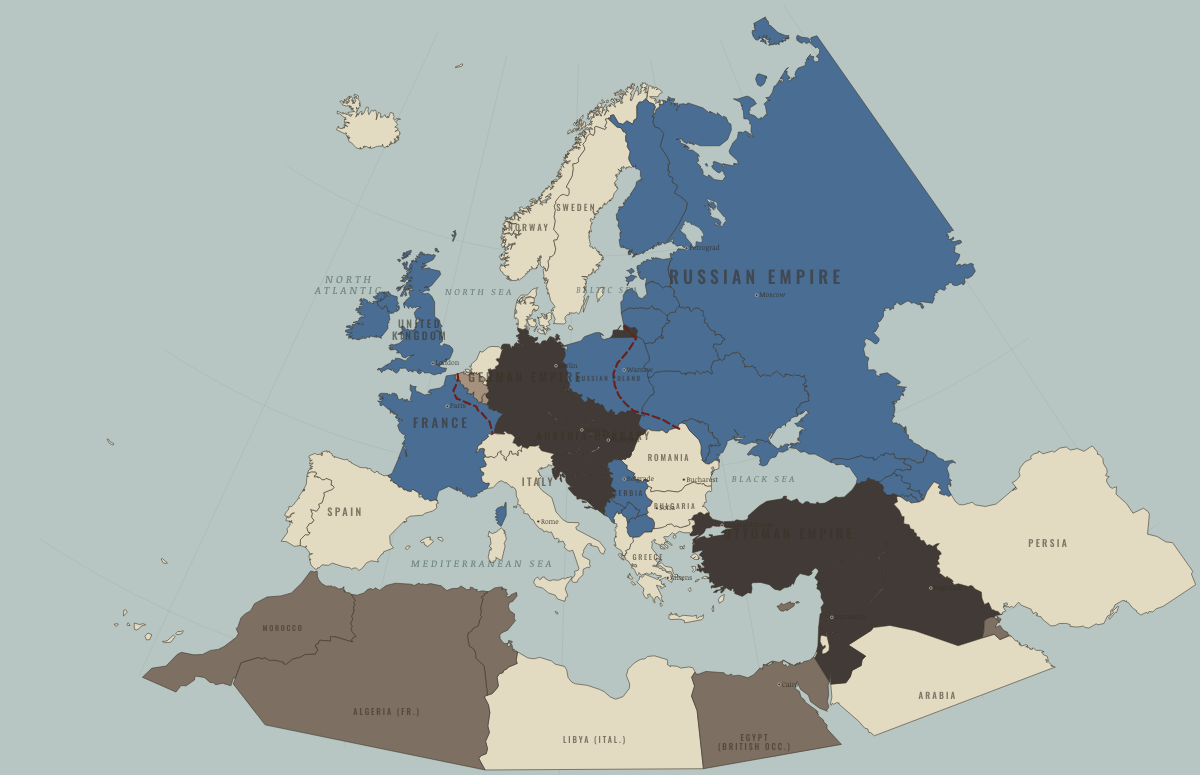
The Ottoman Empire fought Russia in the World War, lost and dissolved. Kemal’s new Turkey emerged from its ruins and briefly found common cause with Soviet Russia against the Western powers. Both were revolutionary states on the Black Sea whose monarchies had been overthrown, yet they watched one another warily across the Caucasus.
| Foreign powers & intervention — the opening position |
RUSSIAN REVOLUTION: EVERY CHAPTER AND MAP →
Ottoman Empire · WWI
The Ottoman Empire appears here with its Arab provinces composed of modern states. Entering the war in November 1914, it defended Gallipoli brilliantly (Ch. 6) and destroyed a British army at Kut. Its government also used the cover of war to murder the Armenians (Ch. 6). Defeat at Megiddo (Ch. 12) brought partition, Sèvres and a map drawn by the victors; Mustafa Kemal’s new Turkey tore it up by 1923. Six centuries of empire had ended, leaving mandates that are the modern Middle East.
Turkey · Stalin’s Soviet Union
Turkey remained neutral for most of the war. In 1945–46 Stalin pressed it for bases in the Straits and the return of Kars and Ardahan provinces. American support, announced in the Truman Doctrine of 1947, ended the pressure. Turkey joined NATO in February 1952, explaining its change to blue on the map.
| Rivals & the Western bloc — the opening position | |
| Rivals & the Western bloc |
STALIN’S SOVIET UNION: EVERY CHAPTER AND MAP →
Turkey · Road to WW2
Turkey was courted by every bloc and read the decade correctly. It negotiated the 1936 Montreux Convention for itself and became guarantor of the Straits. Agreements followed with Britain and France in 1939 and Germany in 1941. Turkey fought for no one until its symbolic declaration in 1945. Its survival as a small power was played as a hand of cards.
| Neutral & unaligned — the opening position |
ROAD TO WW2: EVERY CHAPTER AND MAP →
Turkey · WW2
Turkey stayed neutral until a symbolic declaration of war in February 1945. Its geography made that neutrality strategically important: both sides courted Turkey, Germany received its chromite, and spies used it as a listening post.
Turkey · Cold War
| US-aligned states — the opening position | |
| US-aligned states | |
| NATO & core Western allies |
COLD WAR: EVERY CHAPTER AND MAP →
Turkey · Feminism and the Tunisian Revolution
| Right won in law — the opening position | |
| No reform yet / outside this story | |
| Right won in law |
FEMINISM AND THE TUNISIAN REVOLUTION: EVERY CHAPTER AND MAP →
Turkey · Refugee crises
| Western bloc or democracy — the opening position | |
| Western bloc or democracy |
REFUGEE CRISES: EVERY CHAPTER AND MAP →
Related
THE FREE PRINTABLE STUDY GUIDE
Get a printable atlas study guide of your choice free. I’ll send you a few short letters, then one when a new atlas opens. That’s all. — Paul
NO TRACKING · YOUR ADDRESS IS USED FOR THE DISPATCH AND NOTHING ELSE · UNSUBSCRIBE ANYTIME