15 ATLASES
History of Poland in maps
Poland as it appears in 15 interactive history atlases, from 1095 to 2015: Poland, the Polish duchies, the Polish lands, Poland-Lithuania. Each era below lists who ruled the land and when control changed, linked to the dated map that shows it.
WW2 is free — every chapter. No sign-up.
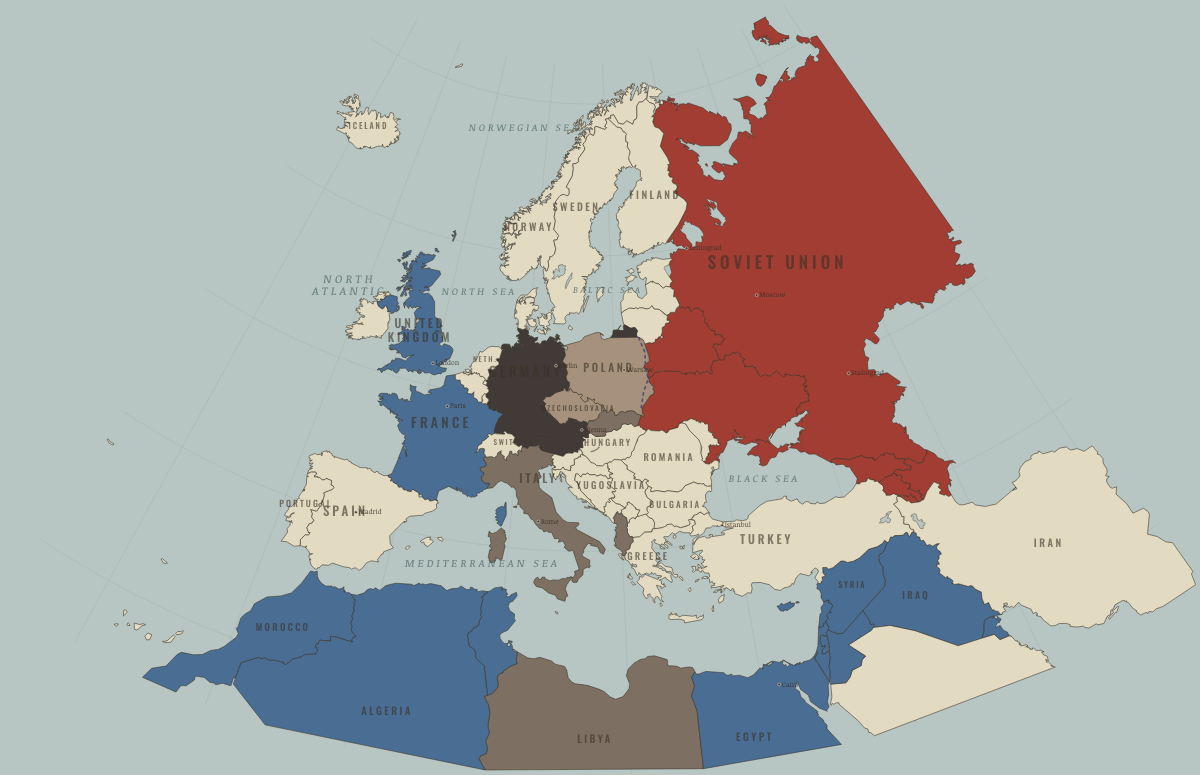
What was Poland before it was Poland? The sections below follow this land through every era covered by the Maps of History atlases: who ruled it, what it was called, and when control changed. Each line links to the dated map. Modern borders serve as an approximation, as each atlas says on the map itself.
Beyond the Amber Road (mod. Poland) · Ancient Rome
ANCIENT ROME: EVERY CHAPTER AND MAP →
Poland · Norse and Aztecs
| Other peoples and states — the opening position |
NORSE AND AZTECS: EVERY CHAPTER AND MAP →
Poland · Crusades
| Latin Christendom — the opening position |
CRUSADES: EVERY CHAPTER AND MAP →
The Polish duchies (mod. Poland) · Mongol Empire
The attack on the Polish duchies served the invasion of Hungary: it was a feint to keep Polish knights away from the Mongol flank. At Legnica on 9 April 1241, Duke Henry’s army was destroyed and Kraków burned, two days before Mohi. Further raids followed in 1259 and 1287, but Poland was never occupied. Historians note that it was too far from the grass to be worth holding.
| Other settled powers (Jin China, Christendom, Delhi) — the opening position | |
| The Mongol Empire | |
| Other settled powers (Jin China, Christendom, Delhi) |
MONGOL EMPIRE: EVERY CHAPTER AND MAP →
The Polish lands (Prussian, Russian and Austrian) · Industrial Revolution
Prussia, Russia and Austria divided the Polish lands throughout the period of this atlas, so industrialization took place under three governments. Prussian Upper Silesia became one of Europe’s great coalfields. In Russian Poland, Łódź grew from a small town into the Polish Manchester: German, Jewish and Polish entrepreneurs built textile mills there, and migrants from the countryside worked in them. Its workers struck in 1892 and rose again during the revolution of 1905.
| Industrialising — the opening position | |
| Industrialising | |
| Industrialising |
INDUSTRIAL REVOLUTION: EVERY CHAPTER AND MAP →
Poland-Lithuania (mod. Poland) · Age of Revolutions
Poland disappeared in 1795 after three partitions. Napoleon revived a smaller version as the Duchy of Warsaw in 1807; at Vienna it was traded for a Russian-ruled “Congress Kingdom.” Poles revolted in 1830 and 1846, while their soldiers fought for France from Italy to Haiti. In Haiti, some Polish legionaries defected when ordered against fellow strugglers for freedom. Through the age, the Polish nation survived without a state.
| The conservative monarchies — the opening position |
AGE OF REVOLUTIONS: EVERY CHAPTER AND MAP →
Poland · Meiji Japan and post-Soviet Russia
Poland was a restless Soviet ally. Workers revolted in 1956, 1970 and 1976; the Solidarity union emerged in 1980, and martial law followed in 1981. In June 1989 Solidarity won the bloc’s first partly free elections. Poland’s rapid “shock therapy” in 1990 then became a model that Russian reformers hoped to follow. Poland joined NATO in 1999, as the 2000 map shows.
| Soviet-bloc states — the opening position | |
| Independent neighbours | |
| Western powers and allies |
MEIJI JAPAN AND POST-SOVIET RUSSIA: EVERY CHAPTER AND MAP →
Poland (Russian, German & Austrian partitions) · Russian Revolution
Congress Poland was the part of partitioned Poland ruled by the Tsar. It rose against Russia in January 1863, and after the rising was crushed, its autonomy was abolished and Russian imposed in schools and offices. Poland was reborn on 11 November 1918, after 123 years partitioned among Russia, Germany and Austria, but its borders still had to be fought for on every frontier. In August 1920 its army stopped the Red Army at the gates of Warsaw, ending Bolshevik hopes of carrying revolution into Europe. The border Poland won at Riga lasted until Hitler and Stalin erased it in 1939.
| The Tsarist empire — the opening position | |
| Foreign powers & intervention | |
| Breakaway national states |
RUSSIAN REVOLUTION: EVERY CHAPTER AND MAP →
Poland (partitioned) · WWI
Since 1795 Poland had been divided among the three empires whose armies met on its soil. Poles were conscripted into all three, and in 1914–15 the Eastern Front crossed the partition. German occupation followed in 1915. Independence was proclaimed under Piłsudski on 11 November 1918, but the borders still had to be fought out on every side, including the defeat of the Red Army at Warsaw in 1920. The state restored at Versailles would be the first erased in the next war.
| The Entente & Allies — the opening position | |
| The Entente & Allies | |
| Under Central Powers occupation | |
| Neutral or unaligned | |
| The Entente & Allies | |
| Under Central Powers occupation | |
| Neutral or unaligned |
Poland · Stalin’s Soviet Union
The Nazi–Soviet Pact provided for the partition of Poland, which Germany and the Soviet Union carried out in September 1939. The Soviet half was annexed as western Ukraine and western Belarus. In 1940 the NKVD shot about 22,000 Polish officers and officials at Katyn and elsewhere, and deported hundreds of thousands of Polish citizens. Poland moved west in 1945, losing its eastern lands in exchange for German territory. By 1947 a communist government loyal to Moscow ruled the country.
| Nazi Germany & its allies — the opening position | |
| Nazi Germany & its allies | |
| Satellites & communist allies |
STALIN’S SOVIET UNION: EVERY CHAPTER AND MAP →
Poland · Road to WW2
In one year Poland refused both dictators; in one month they partitioned it. Poland declined Hitler's offer of client status and, despite Britain's guarantee, fought alone. Its disappearance from the map was not a capitulation. A government-in-exile, an underground state at home and pilots over London in 1940 continued the struggle. A fifth of Poland's people would not survive the war its refusal opened. See also the ◆ at Katyń.
| Neutral & unaligned — the opening position | |
| Occupied — held by force |
ROAD TO WW2: EVERY CHAPTER AND MAP →
Poland · WW2
Poland was the war’s first victim and among its greatest sufferers in proportion to population. Germany and the Soviet Union partitioned it in 1939; the Holocaust’s extermination camps were located there, and Warsaw suffered betrayal in 1944. Poland was then “liberated” into Soviet control, and at the peace its territory shifted some 200 km west. It produced no collaborationist government, and its resistance was Europe’s largest.
| Axis-occupied — the opening position | |
| Axis-occupied | |
| Soviet Union |
Poland · Cold War
The Cold War was first argued over Poland (Ch. 1). Yalta promised it free elections; a police state followed, and unrest returned in 1956, 1970, and 1976. Solidarity (Ch. 10) then organized ten million people. After its members were jailed under martial law, the movement took a seat at the Round Table eight years later. Its sweep of the June 1989 election began the bloc’s six-month collapse. Poland had lost every Cold War battle except the last.
| Soviet-aligned states — the opening position | |
| In upheaval / changing sides | |
| Non-aligned & neutral | |
| In upheaval / changing sides | |
| Non-aligned & neutral |
COLD WAR: EVERY CHAPTER AND MAP →
Poland · Feminism and the Tunisian Revolution
| Right won in law — the opening position | |
| Partial or unequal; treaty signed only; transition | |
| No reform yet / outside this story | |
| Right won in law |
FEMINISM AND THE TUNISIAN REVOLUTION: EVERY CHAPTER AND MAP →
Poland · Refugee crises
The victors moved Poland westward. It lost nearly half its prewar territory to the Soviet Union and gained German lands east of the Oder and Neisse. Millions of Germans were expelled or left, while some 1.2 to 1.5 million Poles and Jews arrived from the east and about 482,000 Ukrainians went to Soviet Ukraine. In 1947 Operation Vistula scattered another 140,000 Ukrainians across Poland’s new west. Before the war minorities had made up about a third of the population; by 1950 the country was almost wholly Polish.
| Soviet-occupied or communist — the opening position | |
| Western bloc or democracy |
REFUGEE CRISES: EVERY CHAPTER AND MAP →
Related
THE FREE PRINTABLE STUDY GUIDE
Get a printable atlas study guide of your choice free. I’ll send you a few short letters, then one when a new atlas opens. That’s all. — Paul
NO TRACKING · YOUR ADDRESS IS USED FOR THE DISPATCH AND NOTHING ELSE · UNSUBSCRIBE ANYTIME