9 ATLASES
History of the Philippines in maps
The Philippines as it appears in 9 interactive history atlases, from 1750 to 2000: the Philippines, Philippines. Each era below lists who ruled the land and when control changed, linked to the dated map that shows it.
WW2 is free — every chapter. No sign-up.
What was the Philippines before it was Philippines? The sections below follow this land through every era covered by the Maps of History atlases: who ruled it, what it was called, and when control changed. Each line links to the dated map. Modern borders serve as an approximation, as each atlas says on the map itself.
The Philippines (Spanish; American from 1898) · Industrial Revolution
| Colony or dependency — the opening position |
INDUSTRIAL REVOLUTION: EVERY CHAPTER AND MAP →
The Philippines · Meiji Japan and post-Soviet Russia
| Western powers and allies — the opening position |
MEIJI JAPAN AND POST-SOVIET RUSSIA: EVERY CHAPTER AND MAP →
Philippines · WWI
The Philippines (American) · Chinese Revolution
The Philippines, an American colony across the sea, had a schedule for independence: a commonwealth in 1935 and a republic in 1946. It was a test of whether an empire could withdraw gracefully. Japan’s occupation in 1941–45 interrupted that course with a brutality Manila shared with Chinese cities. Among the guerrillas who fought back was the Hukbalahap, a peasant, communist-led movement schooled in doctrines also circulating from Yan’an. Independence came in 1946, but the Huks were excluded from its politics. Their rebellion continued into the 1950s, an offshore echo of the Chinese revolution.
| Foreign empires — British, French, Russian, American — the opening position | |
| The Empire of Japan & its puppets | |
| Foreign empires — British, French, Russian, American |
CHINESE REVOLUTION: EVERY CHAPTER AND MAP →
The Philippines (US Commonwealth) · Road to WW2
| Colonial empires & possessions — the opening position |
ROAD TO WW2: EVERY CHAPTER AND MAP →
Philippines · WW2
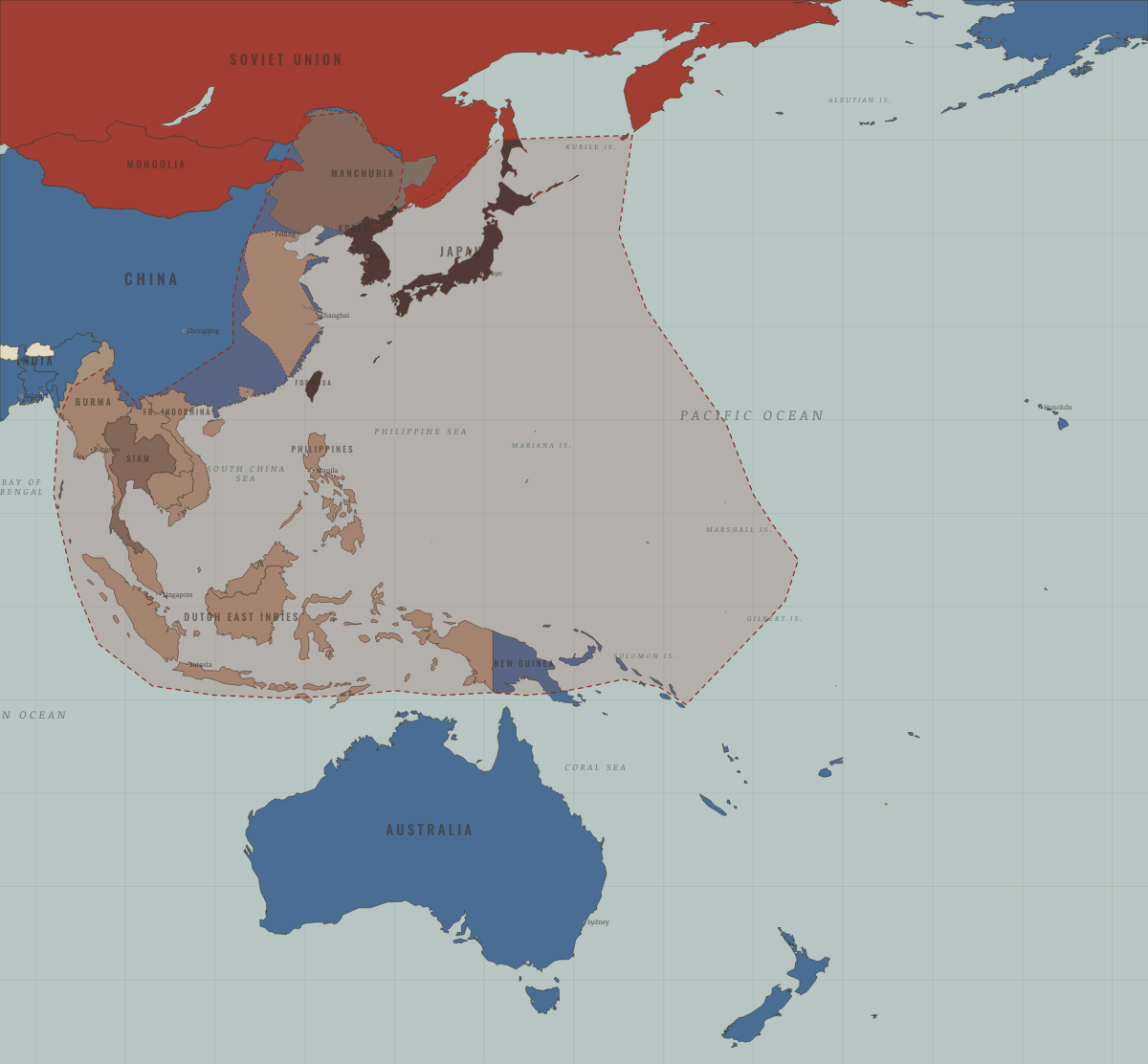
The Philippines was an American colony promised independence when Japan overran it in 1942; the Bataan death march followed. MacArthur made his promised return at Leyte in 1944, and the Battle of Manila devastated the city. Independence came in 1946, the first domino of postwar decolonization.
| Western Allies — the opening position | |
| Axis-occupied | |
| Western Allies |
Philippines · Cold War
| NATO & core Western allies — the opening position | |
| US-aligned states |
COLD WAR: EVERY CHAPTER AND MAP →
Philippines · Refugee crises
The Philippines hosted American evacuees at Subic Bay in 1975 and opened a first-asylum camp on Palawan from 1979. From 1980 the Refugee Processing Center at Bataan prepared more than 400,000 people, who learned English before going to the United States. In 1981 the Philippines became the only first-asylum state in the region to accede to the Refugee Convention.
| Western bloc or democracy — the opening position | |
| First asylum open | |
| First asylum restricted | |
| First asylum open |
REFUGEE CRISES: EVERY CHAPTER AND MAP →
The Philippines · Mao’s China
| Beijing’s adversaries — the opening position | |
| Neutral, non-aligned or colonial |
MAO’S CHINA: EVERY CHAPTER AND MAP →
Related
THE FREE PRINTABLE STUDY GUIDE
Get a printable atlas study guide of your choice free. I’ll send you a few short letters, then one when a new atlas opens. That’s all. — Paul
NO TRACKING · YOUR ADDRESS IS USED FOR THE DISPATCH AND NOTHING ELSE · UNSUBSCRIBE ANYTIME