8 ATLASES
History of Mexico in maps
Mexico as it appears in 8 interactive history atlases, from 1750 to 2015: Mexico, New Spain, New Spain / Mexico. Each era below lists who ruled the land and when control changed, linked to the dated map that shows it.
WW2 is free in full, and chapter 1 of every atlas is free. A free account opens 3 more chapters a day. Starter, at $9 a month, opens all 21 with no daily limit — see the plans.
Free printable Feminism and the Tunisian Revolution study guide, sent by email ↓
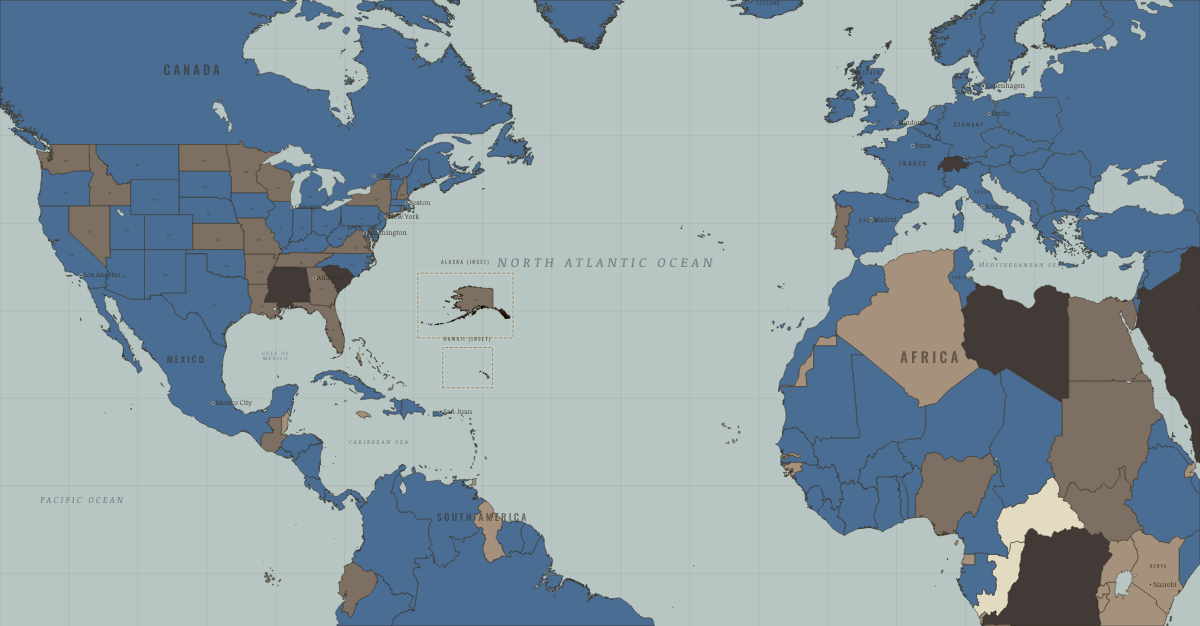
What was Mexico before it was Mexico? The sections below follow this land through every era covered by the Maps of History atlases: who ruled it, what it was called, and when control changed. Each line links to the dated map. Modern borders serve as an approximation, as each atlas says on the map itself.
Mexico — beyond the empire · Norse and Aztecs
Many peoples beyond the empire were never ruled by the Triple Alliance. They included northern hunting and farming peoples whom the Mexica called Chichimecs, the Huastec lordships of the northern Gulf coast and the states of the isthmus. The empire’s reach was uneven, and its frontiers were places of trade, raiding and diplomacy.
| Other peoples and states — the opening position |
NORSE AND AZTECS: EVERY CHAPTER AND MAP →
Mexico (New Spain to 1821) · Industrial Revolution
| Colony or dependency — the opening position | |
| Agrarian economy |
INDUSTRIAL REVOLUTION: EVERY CHAPTER AND MAP →
New Spain (mod. Mexico) · Age of Revolutions
New Spain’s independence came through two revolutions. Hidalgo and Morelos led popular risings of villagers in 1810–15, which creole officers crushed. When Spanish liberalism later threatened their privileges, those officers made a conservative break of their own under Iturbide in 1821. Empire gave way to a republic in 1824, then came decades of coups and the loss of the far north. The Indigenous and agrarian social question remained open.
| Colonial possessions — the opening position | |
| Republics & revolutionary states |
AGE OF REVOLUTIONS: EVERY CHAPTER AND MAP →
New Spain / Mexico · Haiti and Kenya independence
| Under colonial rule — the opening position | |
| Other states and societies |
HAITI AND KENYA INDEPENDENCE: EVERY CHAPTER AND MAP →
Mexico · American Civil War
While the United States fought its Civil War, Mexico faced an invasion of its own. France invaded in 1862 and installed Maximilian of Habsburg as emperor against Juárez’s republic. Napoleon III had explicitly counted on the United States being too occupied to enforce the Monroe Doctrine. Confederate Texas, meanwhile, traded cotton through Matamoros around the blockade throughout the war. After Appomattox, Sheridan brought 50,000 veterans to the Rio Grande, and Washington armed the Juaristas. France withdrew in 1867, and Maximilian faced a firing squad. Both republics survived invasions during the same decade, a parallel neither overlooked.
| Mexico, 1840–54 — the opening position | |
| Neighbors & the outside world | |
| Neighbors & the outside world |
AMERICAN CIVIL WAR: EVERY CHAPTER AND MAP →
Mexico · WWI
Mexico · Cold War
| US-aligned states — the opening position |
COLD WAR: EVERY CHAPTER AND MAP →
Mexico · Feminism and the Tunisian Revolution
Women gained the national vote in Mexico in 1953 and first used it in 1955. Twenty years later Mexico City hosted the first UN World Conference on Women. There, Bolivian, Mexican and American activists argued over whether poverty or patriarchy came first. Mexico was among the first countries to ratify CEDAW, in March 1981.
| Refused: women excluded; ERA never ratified — the opening position | |
| Right won in law | |
| No reform yet / outside this story | |
| Right won in law |
FEMINISM AND THE TUNISIAN REVOLUTION: EVERY CHAPTER AND MAP →
Related
THE FREE PRINTABLE STUDY GUIDE
Get a printable atlas study guide of your choice free. I’ll send you a few short letters, then one when a new atlas opens. That’s all. — Paul
NO TRACKING · YOUR ADDRESS IS USED FOR THE DISPATCH AND NOTHING ELSE · UNSUBSCRIBE ANYTIME