15 ATLASES
History of the Czech Republic in maps
The Czech Republic as it appears in 15 interactive history atlases, from 264 BC to 2015: Boiohaemum, Bohemia, Kingdom of Bohemia, Bohemia and Moravia, Czechoslovakia, Austria-Hungary, Czech lands, Czech Republic. Each era below lists who ruled the land and when control changed, linked to the dated map that shows it.
WW2 is free — every chapter. No sign-up.
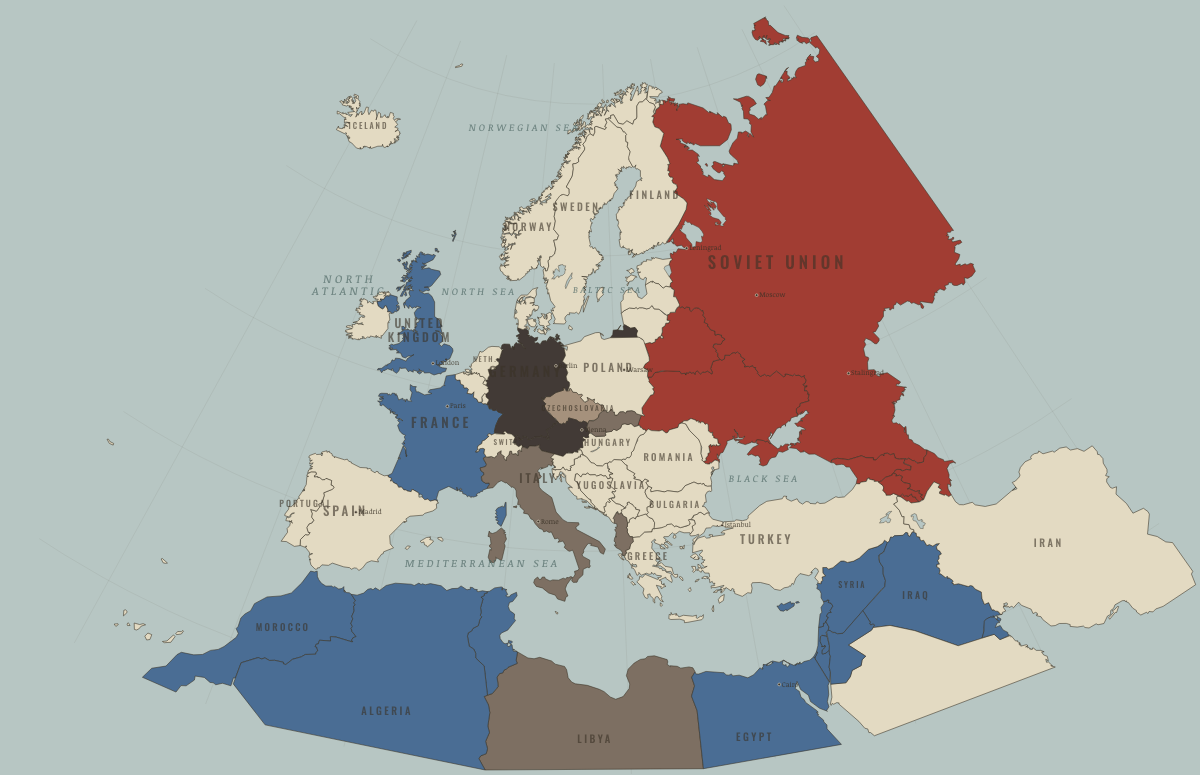
What was the Czech Republic before it was Czech Republic? The sections below follow this land through every era covered by the Maps of History atlases: who ruled it, what it was called, and when control changed. Each line links to the dated map. Modern borders serve as an approximation, as each atlas says on the map itself.
Boiohaemum (mod. Czechia) · Ancient Rome
| 264 BC | Tribal peoples & confederations — the opening position |
ANCIENT ROME: EVERY CHAPTER AND MAP →
Czech Republic · Norse and Aztecs
| Other peoples and states — the opening position |
NORSE AND AZTECS: EVERY CHAPTER AND MAP →
Bohemia (mod. Czechia) · Crusades
| Latin Christendom — the opening position |
CRUSADES: EVERY CHAPTER AND MAP →
Kingdom of Bohemia · Mongol Empire
| Other settled powers (Jin China, Christendom, Delhi) — the opening position |
MONGOL EMPIRE: EVERY CHAPTER AND MAP →
Bohemia and Moravia (Habsburg Empire) · Industrial Revolution
Bohemia and Moravia formed the industrial heart of the Habsburg Empire. Coal, long-established linen and glass industries, and northern textile towns gave the region resources and skills on which to build. Brno became known as the Moravian Manchester, while the Vítkovice ironworks near Ostrava grew on Upper Silesian coal. Czech and German workers and entrepreneurs built this industrial region within a mostly agrarian empire, helping explain the confidence of Czech nationalism by 1914.
| Industrialising — the opening position | |
| Industrialising | |
| Industrialising |
INDUSTRIAL REVOLUTION: EVERY CHAPTER AND MAP →
Bohemia (mod. Czechia) · Age of Revolutions
| The conservative monarchies — the opening position |
AGE OF REVOLUTIONS: EVERY CHAPTER AND MAP →
Czechoslovakia (Czech lands; Czech Republic from 1993) · Meiji Japan and post-Soviet Russia
Warsaw Pact tanks crushed Czechoslovakia’s Prague Spring in 1968. The episode convinced Soviet leaders that reform was dangerous, while younger officials, including Gorbachev, saw a system in need of renewal. In November 1989 the peaceful Velvet Revolution brought the dissident playwright Václav Havel to power. Czechoslovakia divided peacefully into the Czech Republic and Slovakia on 1 January 1993.
| Soviet-bloc states — the opening position | |
| Independent neighbours | |
| Western powers and allies |
MEIJI JAPAN AND POST-SOVIET RUSSIA: EVERY CHAPTER AND MAP →
Austria-Hungary (mod. Czechia) · Russian Revolution
One of the strangest armies in this story came from the Czech lands of Austria-Hungary. Tens of thousands of Czech and Slovak prisoners of war volunteered to fight for the Allies and for a country that did not yet exist. Their Legion was stranded on the Trans-Siberian in 1918 and accidentally lit the civil war. Masaryk turned its fame into Allied recognition. When Czechoslovakia was declared in October 1918, its soldiers still held Siberian railway stations 7,000 km from Prague.
| Foreign powers & intervention — the opening position |
RUSSIAN REVOLUTION: EVERY CHAPTER AND MAP →
Czech lands (Austria-Hungary) · WWI
People from the Czech lands fought largely in other people’s uniforms, but prisoners of war and deserters also joined the Czechoslovak Legion. Serving the Entente from France to Siberia, the Legion briefly held the Trans-Siberian railway in 1918. Its exploits gave Masaryk’s campaign in exile credibility. Czechoslovakia, proclaimed in October 1918, became the settlement’s most democratic creation.
Czechoslovakia (Czech lands) · Stalin’s Soviet Union
Czechoslovakia was central Europe’s only democracy to survive the 1930s, until Britain and France let Hitler take the Sudetenland in 1938 and the rest in 1939. Largely liberated by the Red Army, it restored a multi-party system in 1945, with the communists its largest party. They seized full power in February 1948. The 1952 trial of party leader Rudolf Slánský showed that loyalty to Moscow protected no one.
| Nazi Germany & its allies — the opening position | |
| Nazi Germany & its allies | |
| Other states | |
| Satellites & communist allies |
STALIN’S SOVIET UNION: EVERY CHAPTER AND MAP →
Czechoslovakia (Czech lands) · Road to WW2
By 1938 Masaryk's republic was the region's only functioning democracy, with a real army behind real mountains. Its friends signed it away at a conference from which it was excluded. Six months later the remainder was swallowed whole. The Škoda arsenal went on to arm the Wehrmacht that took Paris, and the betrayal converted appeasement's last believers.
| Democracies & powers fighting them — the opening position |
ROAD TO WW2: EVERY CHAPTER AND MAP →
Czech Republic · WW2
Czechoslovakia was betrayed at Munich in 1938 and occupied outright by Germany in 1939. Its government-in-exile was the only one whose country Germany held from the first day of the war to the last. The cost of “peace for our time” was paid twice: the Škoda and Brno arms works equipped the Wehrmacht for its early campaigns, while escalating terror ruled the Protectorate. After Resistance parachutists killed SS chief Heydrich in May 1942, Lidice was erased and its destruction broadcast as a warning to Europe. Liberation in 1945 brought the expulsion of some three million Sudeten Germans, a final consequence of Munich; a communist coup followed within three years.
| Axis-occupied — the opening position | |
| Axis-occupied | |
| Soviet Union |
Czech lands · Cold War
Czechoslovakia had been betrayed at Munich before a coup took it in 1948, hardening Western resolve (Ch. 2). Its next great challenge to the bloc came in 1968, with “socialism with a human face.” Half a million fraternal troops crushed that heresy. Charter 77 kept the record; the Velvet Revolution then won in eleven days and put its imprisoned playwright in the castle.
| Soviet-aligned states — the opening position | |
| Soviet-aligned states | |
| In upheaval / changing sides | |
| Non-aligned & neutral | |
| Soviet-aligned states | |
| In upheaval / changing sides | |
| Non-aligned & neutral |
COLD WAR: EVERY CHAPTER AND MAP →
Czechoslovakia (Czech lands) · Feminism and the Tunisian Revolution
| Right won in law — the opening position | |
| Partial or unequal; treaty signed only; transition | |
| No reform yet / outside this story | |
| Right won in law |
FEMINISM AND THE TUNISIAN REVOLUTION: EVERY CHAPTER AND MAP →
Czechoslovakia (Czech lands) · Refugee crises
Munich and German occupation had broken Czechoslovakia. In 1945 its leaders resolved that its three million Germans must go. The “wild” expulsions of 1945 and organized trains of 1946 emptied much of the Sudeten borderlands, while the Beneš decrees stripped Germans of citizenship and property. Czechs and Slovaks resettled the empty villages. After the communists took power in 1948, Czechs themselves sought refuge in the West.
| Neutral or between the blocs — the opening position | |
| Soviet-occupied or communist | |
| Western bloc or democracy |
REFUGEE CRISES: EVERY CHAPTER AND MAP →
Related
THE FREE PRINTABLE STUDY GUIDE
Get a printable atlas study guide of your choice free. I’ll send you a few short letters, then one when a new atlas opens. That’s all. — Paul
NO TRACKING · YOUR ADDRESS IS USED FOR THE DISPATCH AND NOTHING ELSE · UNSUBSCRIBE ANYTIME