Ancient Rome · CHAPTER 11 ·
Fall of the Western Roman Empire
Chapter 11 of The Rise and Fall of Rome, 264 BC – AD 476: “The Fall of the West”
Between 410 and 476 the Western Roman Empire lost provinces faster than it could replace their taxes. The decisive blow came on 19 October 439, when Geiseric’s Vandals took Carthage and Africa, which supplied Rome’s grain and much of the West’s revenue; a joint armada sent to recover it was destroyed off Cape Bon in 468.
Chapter 11 is included with every paid plan. WW2 is free in full, and chapter 1 of every atlas is free. A free account opens 3 more chapters a day. Starter, at $9 a month, opens all 21 with no daily limit — see the plans.
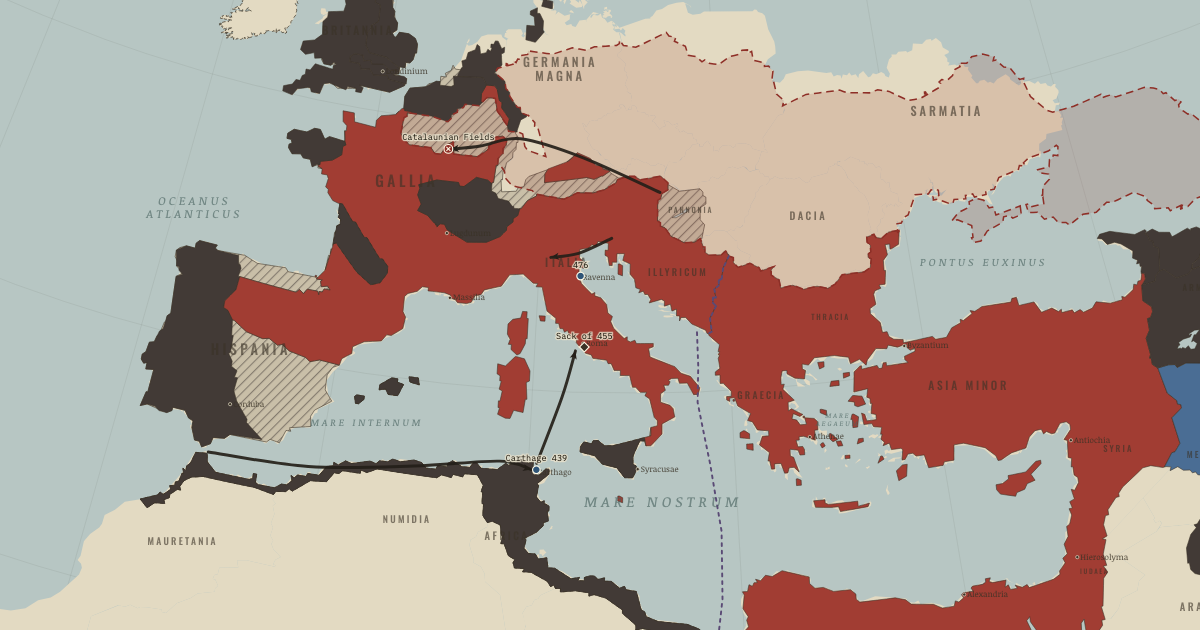
The map above is the world of The Roman Empire, AD 451 — Attila.
SHORT EXPLANATION
In 439 the Vandals captured Carthage, taking from the Western empire a province that supplied Rome with grain and its government with a large share of its remaining taxes. The loss made defense harder to finance: fewer taxes meant less money for soldiers, and a weaker army was less able to prevent further losses.
Western forces could still win, as the coalition that checked Attila in 451 showed. But attempts to recover Africa failed, including a costly expedition sent with the East in 468. In 476 Odoacer deposed the young Romulus Augustulus. The western imperial office ended, while Roman law, officials and churches continued under new rulers and the eastern empire survived.
The full story
The Western empire needed Africa to pay for its defense. By the time Geiseric led perhaps eighty thousand Vandals and their families across the strait of Gibraltar in 429, war and the loss of control had disrupted revenue from Britain, Spain and Gaul. Africa, by contrast, remained prosperous and comparatively secure. It supplied grain to Rome and may have furnished two-fifths of the revenue still available to the western government, much as Egypt supported the East. Geiseric moved along the coast and took Carthage without a siege on 19 October 439. The government now had to find the money to recover a province whose taxes it had just lost.
Both imperial governments understood what was at stake. Expeditions in 441 and 460 failed, and in 468 East and West sent a great armada against Geiseric. It is said to have numbered some eleven hundred ships and cost roughly a year of eastern revenue. Off Cape Bon, Vandal fire-ships destroyed it. The scale of that failure left no affordable comparable attempt to restore the African tax base.
Military success elsewhere could not repair that loss. In 451 Aetius led Roman and federate forces alongside Visigothic allies against Attila at the Catalaunian Fields, where they checked the Huns. Yet court politics then deprived the West of its commander: Valentinian III had Aetius murdered in 454 and was himself murdered in 455. As central authority contracted toward Italy, the government had fewer resources and fewer capable leaders with which to hold its mixed armies together.
Odoacer deposed the child emperor Romulus Augustulus in 476 and sent the imperial insignia to Constantinople. There was no great final battle. The new kings retained Roman officials, bishops and law because they remained useful instruments of government. Much of Roman society continued, but the western office that had coordinated armies and collected taxes had ended. Land grants to federate soldiers had helped meet immediate obligations when cash was short, while removing property from future taxation. The failure to recover Africa had left the government with no obvious way to rebuild that revenue.
FULL EXPLANATION
Why Carthage Mattered More Than Rome
The sacks of Rome in 410 and 455 are easy to remember. Carthage matters for a different reason: its capture deprived the western government of the means to defend what remained. Britain and much of Spain and Gaul no longer supplied dependable revenue, while Africa was prosperous, comparatively secure and taxable. Estimates of its exact share of the budget vary, but its central fiscal role is clear. A soldier had to be paid, fed, equipped and transported; behind him stood the surplus of several farming households and the work of administrators. After 439 the demands on the army did not disappear with African income. Giving federates land could meet an obligation without cash, but it could also diminish future taxes. The fleets of 441, 460 and 468 show that the imperial governments recognized the problem and had a strategy: recover the province that could help pay for defense. Those operations failed.
Why 476 Was So Quiet
Romulus Augustulus had been installed by his father while still a child, and Constantinople had never recognized him as the lawful western emperor. His deposition in 476 ended the western imperial office, but to many people it could appear as another change in military government. Senators kept estates, bishops connected cities, and the new kings employed Roman administrators and issued laws in Latin. Salvian, writing around 440, claimed that some poor Romans fled to the Goths to escape Roman tax collectors. His moralizing account is not a survey, but it suggests why a government that demanded taxes while failing to provide protection might command little loyalty. There was no organized resistance in 476. Continuity for senators should not be mistaken for unchanged lives everywhere: archaeology shows severe regional contraction in trade, towns and material production. A state could disappear while many of its institutions survived, and different people could experience that change very differently.
Key places on the map
On this day
Why it happened
Africa and the army. The western army depended on the combined revenues of Africa, Gaul, Spain and Italy. One estimate puts the cost of a late Roman soldier at roughly the taxes of five peasant households. Britain was lost in 410; Sueves and Vandals entered Spain after 409, with much of it lost by the 420s; Aquitaine was ceded to the Visigoths in 418; and northern Gaul became autonomous. Africa fell in 439. Revenue may then have been halved, although the threats remained. Grants of land to federates answered an immediate need for payment at the cost of reducing the taxable base again.
Federate soldiers and their patrons. Western armies in the 450s brought Gothic, Hunnic, Burgundian and other forces together under Roman patrons. Their coalition could be effective, as the Catalaunian Fields showed, but its members expected support and rewards. In 476 soldiers sought land in place of pay, and Odoacer removed a government unable to satisfy them. The relationship recalls the client armies of Chapter 4: the ties that helped commanders assemble forces also gave soldiers’ demands political force.
The eastern choice. The East had its own defense to finance. Constantinople paid gold to Attila, potentially buying relief more cheaply than war, and fortified the Theodosian Walls. Yet the joint expedition of 468 shows that it also committed vast resources to recovering Africa. After the fleet was destroyed at Cape Bon, it mounted no comparable attempt. The surviving eastern tax base and administration later supported Justinian’s brief reconquests of Africa and Italy, as well as the preservation of Roman law. The division marked in 395 had become a division between a surviving eastern core and a West the East could no longer restore at that cost.
Loyalty and protection. Odoacer met no popular rising or senatorial resistance in 476, and no province is recorded begging for reunion. Different groups had reasons to accept a new ruler. Aristocrats could retain estates and serve kings who governed through Roman law, officials and the church. Salvian reported around 440 that some poor Romans went to the Goths to escape Roman tax collectors. He wrote as a moral critic, not a pollster; still, his account raises a question about loyalty to a government that continued to demand taxes after it had ceased to protect its subjects.
THE TURNING POINT
Carthage, 19 October 439. A tradition says that Geiseric entered Carthage while its garrison watched races at the hippodrome; the city fell without a siege. Its capture connects the end of the western empire to the beginning of this atlas. Six centuries earlier, the Republic built successive fleets to contest Carthage’s power at sea. Now a sea-borne enemy held the city and the African revenues Rome needed. The fleets of 441, 460 and 468 failed to recover them. The two Carthage markers show how the same city remained important as Rome’s fortunes changed.
What it changed
Successor kingdoms. The western provinces became kingdoms governed by Visigoths in Spain, Franks in Gaul, Vandals in Africa and Ostrogoths in Italy. These military elites ruled Roman populations and relied on established landowners, bishops and Latin law. Their kingdoms followed different courses, but the settlements of 418–511 helped shape later western Europe; the Frankish kingdom contributed to the formation of France. The end of western imperial government opened the histories of these successor states.
Bishops and cities. Bishops possessed literacy, resources and networks organized through Roman dioceses. As imperial administration weakened, cities could look to them for food, ransom, justice and records. The bishop of Rome already claimed primacy, and no western emperor now resided in the city. The medieval papacy developed over a longer period, but the church acquired responsibilities as well as influence in the changing order. Chapter 12 follows that development.
Roman rule in the East. In 476 Constantinople retained an emperor, Roman administration and law, Greek learning and an economy using the gold solidus. Justinian’s codification in 529–534 became an important ancestor of later civil-law systems. The imperial line continued until 1204, and a Roman empire endured in the East for centuries after 476. Its people understood themselves as Romans, even as Greek became central to their political culture. The final map shows where imperial Rome continued.
DISCUSSION QUESTION — Why did the East survive when the West fell? Consider geography, wealth and contingency, and what they imply about the West’s chances.
Many historians rank geography first. Constantinople was protected by the Bosporus and the Theodosian Walls, and Anatolia, Syria and Egypt supplied a comparatively sheltered tax base. Western wealth in Africa, Italy and southern Gaul lay behind long, exposed frontiers. Wealth comes next, although the two were connected: the richer, more urbanized and monetized East could pay Attila, maintain armies and recover from defeats such as Cape Bon. The West never recovered Africa’s revenue. Contingency mattered as well: Geiseric took Africa, eastern diplomacy directed Theodoric toward Italy in 488, and eastern emperors were not children during the worst decades. On this ranking, holding or recovering Africa was a major western chance. The expeditions of 441–468 show that rulers saw its importance, though recovering it would not have resolved every political difficulty.
An interesting fact
Romulus Augustulus, deposed in 476, bore the name of Rome’s founder and a diminutive of its first emperor: Augustulus means “little Augustus.” He received a pension of 6,000 solidi a year and lived at Lucullus’s former villa on the Bay of Naples. Around 507–511 Cassiodorus recorded a grant to a “Romulus”; if this was the former emperor, he may have survived his empire by thirty years. Constantinople had never recognized him as emperor. Its recognized western emperor, Julius Nepos, remained in Dalmatia until his murder in 480.
Related
THE FREE PRINTABLE STUDY GUIDE
Get the printable study guide for Rome free. I’ll send you a few short letters, then one when a new atlas opens. That’s all. — Paul
NO TRACKING · YOUR ADDRESS IS USED FOR THE DISPATCH AND NOTHING ELSE · UNSUBSCRIBE ANYTIME