Ancient Rome · EPILOGUE ·
Why Rome fell
Chapter 12 of The Rise and Fall of Rome, 264 BC – AD 476: “Why Rome Fell — and What Survived”
No single cause explains the fall of the Western Roman Empire: weak succession rules, civil war, frontier pressure, disease and a thin tax base interacted. The Huns pushed armed peoples inside the frontier and the loss of Africa in 439 broke the West’s finances, while the richer East, behind Constantinople’s defences, survived.
Chapter 12 is included with every paid plan. WW2 is free in full, and chapter 1 of every atlas is free. A free account opens 3 more chapters a day. Starter, at $9 a month, opens all 21 with no daily limit — see the plans.
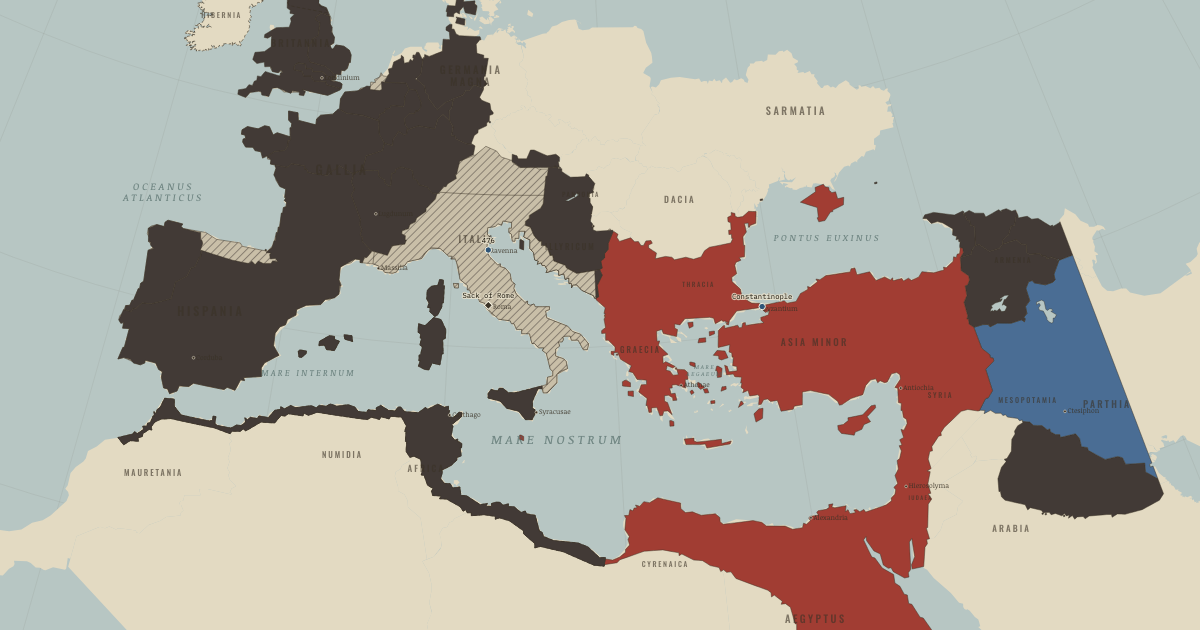
The map above is the world of The Roman Empire, AD 476 — The last emperor of the West.
SHORT EXPLANATION
The Western empire fell through difficulties that compounded one another. Disputed succession and civil war weakened its government; epidemics, frontier pressure and a thin tax base made recovery harder. The Huns’ westward movement pushed armed peoples into Roman territory. After the loss of Africa in 439, the West had less revenue with which to pay the army needed to defend its remaining provinces. Decisions taken under pressure helped turn these problems into a cascade.
The East survived. Its richer, more urban provinces and Constantinople’s defenses gave it resources to maintain armies, make agreements with enemies and recover from defeats. Roman law, Christianity, Latin-derived languages, roads and ideas of empire also continued after western imperial government ended. “Fall” describes the political and material collapse; “transformation” describes institutions and practices that survived in changed hands.
The full story
For more than two centuries scholars have disputed why Rome fell. One counted over two hundred explanations, including moral decay, lead poisoning and climate change. The number matters because it forces us to ask what each explanation is meant to explain. The western imperial government disappeared; Roman institutions also endured; and evidence from the provinces shows severe material losses. These are connected events, but they are not identical.
Peter Heather and Chris Wickham are associated with a fiscal-military explanation: armies depended on taxes, while taxpayers depended on armies for protection. The movement of the Huns helped drive armed peoples across the frontier. When Africa was lost in 439, the western state lost revenue it needed to maintain forces and recover territory. Further losses could then weaken the army still more.
Peter Brown’s account of transformation draws attention to continuities. Roman elites became bishops, kings took the place of emperors, and institutions persisted under new rulers. Bryan Ward-Perkins, by contrast, emphasizes the contraction of trade, coinage, towns and literacy in the West. A bishop working in a Roman city is evidence of continuity; his presence does not tell us how many coins or how much pottery reached the people around him. Both kinds of evidence belong in the account.
The strongest explanation brings these developments together. Unsettled succession, thin finances and long frontiers had left the empire vulnerable before the movement of steppe peoples brought a major external shock. Rulers and commanders made choices under pressure, many reasonable as they appeared at the time. Their combined consequences could nevertheless be disastrous: each loss of taxable land left less money for defense, and a weaker army found it harder to protect what remained. This is a cascade, not a single blow.
The East’s survival tests the explanation. Christianity, one-man rule and heavy taxation existed there too, so none alone accounts for the different outcomes. Constantinople’s defenses and access by water helped protect a government supported by richer, more urban provinces. Revenue and transport turned those advantages into armies and diplomacy. Choices and chance affected the timetable: Valens attacked too early at Adrianople, the western court mishandled Alaric, and expeditions against Africa failed. The comparison helps explain why losses that the East could absorb became harder for the West to reverse.
FULL EXPLANATION
Fall and transformation
Start with the people who governed after the western emperors. Roman aristocrats served new kings; bishops worked through Roman cities and administrative districts; Latin law and identity persisted. These continuities make transformation a useful description. Now look at the objects and places through which people lived. Archaeology shows fewer coins, simpler pottery, shrinking towns and less long-distance trade; some regions also lost literacy and building skill. Institutions could adapt while the material systems available to ordinary people contracted. Place matters as well: Britain saw a particularly sharp collapse, parts of Gaul and Italy retained more continuity, and the eastern Mediterranean remained more complex. The competing terms come closer once we specify their subject. Identities and institutions survived in altered form even as western taxation, urban services and access to traded goods declined.
The surviving half
Why did the East endure when the West did not? Christianity, monarchy and heavy taxation were common to both, so none alone explains the difference. Constantinople had formidable land and sea walls and could be supplied by water. Dense cities and rich tax regions lay nearer the eastern core, giving its government resources to rebuild armies, pay enemies and sometimes direct Gothic forces westward. Rulers, diplomatic successes and the fortunes of invasions mattered too. Nor was the western outcome inevitable: retaking Africa might have restored its fiscal base, a prospect that helps explain the great joint investment of 468. Geography worked through the people, revenue and routes it protected. Institutions then helped determine how those resources were used.
Key places on the map
Why it happened
Historians and their questions. Historians bring questions from their own times to the evidence. Gibbon emphasized superstition and despotism, concerns recognizable in an Enlightenment writer; the 1930s brought attention to economic collapse, and overextension resonated during the Cold War. Scholars now investigate pandemics, climate shifts and migration, using evidence that includes ice cores, genomes and shipwreck counts. The growing record can answer new questions, while the choice of questions still deserves scrutiny. We can examine a historian’s argument, its evidence and what it leaves aside, just as the atlas’s field questions invite us to do.
Compare the surviving East. The eastern empire shared Christianity, imperial monarchy and Roman law with the West, yet endured for another thousand years. That comparison rules out any one of those shared conditions as a sufficient explanation of the different outcomes. It also directs us toward differences: the East had a defensible core and denser sources of revenue, and the two halves faced the fifth-century movement of steppe peoples differently. Geography, money and exposure need to be considered together.
Roman prestige after western rule. Western imperial power disappeared, but its authority remained useful to successors. Rulers minted coins in emperors’ names and legislated in Latin; Frankish kings held consular titles, and the Church retained elements of Roman administrative geography. European rulers continued to treat Rome as a standard of legitimacy long afterward. Its prestige could grow even as its political power vanished: a king could invoke Roman authority without restoring the state that had exercised it.
THE TURNING POINT
Constantinople and the surviving empire. Constantine chose the Bosporus for his capital, inaugurated in 330. Close to rich provinces, Constantinople could be supplied by sea and protected by defenses that helped its government withstand dangers western rulers struggled to meet. The two halves’ fortunes were connected: Alaric moved west, Attila accepted eastern payments and later turned west, and diplomacy at times directed Gothic forces westward. When Ottoman cannon helped bring Constantinople down in 1453, 977 years after the atlas’s final 476 snapshot, people in Italy could regard the event as the end of the Roman Empire. The eastern empire had carried its imperial tradition long after the western office disappeared.
What it changed
Lessons from the map. Across twelve chapters, several relationships recur. Early Roman alliances gave some defeated communities a stake in the new order; arrangements sustained by fear faced different strains. Unsettled succession repeatedly opened the way to civil war. In the late West, lost tax revenue weakened armies and made further territory harder to defend. These are arguments about particular Roman events. To use them elsewhere, we must ask whether the same mechanisms are operating in the other case.
An argument with a long afterlife. Later thinkers used Rome to ask questions about their own societies. Machiavelli read Livy for lessons about republics. The American founders drew on Roman precedents and fears in institutions including term limits, civilian command and a Senate. Gibbon wrote as Britain’s empire was rising. Such comparisons can illuminate a crisis when they explain how events work in both cases; a resemblance to Rome is a starting point for that inquiry.
Follow a territory. Free Explore lets you follow a territory through these changes. Trace Africa from Carthaginian to Roman to Vandal control, Asia Minor from Hellenistic to Roman and still Roman at the end, or Gaul from Vercingetorix through the Gallic Empire to the Visigoths. Open the dossiers as you go. Each change of color stands for a longer history, and the Field Exam offers a way to test what you have learned from the map.
DISCUSSION QUESTION — “Rome did not fall; it was transformed.” “Rome fell, and civilization measurably collapsed with it.” How can each side make its case, and what matters in choosing between them?
The case for transformation begins with what remained: aristocrats wrote Latin, kings governed with Roman law and bishops, and the Church carried institutions into the successor kingdoms. On this view, “decline” can also express a preference for classical monuments over later forms of life. The case for fall points to material evidence from the fifth- to seventh-century West: less long-distance trade and coin use, smaller towns, changes in literacy and even smaller cattle. Many people appear to have had access to fewer goods and services, although conditions varied by place. Both accounts describe real changes. The choice of emphasis matters because a history centered on elites who retained their position can miss losses borne by others, while an account of collapse can miss what communities preserved and remade. Present concerns can shape the choice: continuity may reassure readers anxious about change, while collapse can warn about fragile systems. The evidence still has to tell us what happened, where and to whom.
An interesting fact
Under Ottoman rule, Greek Orthodox subjects were administered as the Rum milleti — the “Roman nation.” Greek villagers continued to call themselves Romioi, Romans, into the twentieth century, although most spoke no Latin. The Roman name also remains visible in Rome itself. Manhole covers, buses and fountains bear SPQR, Senatus Populusque Romanus, the Senate and People of Rome. The republican formula predates Caesar and remains part of the city’s public life.
Related
THE FREE PRINTABLE STUDY GUIDE
Get the printable study guide for Rome free. I’ll send you a few short letters, then one when a new atlas opens. That’s all. — Paul
NO TRACKING · YOUR ADDRESS IS USED FOR THE DISPATCH AND NOTHING ELSE · UNSUBSCRIBE ANYTIME