MAPS OF HISTORY · WWI · ALL CHAPTERS · CHAPTER 4
CHAPTER 4 · 1915 · NOV 1915
The Widening War
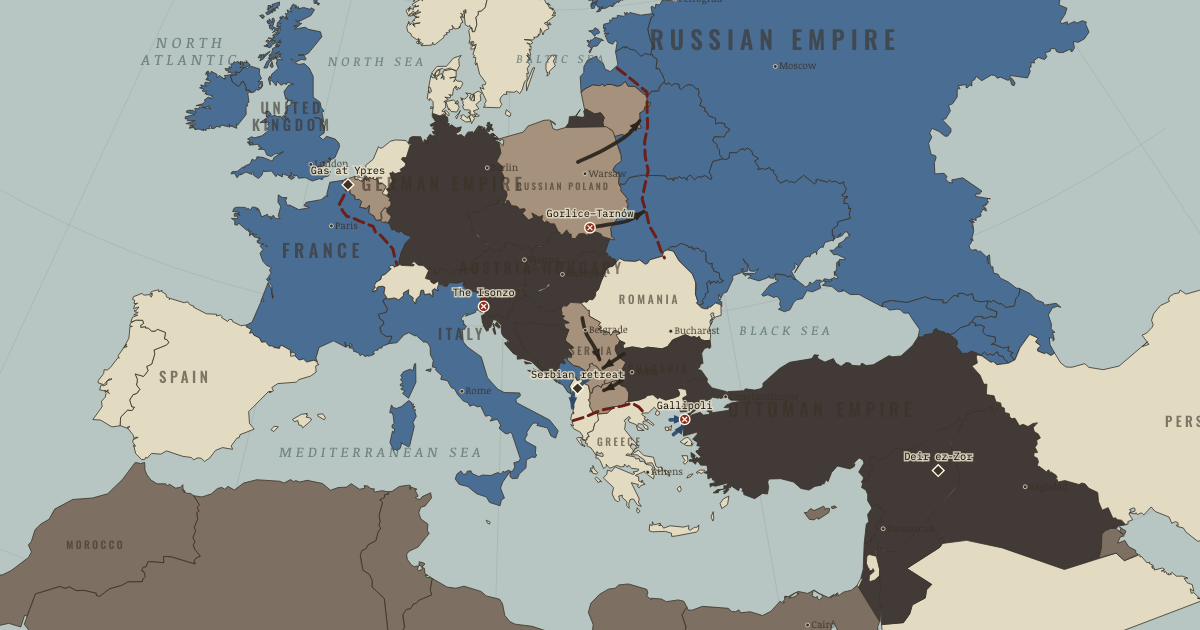
The map above is the world of NOV 1915 — The widening war.
BRIEF EXPLANATION — THE ESSENTIAL ARGUMENT
With the Western Front frozen into deadlock, both alliances spent 1915 searching for a way around it, and that search turned a European struggle into a wider war fought from the Alps to Anatolia. Each side tried to win over neutral states and to knock out the enemy’s weaker partners. Italy joined the Entente in return for promises of Austro-Hungarian territory, the Allies attacked the Dardanelles straits in the hope of reaching Constantinople and reopening a supply route to Russia, and Bulgaria joined the Central Powers to recover land it had lost to Serbia. The Allied attack at Gallipoli failed, Serbia was overrun, and the Central Powers gained a continuous land corridor linking Berlin to the Ottoman Empire.
The Eastern Front moved much farther in 1915 than the Western. A concentrated German-Austrian blow at Gorlice–Tarnów broke the Russian line and forced the long withdrawal known as the Great Retreat, in which Russia gave up Poland and Lithuania. Under the cover of war, the Ottoman government deported and murdered the Armenians of Anatolia on a genocidal scale, killing an estimated 800,000 to 1.5 million people. This belongs to the war’s central story and appears on the map as memory rather than as a footnote to the fighting.
GUIDED EXPLANATION
With the Western Front blocked, both coalitions looked elsewhere for a decision. Germany used poison gas at Ypres and opened the age of chemical warfare. Italy joined the Entente in exchange for promised Austro-Hungarian territory and began a long series of attacks along the Isonzo river. At Gallipoli, Allied forces tried to force the Dardanelles, resupply Russia and drive the Ottoman Empire out of the war, but the Ottoman defenders held the ridges and the operation ended in evacuation.
On the Eastern Front, the German-Austrian attack at Gorlice–Tarnów broke the Russian line and forced the Great Retreat from Poland and Lithuania. Bulgaria then joined the Central Powers and helped overrun Serbia, whose army retreated across the Albanian mountains in a winter march that became a humanitarian disaster. Under the cover of war, the Ottoman government deported the Armenians of Anatolia toward the Syrian desert and carried out mass killing and deliberate starvation, and estimates of the dead range from about 800,000 to 1.5 million. This genocide is marked here as memory.
These scattered campaigns were linked by the pressures of coalition warfare. The Dardanelles plan aimed to open Russia’s supply route and win over neutral Balkan states, but it demanded amphibious skills the Allies did not yet possess, and its failure made the Central Powers look stronger. Gorlice then showed that concentrated artillery could break a thin eastern front, where troops and rail support were sparser than in France. Bulgaria joined in October once it judged that Serbia was isolated and a German victory could restore Macedonia, and the resulting corridor from Berlin to Constantinople strengthened Ottoman supply. Russia survived the loss of territory, yet refugees, shortages and defeat damaged confidence in the monarchy, and the Tsar’s decision to take personal command tied every later military failure directly to his own rule. Movement on the map thus produced deep political strain far behind the front.
DEEP EXPLANATION — EVIDENCE & INTERPRETATION
Peripheral strategy and the limits of capability
The plan to force the Dardanelles addressed a real strategic problem, since opening the straits could resupply Russia, threaten the Ottoman capital and sway the wavering Balkan states, yet its failure shows how far an attractive objective can lie from an achievable operation. The naval commanders first tried to push warships through mined narrows without secure minesweeping, and when that failed the troops landed only after surprise had already been lost. Steep ridges, poor intelligence, divided command and almost no experience of amphibious landings all favoured the Ottoman defenders, who held the high ground and could move along interior lines. Mustafa Kemal’s quick decisions mattered, but so did a defensive geography the planners had treated as empty space. There is therefore no need to choose between calling the campaign a good idea and calling it badly executed, because a strategy is only sound when its ends, its means and its operational difficulty actually fit together. Gallipoli’s ends were genuine, but the means assigned to it never made success likely enough.
Gorlice and the strain on the Russian state
Gorlice–Tarnów succeeded through concentration, surprise and a short, intense bombardment aimed at a thin sector of the Russian line, and the local breakthrough then widened into a general retreat because Russia’s railways and reserves could not seal the gap in time. The lost territory alone does not explain why the campaign mattered so much. The Great Retreat uprooted civilians, disrupted food and transport, shook confidence in the army and pushed Tsar Nicholas II into taking personal command at the front. That decision tied the legitimacy of the monarchy directly to future battlefield results while leaving the government at home in weaker hands. The episode illustrates a conversion mechanism that runs through the whole war, in which military defeat becomes revolutionary pressure once a state can neither spread the costs of that defeat nor explain its purpose. Russia rebuilt much of its army by 1916, but it did not rebuild the same reserve of public trust before revolution came in 1917.
New here? Chapters 1–2 of every atlas are free to sample, and the WW2 atlas is free in full. One membership opens all thirteen — the Cartographer’s Circle.
THE SITES
ON THIS DAY
WHY IT HAPPENED
The “easterner” temptation. If the Western Front is a wall, said London’s easterners, go around: the Dardanelles, Salonika, Mesopotamia. The logic was real — knock out weak allies, open Russia’s supply line (grain out, shells in), rally the Balkans. The execution required amphibious and expeditionary competence nobody yet had, at the end of supply lines the “sideshows” never got priority on. The strategic idea kept being right on paper and dying of logistics.
Italy auctioned. Italy had been the Triple Alliance’s third member — and stayed neutral in 1914, arguing the alliance was defensive. In 1915 both sides bid for it; the Entente could offer what wasn’t theirs: Trentino, Trieste, Dalmatia. The secret Treaty of London (26 April) bought an army of 875,000 — and planted a grievance, because at Versailles Italy would receive less than the promise, and “mutilated victory” would become Fascism’s founding myth.
Bulgaria’s price. Bulgaria, mauled in 1913’s Second Balkan War, wanted Macedonia back from Serbia. After Gallipoli stalled and Gorlice broke Russia’s prestige, Berlin looked the stronger horse — and could pay in Serbian land. Bulgaria’s entry (October 1915) doomed Serbia and opened the Berlin–Constantinople railway: watch the charcoal corridor connect on the map. Small states read maps too; nothing recruits like victory.
Why the east bent when the west would not. Twice the frontage, half the force density, weaker Russian rail behind the front and a Russian army short a rifle per man in 1915: breakthrough was possible in the east in a way it simply was not in France. Falkenhayn never believed the east could be decisive — space swallows victories, as Napoleon learned — but 1915 bought the Central Powers a year and nearly broke Russia’s state.
THE TURN
Gorlice–Tarnów, 2 May 1915. The war’s most consequential forgotten battle: a four-hour hurricane bombardment on a narrow front — the method later perfected everywhere — and the entire Eastern Front moves 500 km. It saved Austria-Hungary (for now), convinced Bulgaria, doomed Serbia, and poisoned Russia from within: after the Great Retreat, Tsar Nicholas took personal command at the front, making every future defeat personally his. The road to February 1917 starts here.
WHAT IT CHANGED
Russia wounded where it cannot heal. The army recovers — 1916 will prove it — but the home front does not: refugees choke the cities, inflation eats wages, and the Tsar at headquarters leaves Petrograd to the Tsarina and Rasputin. Military defeat is being converted into political collapse on a three-year fuse.
A corridor of empires. With Serbia crushed, trains run Berlin–Vienna–Sofia–Constantinople: guns and gold south, and the Ottoman war effort — Gallipoli’s ammunition included — is resupplied. The Central Powers are now a contiguous bloc from the North Sea to Mesopotamia; the Entente’s answer is the slow siege you will see at sea.
Gallipoli’s long shadow. Churchill fell from office and went into the trenches. Amphibious warfare was written off until planners studied Gallipoli’s failures and prepared differently for 1944. Australia and New Zealand date their nationhood from Anzac Cove; 25 April remains their day of remembrance. Mustafa Kemal also began the ascent that ended with him founding modern Turkey on the empire’s ruins.
The genocide, named. The Armenian genocide is this war’s deepest civilian crime: a government using war’s cover and machinery — railways, gendarmes, requisition law — against its own citizens. The Entente coined “crimes against humanity” for it in May 1915, then largely dropped the matter at the peace. Impunity was noticed; Hitler would later ask who remembered the Armenians. Memory is not decoration — it is deterrent, which is why this marker is on the map.
FIELD QUESTION — Gallipoli: a brilliant strategy ruined by execution, or a bad idea rescued by nothing?
Make both cases honestly. For the concept: the Ottoman Empire was the bloc’s weakest member; the straits were the only route to resupply Russia at scale, whose shell famine was real; success might have swung the neutral Balkans. Against it: the naval-only attempt forfeited surprise; minesweepers crewed by civilians turned back under fire; the land plan assumed terrain and an enemy that didn’t exist — ridge country, and an Ottoman army that fought superbly under Kemal on interior lines. The execution was unarguably botched (August’s Suvla landing met almost no opposition and dug in on the beach). Most historians now judge: a genuine strategic idea, of a difficulty its authors never grasped — the gap between “worth trying” and “achievable with 1915’s tools” is where 130,000 men died. The meta-lesson: grade strategies on the capabilities you have, not the ones the map assumes.
AN INTERESTING FACT
The chlorine cloud at Ypres was one chemist’s project: Fritz Haber, whose nitrogen-fixing process feeds — then and now — a large share of humanity, and who organized gas warfare as a patriotic duty. Days after he returned from the front, his wife Clara Immerwahr — the first woman to earn a doctorate in chemistry at Breslau — shot herself with his service pistol; whether it was protest at his work is still debated, because the surviving evidence is fragmentary. In 1918 Haber received the Nobel Prize for the ammonia synthesis that, by replacing blockaded Chilean nitrates, was also keeping German shells filled — one chemistry, feeding and killing at once.
THE DISPATCH
One short letter when a new atlas opens — and the printable study guide for WWI is yours now, free.
NO TRACKING · YOUR ADDRESS IS USED FOR THE DISPATCH AND NOTHING ELSE · UNSUBSCRIBE ANYTIME