MAPS OF HISTORY · WWI · ALL CHAPTERS · CHAPTER 5
CHAPTER 5 · 1916 · NOV 1916
The Furnaces
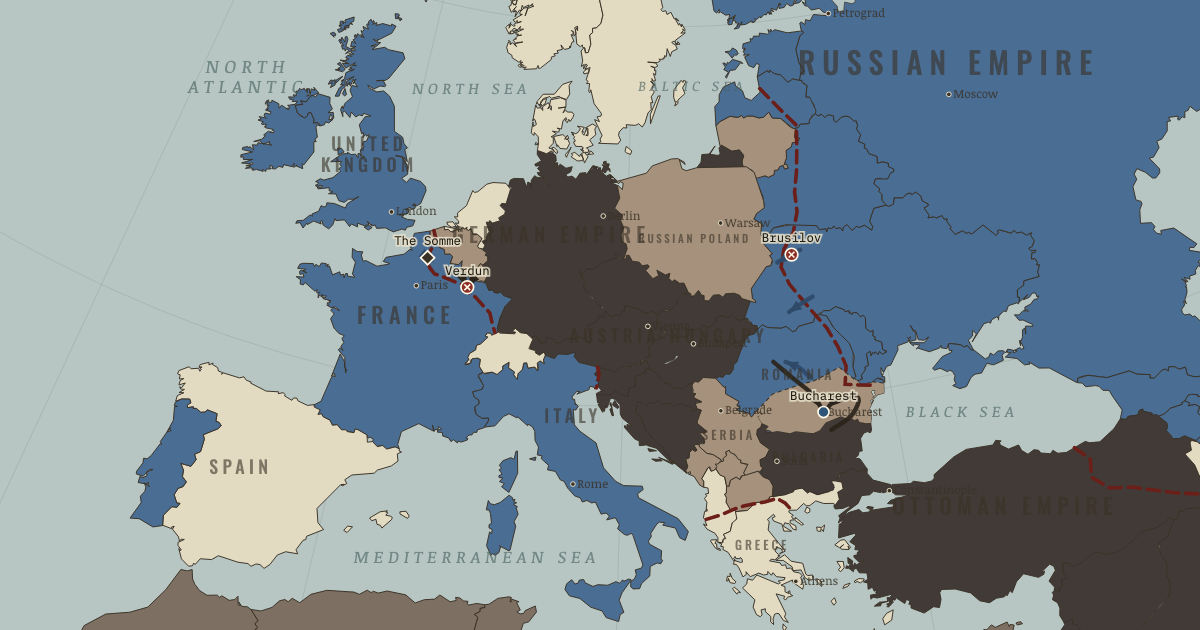
The map above is the world of DEC 1916 — The furnaces.
BRIEF EXPLANATION — THE ESSENTIAL ARGUMENT
By 1916 both sides had abandoned the hope of a quick breakthrough and turned instead to a strategy of attrition, meaning a deliberate effort to wear down the enemy’s manpower and morale faster than he could replace them. Germany attacked the fortress city of Verdun precisely because France, for reasons of pride and politics, felt bound to defend it, so that the battle would grind down the French army in a place it could not abandon. The Allies attacked on the Somme partly to draw German strength away from Verdun. Both battles consumed hundreds of thousands of men and moved the front only a few kilometres, which exposed the central weakness of attrition as a battle plan.
The year’s one great success came on the Eastern Front, where the Russian general Brusilov broke the Austro-Hungarian line by attacking across a broad front and keeping his intentions hidden until the last moment. Russia could not sustain the method, however, because its railways and reserves were unable to feed the advance. Encouraged by Brusilov’s victory, Romania joined the Entente and was quickly overrun, losing its grain and oil to the Central Powers. The year showed that attrition could favour the coalition with greater resources over the long run, even though any single attritional battle remained almost impossible to control.
GUIDED EXPLANATION
Germany attacked Verdun because France felt bound to defend the fortress city whatever the cost. Falkenhayn, the German commander, intended to drain French manpower there, though historians still debate exactly what his later memorandum claimed. The battle instead exhausted both armies almost equally. Pétain kept the French defence working by rotating divisions through the fighting quickly and by improving the single supply road into the city.
The Somme offensive began in part to relieve the pressure on Verdun. Its first day was the bloodiest in British military history and turned the battle into a memorial to mass loss, yet it also forced the British army to learn new methods of using artillery and infantry. On the Eastern Front, Brusilov kept his intentions hidden by preparing attacks across a broad front and shattered the Austro-Hungarian armies. Romania entered the war after that success, but Central Powers forces overran much of the country and seized its grain and oil.
Attrition means wearing down an enemy’s people and material faster than they can be replaced, and its results in 1916 depended entirely on the level at which it was applied. Across the whole war it favoured the larger Entente coalition, but within any single battle commanders could not control the exchange of losses. Verdun cost France and Germany roughly similar casualties, so Falkenhayn’s method failed on its own terms. The Somme gained little ground, yet it relieved Verdun, damaged German units and taught the British costly lessons about barrages, small-unit tactics and tanks. Brusilov succeeded because he attacked across many sectors with little warning, and he came close to breaking Austria-Hungary, though weak railways and poor cooperation denied him a decisive result. Romania then mistook a moment of Entente success for a stable balance of power and entered the war at the worst possible time.
DEEP EXPLANATION — EVIDENCE & INTERPRETATION
Two meanings of attrition
Attrition can describe either a grand strategy or a battlefield method, and blurring the two distorts the meaning of 1916. As a grand strategy, the Entente could reasonably expect its superior population, industry, finance and access to the sea to exhaust the Central Powers over time. As a battle method, a commander could not guarantee a favourable exchange of losses simply by attacking a place the enemy valued, and Verdun exposed this weakness cruelly. Germany had to attack fortified ground, and once national prestige became attached to the positions it captured, it defended them in turn at enormous cost. The Somme likewise inflicted serious losses on Germany, but only at a terrible price to the attacking Allies. Attrition was therefore rational as a long-run comparison of resources yet unreliable as a promise that a given offensive would bleed only the opponent. The real question is how leaders measured their gains, adapted their methods and weighed the human cost of the pressure they were trying to create.
Why Brusilov’s method worked
Brusilov rejected the usual practice of massing troops conspicuously against a single narrow point, which always warned the defender where the blow would fall. Instead his armies prepared several sectors at once, dug approach trenches close to the Austro-Hungarian positions and relied on shorter bombardments guided by aerial observation, so that the defender could not tell where the main attack would come and spread his reserves too thinly. Austro-Hungarian cohesion was already fragile, which magnified the shock of the assault. The offensive still met real limits, because neighbouring Russian commands failed to coordinate, the railways could not support an endless advance, German reinforcements stiffened the defence, and later attacks around Kovel fell back into the old costly methods. The battle matters because it proved that trench deadlock was not a law of nature, since density, surprise, command and logistics could all change the outcome. It also shows that clever tactics on their own cannot repair a state’s shortages or a coalition’s poor coordination.
New here? Chapters 1–2 of every atlas are free to sample, and the WW2 atlas is free in full. One membership opens all thirteen — the Cartographer’s Circle.
THE SITES
ON THIS DAY
WHY IT HAPPENED
Attrition chosen, not stumbled into. Verdun is the war’s clearest case of attrition as designed strategy rather than accepted byproduct. Its logic required the exchange rate to favor the attacker — but attacking a fortress zone under its guns produced no such rate, and prestige soon reversed the roles: by summer Germany was defending its gains at Verdun for the same face-saving reasons France had defended the city. A strategy premised on the enemy’s irrationality had made its author irrational first.
Coalition warfare sets the calendar. The 1916 offensives were synchronized at Chantilly in December 1915: simultaneous pressure east, west and south so Germany could reinforce nowhere. Verdun preempted the plan and turned the Somme from a joint French-British offensive into a mostly British one launched early, on ground chosen only because the armies met there. Half of understanding 1916 is seeing each battle as a payment to an ally.
Brusilov’s method: why it worked once. Brusilov attacked wide instead of narrow — no telltale massing, dugouts sapped to within 75 meters of Austrian lines, reserves distributed, artillery registered by air photo. It traded the doctrine of overwhelming one point for surprise at many. It broke an army whose Slavic regiments increasingly surrendered — and then outran its railways, met German stiffening, and bled out attacking Kovel the old way. The method was right; the Russian state behind it could only afford it once.
Romania reads the map wrong. Bucharest joined for Transylvania — its blue arrow on the map — after Brusilov made the Habsburgs look finished, extracting Entente promises much like Italy’s. But it bordered three enemies, its army was short of everything, and Russia’s help came late and grudging. Its collapse handed Germany a million tons of grain and a vital oilfield: the entry designed to shorten the war lengthened it. Small-power timing is a discipline of its own; compare Bulgaria’s (Ch. 4) — and its eventual bill (Ch. 10).
THE TURN
Verdun holds — and consumes its designer. By July, Falkenhayn’s offensive had failed by its own metric and he was dismissed in August — replaced by Hindenburg and Ludendorff, the eastern idols, who now effectively run Germany: total mobilization at home (the “Hindenburg Programme”), and soon the decision for unrestricted submarine warfare. Verdun’s deepest consequence isn’t on this map’s front lines: it is who now decides, in Berlin, how far to gamble.
WHAT IT CHANGED
The arithmetic, honestly. 1916’s ledger: ~300,000 dead at Verdun, ~300,000 more on the Somme, perhaps a million Austro-Hungarian and Russian casualties in the east, Romania overrun — and the front lines moved kilometers. But arithmetic is exactly how the general staffs now think: Germany finishes 1916 outnumbered, blockaded (the “turnip winter” begins), and with a weaker ally to prop; the Entente can replace losses and Germany increasingly cannot. Attrition is monstrous — and it is working, one-sidedly.
Austria-Hungary becomes a protectorate. After Brusilov, Habsburg armies fight under German command, propped by German divisions. The old emperor Franz Joseph dies in November 1916; his successor Karl secretly sounds out the French about peace within months. The empire that started the war can no longer fight it alone — remember this when it dissolves in weeks in 1918.
The men of 1916 remember. Verdun’s survivors — half the French army rotated through — will refuse Nivelle’s next “decisive” offensive within six months. The Somme’s survivors become the hard, method-fighting BEF of 1918. And a German soldier gassed and wounded that year, and the French sergeant at Verdun named de Gaulle, and captain Pétain’s whole generation carry 1916 into the century: the next war’s leaders were all shaped in these two furnaces.
FIELD QUESTION — Was attrition ever a rational strategy — or a euphemism for having none?
Steelman it first: with the front unbreakable (Ch. 3) and Germany facing superior combined resources, forcing a faster mutual consumption genuinely favored the Entente — and by 1918 German manpower did run out first; the blockade was attrition too, and no one calls it thoughtless. Now the indictment: Verdun shows attrition’s fatal dependence on an exchange-rate you cannot actually control, and on treating your own men as a fungible input — a premise that corroded every army’s morale and broke two of them (Russia’s, France’s — partially) before it broke Germany’s. The defensible synthesis: attrition was rational as a framework (win the production-and-manpower war, attack only with favorable method), irrational as a battle plan (“bleed them at point X”). The distinction between strategic patience and tactical butchery is the whole lesson of 1916 — and most of its tragedy is that it took 1916 to learn it.
AN INTERESTING FACT
The Somme went to the cinema while it was still being fought. The Battle of the Somme, cut from footage shot by two official cameramen, Geoffrey Malins and John McDowell, opened on 21 August 1916 and sold an estimated twenty million tickets in six weeks — something like half of Britain filed past real dead and wounded on screen, an intimacy with the front that later official films pulled back from. The irony that keeps film historians busy: the most famous sequence, men going “over the top,” was almost certainly staged for the camera at a trench-mortar school behind the lines — the real thing was unfilmable head-on.
THE DISPATCH
One short letter when a new atlas opens — and the printable study guide for WWI is yours now, free.
NO TRACKING · YOUR ADDRESS IS USED FOR THE DISPATCH AND NOTHING ELSE · UNSUBSCRIBE ANYTIME